Republicans who lost the US Congress have until 11 December to fund the government.
Republicans lost both chambers of the US Congress on 3 November but run them until January. Money for the government ends on 11 December.
What happened
Funding for the US government runs out on . NPR says any extension is all but certain to come through another short-term bill, with Republicans in control of Congress only until January.
Money for the US government runs out on . A short-term law signed on keeps the government funded until that day. Congress must pass a new law by then. If it does not, agencies must start to shut down the work that is not essential and send those staff home.
appropriations and funds made available and authority granted pursuant to this Act shall be available until whichever of the following first occurs: … December 11, 2026.
Continuing Appropriations and Extensions Act, 2027, Sec. 106, signed
The Congress that must decide has just lost an election. On Democrats won both the House of Representatives and the Senate. The new Congress meets only after the new year, so Republicans keep their majorities until then. In the Senate most bills need 60 of 100 votes, so a funding law needs some Democrats.
This Congress has let money run out three times since . The longest lapse lasted 42 full days, after Democrats asked for help with health insurance costs to continue. After a three-day lapse from , money for the Department of Homeland Security, which runs immigration enforcement, was missing for 75 days to .
Before the election, Rosa DeLauro said no one wanted a shutdown. She is the top Democrat on the House spending committee. After the election, President Donald Trump told supporters “I will VETO anything that hurts America”, but he also said “I don’t want to just be sitting there for two years vetoing everything”. Ro Khanna, a House Democrat, now wants the next short bill to stop money for US combat in Iran.
Sources: NPR, GovInfo, Congressional Research Service, The Guardian (2), The Hill (2), PBS NewsHour, CBS News
The Pattern
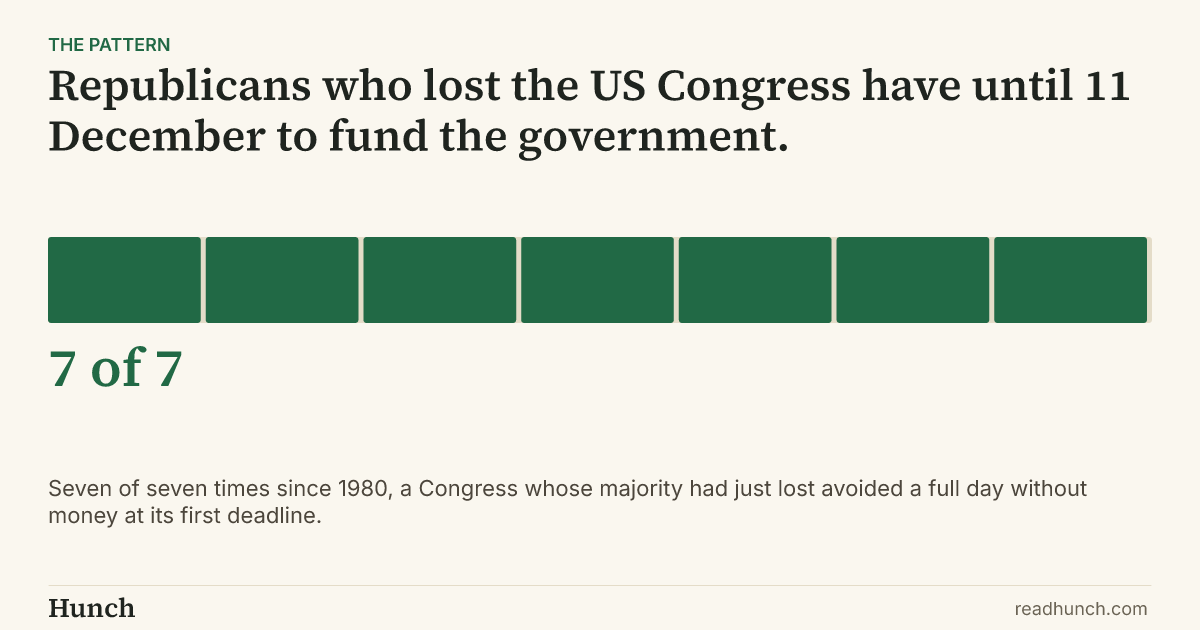
We looked for cases where a US Congress whose majority had just lost an election still had to fund the government before the new Congress arrived. We found seven such sessions, from 1980 to 2024. Each time, money did not run out for a whole day at the first deadline. Once, in 2018, money ran out at the second deadline.
Show the other 5 cases
The Read
In all seven sessions, money did not run out for a whole day at the first deadline. Most often Congress bought time: in four of the seven sessions it passed two or three short bills, and in four it moved the money into the hands of the new Congress. Only in 2014 and 2022 did it fund the government for the full year, and only in 2022 for every part of it. NPR expects “another short-term bill” this time too.
There are reasons for doubt. This Congress has already let money run out three times in one budget year, which none of the seven did. In five of the seven, the law was signed the day after the deadline, and the question looks at 10am on a Saturday. In 2024 the deadline was also a Friday: the budget office stopped preparing for a shutdown early on Saturday, before the bill was signed. For 1980, 2006, 2010 and 2014 the hours are not known. In 1982, when neither chamber changed hands, money ran out at the first deadline for three days.
Sources: Congressional Research Service (2), NPR, CBS News
Disclaimer
Hunch works only from sources that are publicly available, and publishes on the basis of analysis of that material. We do not form an editorial opinion or take sides, we give a simpler and wider view of news that already exists. If information in a source we used was inaccurate, distorted, or later disputed but had already entered our analysis, Hunch accepts no liability for that. Predictions are not advice. Phase 1 markets use Hunch Points, not money.
Published by Hunch under the Editorial Code. Complaints and corrections: /contact/.