US will deny visas to some South Africans. Past targets rarely hit back with bans.
On 15 September the US said it will refuse visas to South Africans it accuses of treating white citizens unfairly. South Africa voiced concern.
What happened
The US Secretary of State, Marco Rubio, announced on visa restrictions on people the US accuses of discriminating against South Africa’s white minority, and South Africa’s foreign ministry said it noted the move with concern.
The US announced the new visa policy on . Marco Rubio, the US Secretary of State, made the announcement. It covers foreign nationals who, in the US view, make or support race-based policies in South Africa or take land without paying for it. No names were given. The US embassy in Pretoria called it the first step in a series of growing measures.
South Africa’s foreign ministry, the Department of International Relations and Cooperation, replied on . Minister Ronald Lamola noted the restrictions with concern. He said US claims repeated a false picture of South African policy, and defended the country’s right to pass laws on past racial injustice. The statement announced no step in return.
Relations have got worse since . The US has cut aid, set tariffs of 30 per cent on South African goods and kept South Africa out of this year’s G20 summit in Miami.
When the US expelled South Africa’s ambassador in , the South African presidency called the step regrettable and asked for proper diplomatic conduct. It expelled no US diplomat.
Sources: BBC, The Guardian, DIRCO, Reuters, BBC
The Pattern
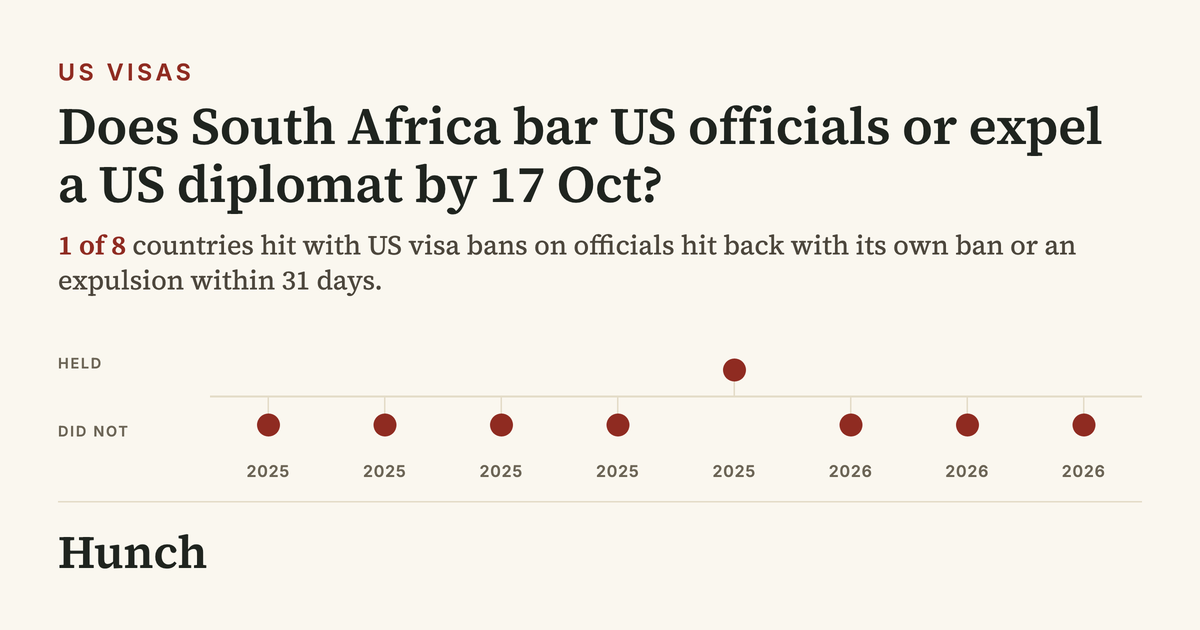
We looked at every country whose officials the US State Department put under a public visa ban since , when Marco Rubio took office. We asked whether that country barred US officials or expelled a US diplomat within 31 days. The eight most recent cases are below. The same US team decided all eight, and Brazil appears three times and Haiti twice. The one country that hit back, China, did so under its 2021 law against foreign sanctions, a tool South Africa does not have.
Show the other 6 cases
The Read
History points to a protest and nothing more. Since the US State Department has announced visa bans on officials of eight countries, and seven of them protested and went no further. Brazil is the clearest test because it was hit three times. Each time it answered with words or a trade process, and its one bar on a Trump adviser came seven months after the US move.
China is the exception, and the reason is visible. It replied to the Tibet visa bans in 14 days under a counter-sanctions law it passed in 2021, which makes a reply close to automatic. South Africa has no such law, and its government has tried to calm the row with Washington, including a White House visit by President Cyril Ramaphosa in . This could change if the US names serving ministers under the new policy. So far no names have been published.
The second market asks about the US side. In five of the seven closed cases the US followed its visa move with sanctions or more visa bans within 90 days: Brazil twice, Haiti twice and Colombia once. The US embassy in Pretoria has already said more steps are coming. The G20 summit in Miami, which South Africa has been kept out of, is the next point where the row will be tested in public.
Disclaimer
Hunch works only from sources that are publicly available, and publishes on the basis of analysis of that material. We do not form an editorial opinion or take sides, we give a simpler and wider view of news that already exists. If information in a source we used was inaccurate, distorted, or later disputed but had already entered our analysis, Hunch accepts no liability for that. Predictions are not advice. Phase 1 markets use Hunch Points, not money.
Published by Hunch under the Editorial Code. Complaints and corrections: /contact/.