Trump bans CNN, MS NOW and Politico from the White House. Will any of them sue?
CNN, MS NOW and Politico reporters had their badges seized at the White House gate on Saturday morning, a day after Trump announced the ban.
What happened
MS NOW, CNN and Politico reporters were refused entry to the White House on Saturday morning; their badges would not scan and were confiscated, a day after Trump announced he was barring the three outlets.
Donald Trump announced on Friday afternoon that CNN, MS NOW and Politico were barred from the White House with immediate effect. He accused them of writing fiction or lies about his administration. He named no story and published no written rule.
The ban was carried out the next morning. MS NOW reporter Akayla Gardner and a photographer found that their badges would not scan, and an officer took them, telling her the decision was above him. A Secret Service agent told CNN’s Betsy Klein that her badge had been switched off. Politico’s Cheyenne Haslett had her pass taken away.
All three outlets answered in legal terms. CNN called the ban an illegal assault on a constitutional right, and MS NOW said it would take any and all steps necessary. The Reporters Committee for Freedom of the Press, a group that defends journalists, said it expected the courts to strike the ban down quickly as flatly unconstitutional.
The Pattern
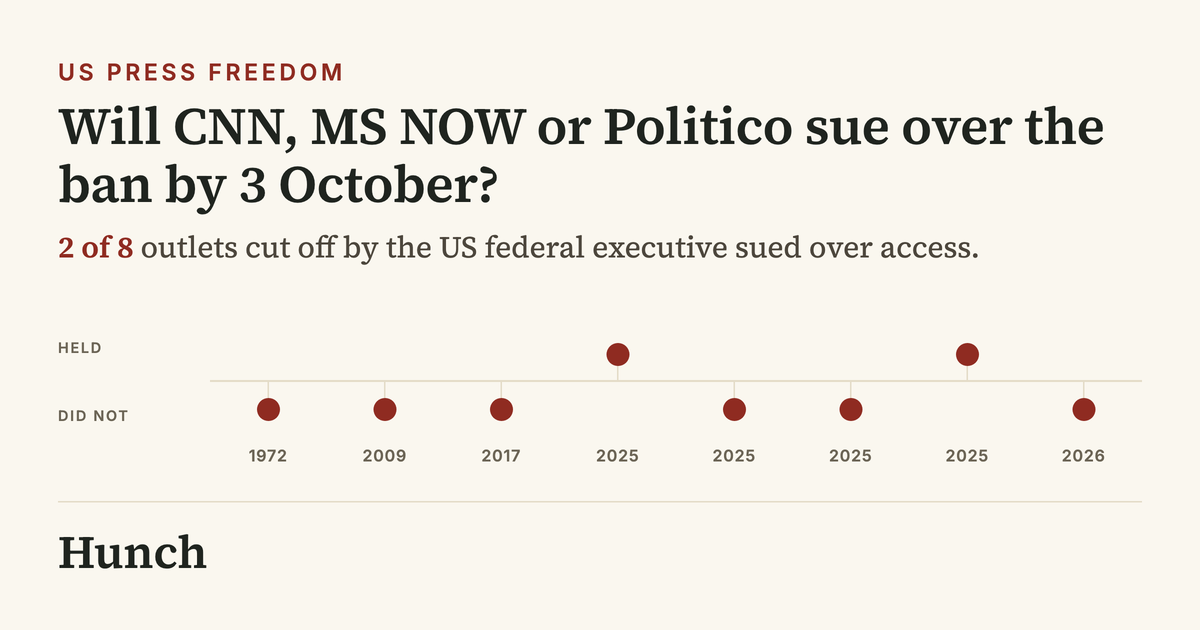
We looked for times since 1972 when the US government cut a named news organisation off from access it already had, and asked whether that organisation itself then went to a federal court over it. We found eight. Cases where a single reporter sued over their own pass are left out because they are a different kind of case. There are three of them, and all three went to court.
Show the other 6 cases
The Read
History leans against a lawsuit. CNN called the ban an illegal assault on a constitutional right and MS NOW promised any and all steps necessary. In only two of the last eight cases since 1972 did the outlet itself go to court: the Associated Press on the tenth day, and the New York Times, against the Pentagon, on the fiftieth.
How the ban was carried out may matter more than how it was announced. Trump named three companies, but the gate switched off three passes, and one MS NOW producer walked in on a badge that still worked. Reporters who sued over their own pass have a different history. Jim Acosta in 2018, Brian Karem in 2019 and Simon Ateba in 2023 all went to court, and all three got their passes back inside a month. This market counts only a suit in which CNN, MS NOW or Politico is itself named as a party bringing the case, because the eight cases are about outlets.
Time is short. The four lawsuits ever brought against the White House over press access were filed on day 6, 10, 11 and 15, and after that the record is empty until day 39. If nothing carrying one of these three names is in a federal court by , history suggests nothing is coming.
Disclaimer
Hunch works only from sources that are publicly available, and publishes on the basis of analysis of that material. We do not form an editorial opinion or take sides, we give a simpler and wider view of news that already exists. If information in a source we used was inaccurate, distorted, or later disputed but had already entered our analysis, Hunch accepts no liability for that. Predictions are not advice. Phase 1 markets use Hunch Points, not money.
Published by Hunch under the Editorial Code. Complaints and corrections: /contact/.