Xi in Washington, tariffs weeks away. Such visits often won an extension or benefit.
Chinese President Xi Jinping is in Washington from 23 to 25 September. The US and China trade truce runs out on 10 November.
What happened
Chinese President Xi Jinping visits Washington from 23 to and meets Donald Trump on Thursday, with the US and China tariff truce agreed in South Korea due to expire on .
It is Xi Jinping’s first White House visit in more than ten years. The White House announcement describes the welcome and the programme and does not mention trade.
Higher US tariffs on Chinese goods come back on unless the two sides extend their truce. The truce, agreed in Busan, South Korea, in , capped US tariffs on Chinese goods at about 20 per cent. In return China paused its new limits on selling rare earths abroad.
The United States will maintain its suspension of heightened reciprocal tariffs on Chinese imports until November 10, 2026.
The White House, fact sheet
The two sides disagree on how long to extend it. Jamieson Greer, who leads US trade talks, said on that Washington could support three to six months, and that no extension would come that day. The US says China has not kept its promises on rare earths.
Both sides added new limits during the truce. The US banned imports of Chinese-made humanoid robots, and China limited drone exports to the US. Beijing said it was left with “no choice but to take necessary countermeasures”.
Sources: Al Jazeera (2), The White House (2), Bloomberg
The Pattern
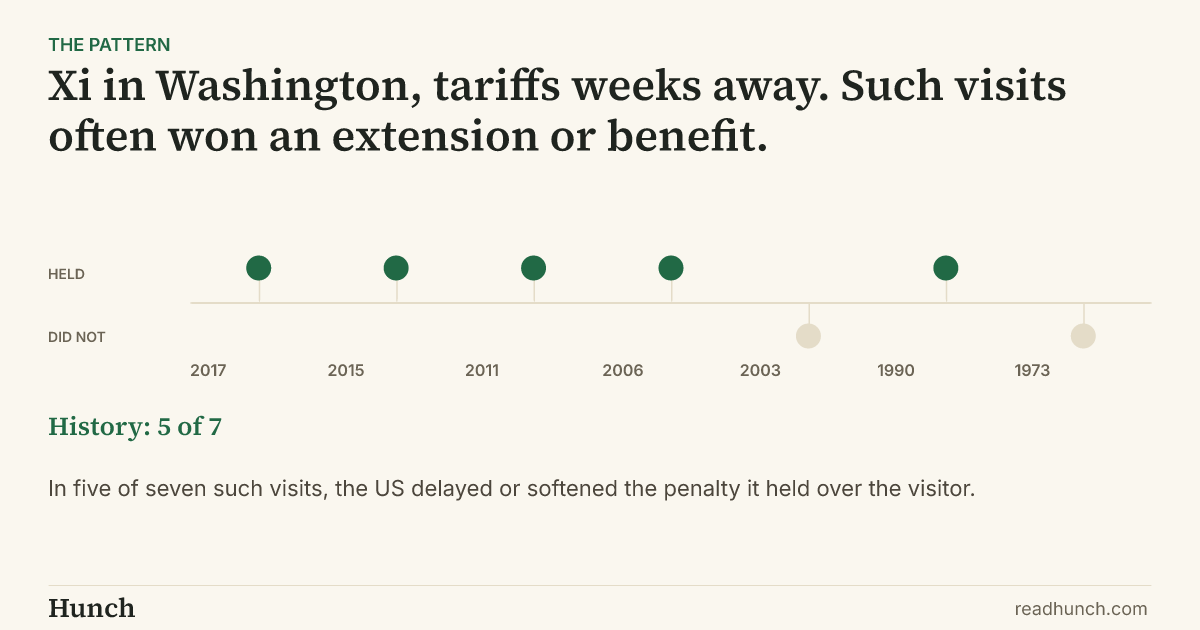
We looked back for times when a US president welcomed the leader of a rival country on a formal visit, while a US penalty on that country had a fixed date. We count a visit as a delay if the US put off, dropped or softened the penalty at the visit or within about three weeks. We found seven such visits since 1973, and five of them were Chinese leaders. In two, 1973 and 2006, the penalty was in the hands of Congress rather than the president.
Show the other 5 cases
The Read
History points to a delay. In five of the seven visits the US put off or softened its penalty, at the visit or within 16 days. In the clearest cases, 2015 and 2011, China had already given ground on the thing the US was angry about. This time that thing is rare earths, and so far the US has offered to extend the truce by six months at most.
There are reasons for doubt. Five of the seven visits were China and the US, so this is mostly the story of one relationship. None of the earlier cases had a truce that had already been extended once, as this one has. Two cases fit less neatly: the 2017 meeting was not a state visit, and in 1990 the US eased only in part.
A signed extension, or a new step from China on rare earths, would answer most of the question. A US order raising tariffs before would look like 2003, when the penalty went ahead.
Disclaimer
Hunch works only from sources that are publicly available, and publishes on the basis of analysis of that material. We do not form an editorial opinion or take sides, we give a simpler and wider view of news that already exists. If information in a source we used was inaccurate, distorted, or later disputed but had already entered our analysis, Hunch accepts no liability for that. Predictions are not advice. Phase 1 markets use Hunch Points, not money.
Published by Hunch under the Editorial Code. Complaints and corrections: /contact/.