The UK Youth Parliament got £453,000 last year. Ministers won't promise any more.
The Department for Culture, Media and Sport will not commit to any more grants for the UK Youth Parliament, which has run since 2000.
What happened
The BBC reported on that the UK Youth Parliament could be axed after the government said it would not commit to further grants, and that no final decision has been made on funding beyond .
The Department for Culture, Media and Sport, which pays for the UK Youth Parliament every year, will not commit to giving it any more grants. A government source said: “The government has not committed to continuing the programme in its current form.”
The Youth Parliament was launched in 2000. It has more than 300 elected members aged 11 to 18, who debate once a year in the House of Commons chamber on a day when MPs are not sitting.
It received £453,000 in the last year alone. That is part of about £2.4m of public money spent on it and other youth projects between 2017 and 2024.
No final decision has been taken on money after . The department says it is designing a replacement, a new scheme to get young people more involved in democracy, with a focus on groups that are under-represented. It is working on this with young people and youth organisations, and says further announcements will come this autumn. That is the only date the government has given itself.
A review the department published in found the parliament was meeting its goals. But only a quarter of young people had heard of it, and some schools felt left out of the process.
The argument does not follow party lines. Jack Rankin, the Conservative MP for Windsor, has said the programme should not get taxpayers’ money or sit in the Commons chamber, and should live on donations instead. Peter Swallow, the Labour MP for Bracknell, who ran for the Youth Parliament at 14, called the cut short-sighted while a bill to lower the voting age to 16 is going through Parliament.
The former Conservative leader Iain Duncan Smith asked the government to set out a credible replacement. The programme is run by the National Youth Agency, which took it over after the British Youth Council closed in 2024.
The Pattern
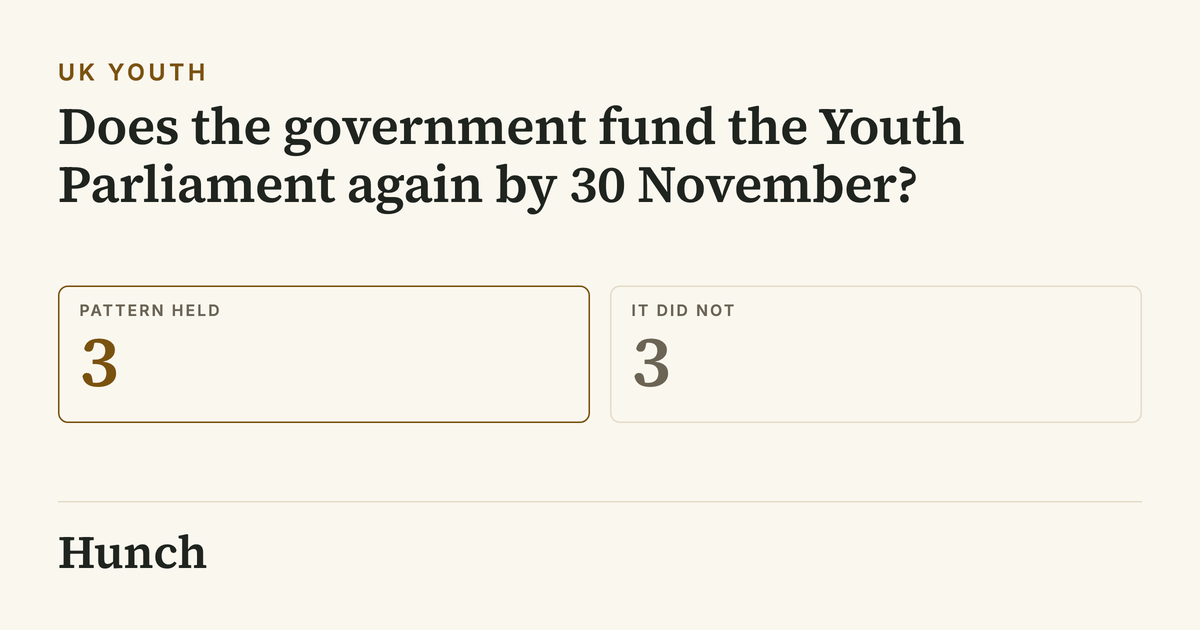
We looked for cases since 2010 where a UK government department, or a body giving out its grants, said it was ending the money for a named programme. We asked whether the same funder then announced new money for that programme, with a figure, within 72 days. A promise with no figure does not count. We found eight. Two came from one campaign and two more from one spending review, so they give six separate decisions.
Show the other 6 cases
The Read
History gives two speeds, and only one fits this case. The fast cases, money back in a day and in eighteen days, were one campaign: free school meals in 2020, with a footballer, a vote in the Commons and front pages behind it. Nothing like that is running here, and the Commons is away until .
The slow cases are the ordinary ones. A department or an arts funder takes the money away in the autumn and puts some of it back in the winter: school sport after sixty-one days, Bookstart after sixty-five and at half the rate, English National Opera after seventy-four. This case belongs with them, which is why the first market asks about rather than next week.
Where money came back, half the time it came back smaller. Booktrust got £13.5m over two years after losing £13m a year. English National Opera got £11.46m for a single year after losing £12.6m a year and a three-year place in the portfolio. So the question that matters is whether anything with the Youth Parliament’s name on it gets a figure before the grant runs out on . The three programmes that never got their money back had one thing in common: the department already had a replacement designed. This department says it is designing one now.
Disclaimer
Hunch works only from sources that are publicly available, and publishes on the basis of analysis of that material. We do not form an editorial opinion or take sides, we give a simpler and wider view of news that already exists. If information in a source we used was inaccurate, distorted, or later disputed but had already entered our analysis, Hunch accepts no liability for that. Predictions are not advice. Phase 1 markets use Hunch Points, not money.
Published by Hunch under the Editorial Code. Complaints and corrections: /contact/.