Volodymyr Zelenskyy sacks an aide after a raid. Will more top officials go?
Volodymyr Zelenskyy sacked a deputy chief of staff hours after a search of her home. Ex-defence minister Mykhailo Fedorov wants a wartime election.
What happened
Zelenskyy dismissed deputy chief of staff Iryna Mudra by decree on , hours after investigators searched her home in a money-laundering probe, as the anti-corruption bureau alleged a criminal group spanning the president’s office, a serving MP and state-bank executives.
Iryna Mudra was the deputy head of Volodymyr Zelenskyy’s office in charge of court matters. He sacked her by decree on and gave no reason. Ukrainian media reported that her home was being searched the same day.
The bureau says its case reaches the president’s office. The National Anti-Corruption Bureau says a criminal group included senior officials of the office, a serving MP, a former MP and bosses of a state bank. It says the group laundered 150m hryvnias, about £2.5m, through a state-owned bank to pay the bail in June of Herman Haluschenko, a former energy minister.
The searches continue a chain of cases that began with the Energoatom scandal of , about kickbacks, or secret payments, on contracts. Timur Mindich, an associate of the president, fled to Israel. Andriy Yermak, then chief of staff, resigned during that investigation and was arrested in May on suspicion of money laundering.
In July Zelenskyy removed Mykhailo Fedorov, the 35-year-old defence minister widely seen as a reformer. It led to the largest street protests of the war, including a Sunday rally of about 2,000 people outside the president’s office.
On Fedorov called in a video for a presidential election during the war. He said democracy cannot be held hostage to Russia, and he proposed what he called a legal, safe and realistic way to hold a vote. Parliament has confirmed Yevhen Khmara as the new defence minister.
Martial law, the special rules of wartime, has suspended elections since 2022. Zelenskyy’s five-year term ran out in . August polls put him on 22.3%, the former commander Valerii Zaluzhnyi on 21.4% and Fedorov third on 13.1%. Projections of a two-person second round favour both challengers.
Sources: The Guardian (2, 3)
The Pattern
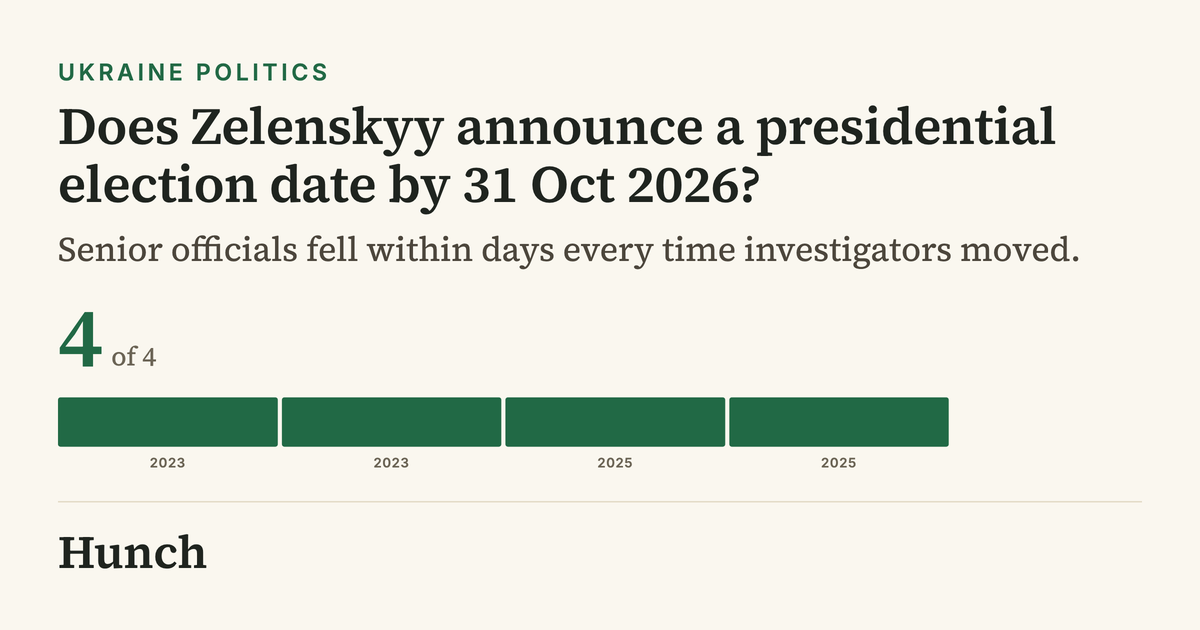
We looked at every big corruption clash in Ukraine since Russia’s full-scale invasion in 2022, where anti-corruption investigators or parliament moved against the government. We found four. Each time, senior officials were out within days. In none of the four did the crisis bring the country any closer to an election.
Show the other 2 cases
The Read
History points to more departures. Zelenskyy’s usual answer in the earlier scandals was to sack people fast and get ahead of the story, and every earlier wave took more than one senior official. The bureau’s case already names an MP and bank bosses as well as Mudra. That is why the market on another departure sits at 66%. On elections the record points the other way. The constitution bars elections in wartime and a fifth of the country is occupied. A president who trails both challengers in second-round projections also has no reason to offer a date.
There are reasons for doubt. For the first time the investigation is inside the president’s own office, while a popular sacked minister stands outside it with 13.1% in the polls and a protest movement. None of the four earlier cases had both. Two of the four also fit less well. In 2025 parliament gave the bureau back its powers and no minister left, and the defence minister in 2023 went only after months of supply scandals. Fedorov may also wait before he declares, because under martial law a formal candidacy means little. That is why his market sits below a third.
More departures become less likely if the bureau’s case stops at formal notices of suspicion, or if Zelenskyy decides to sack no one else so he does not feed Fedorov’s story of crisis. A big Russian attack could also freeze politics at home. Kyiv was under heavy bombing on .
Disclaimer
Hunch works only from sources that are publicly available, and publishes on the basis of analysis of that material. We do not form an editorial opinion or take sides, we give a simpler and wider view of news that already exists. If information in a source we used was inaccurate, distorted, or later disputed but had already entered our analysis, Hunch accepts no liability for that. Predictions are not advice. Phase 1 markets use Hunch Points, not money.
Published by Hunch under the Editorial Code. Complaints and corrections: /contact/.