Cornwall is offered powers with no mayor. No such deal has let an area raise money.
The Prime Minister told the Commons on 1 September that work has begun with Cornwall Council on a deal to hand it powers. It need not have a mayor.
What happened
In a Commons statement the Prime Minister says work has begun with Cornwall Council and its six MPs on a devolution deal, with or without an elected mayor.
The Prime Minister said Cornwall, like many rural economies, lacks a basic level of infrastructure, and that this harms growth. He said he had heard the call from all parties for a devolution deal, which hands powers from central government to an area. He made the same offer to every part of England that has no devolved powers.
BBC News reported that Cornwall’s efforts had been held up because it refused to join with Devon and refused a mayor. The Prime Minister appeared to accept both.
The same statement drew a line around money. The next stage of English devolution, published in July, adds powers that the Prime Minister said mayors had long asked for. They include technical education after 16, help to find work and fiscal devolution, which lets an area raise some money of its own.
The first of these money powers is an overnight visitor levy, a charge on overnight stays, from near the end of the 2027-28 financial year. That is the test a Cornwall deal has to pass. An area can have a deal without a mayor, or it can have a power to raise money. So far in England those two have not come together.
Cornwall has been here before. In the Sunak government offered it a Level 3 deal, which came with a directly elected mayor and £360 million guaranteed over 30 years. On the council’s cabinet dropped it, after a consultation found 69 per cent against a mayor. It took a smaller Level 2 deal without the investment fund instead.
In Labour listed that Level 2 deal among four deals for single councils without a mayor that it planned to take forward. In the Communities Secretary told the council he planned, as an exception, to make Cornwall a Foundation Strategic Authority on its own, without merging it with Devon.
Attempts in the House of Lords to drop the need for a mayor in areas with national minority status ended in with no change to the law.
The council has already accepted the lowest tier. At its meeting on the cabinet agreed to the government’s plan to make Cornwall a single Foundation Strategic Authority. It kept asking the government to add more powers and money for such authorities. It also let the chief executive agree the legal order needed, called a statutory instrument.
At the same meeting the cabinet member in charge answered a question from the public. The council believes every area should be able to decide on an overnight visitor levy, with or without a mayor. The government consulted on the levy in early 2026 and has not yet replied. Areas that bring in a levy must at present give twelve months’ notice.
The next dates are on the council’s own calendar. Full council meets on Tuesday at 10.30am at County Hall in Truro. The cabinet meets on and again on .
Separately, on the council signed an agreement with Homes England that names five priorities. It says more than 20,000 households with a link to Cornwall are registered as needing housing, and around 800 households live in temporary or emergency housing.
Sources: GOV.UK (2, 3), BBC (2, 3), BBC, Cornwall Council (2), Cornwall Council
The Pattern
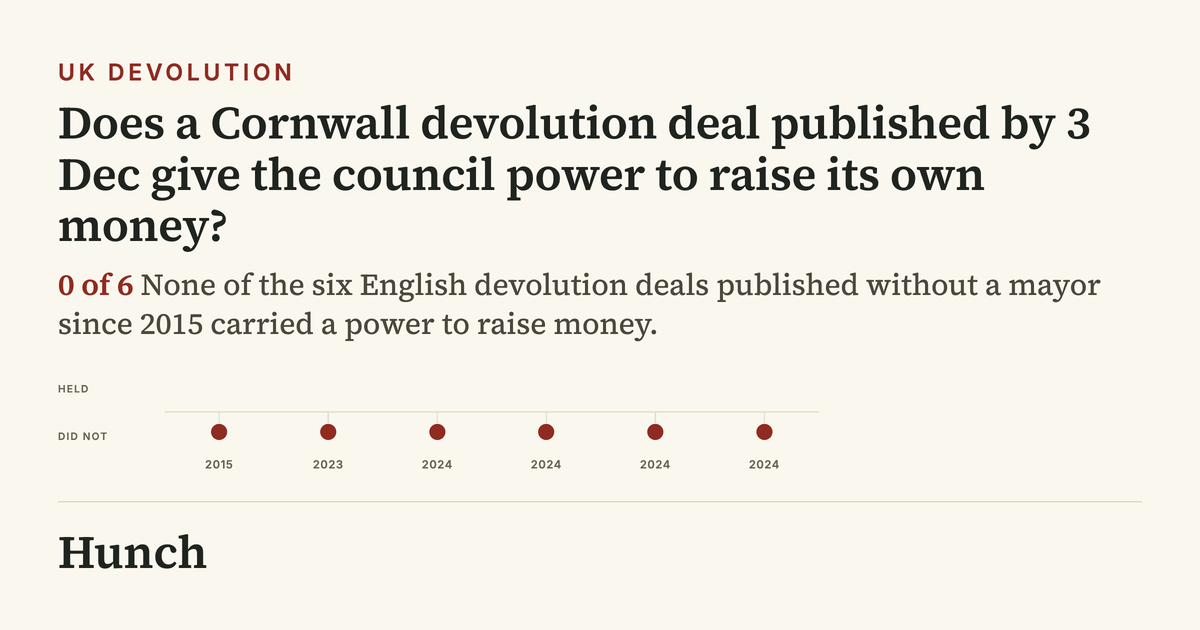
We looked at every devolution deal England has published since 2015 for an area with no directly elected mayor. There are six, starting with Cornwall’s own deal in 2015, the first for a rural county. For each we asked whether it let the area raise money itself, for example through a levy or a tax it keeps. Money sent from Whitehall to spend does not count. Deals with a mayor are left out, and so are deals that were announced but never published. None of the six gave the area a power to raise money.
Show the other 4 cases
The Read
History points against a money power. Six times England has written a devolution deal without a mayor. Each time the area got a training budget, sometimes a fixed pot for investment, and no power to raise money of its own. The Prime Minister’s own statement lists fiscal devolution and the visitor levy among the powers for mayors.
The record is small and may be out of date. The six deals span nine years and two different sets of rules, and three of them were written on the same day from the same template. The English Devolution and Community Empowerment Act has since changed the structures on offer. This government has also broken with the old rule of a mayor or nothing, at least in words, and has a political reason to make Cornwall the proof. If the deal comes with a levy, the old record no longer describes the present, and the record itself could not have seen that coming.
The nearer question is paperwork. The agenda for full council on is already published and does not include devolution. So the cabinet on is the first meeting that could take a paper on the Prime Minister’s offer. The council also has its new authority to set up and a legal order to agree, which is why that market sits near evens. The longer question will be settled by the text of a published Cornwall deal.
Disclaimer
Hunch works only from sources that are publicly available, and publishes on the basis of analysis of that material. We do not form an editorial opinion or take sides, we give a simpler and wider view of news that already exists. If information in a source we used was inaccurate, distorted, or later disputed but had already entered our analysis, Hunch accepts no liability for that. Predictions are not advice. Phase 1 markets use Hunch Points, not money.
Published by Hunch under the Editorial Code. Complaints and corrections: /contact/.