Drought hit UK vegetable crops. In past droughts, shop prices mostly rose later.
Britain is importing lettuce and broccoli after the driest July on record in England and Wales. The next food inflation figure comes on 19 August.
What happened
Supermarkets, pubs and restaurants are buying lettuce and broccoli from Spain in what should be the peak of the British season, as drought and sustained heat cut yields and drive wholesale vegetable prices sharply higher.
Britain is buying salad and vegetables from Spain and the Netherlands in the weeks when home-grown food normally fills the shops. Wholesale prices, what shops pay their suppliers, are up more than 60% for tomatoes, 90% for iceberg lettuce and over 40% for potatoes.
Broccoli harvests have roughly halved, and the English pea harvest is down by about a third. A Yorkshire farmer who grows around 4% of the country’s carrots called it the worst he has seen. The trade expects British carrots to run out months early, so more will be imported in spring.
England had about 6.5mm of rain in July, roughly a tenth of the usual amount, early Met Office figures show. It was the driest July on record for England and Wales. Southern England had just 1.9mm.
Drought has been declared across a large part of England. Around 23 million people face hosepipe bans from water companies, including Thames Water’s 10 million customers.
The next official food price figure comes on . The latest one points the other way. Prices of food and soft drinks rose 1.7% in the year to June, down from 2.2% in May and the lowest since . Wholesale prices change within days. Supermarket contracts, which cover most of what households pay, change much more slowly.
This time the delay could be shorter. The heat has also cut harvests across mainland Europe, so the imports replacing British food cost more than usual. In past droughts, cheaper imports helped keep shop prices down.
Sources: The Guardian, Met Office climate summaries, ONS
The Pattern
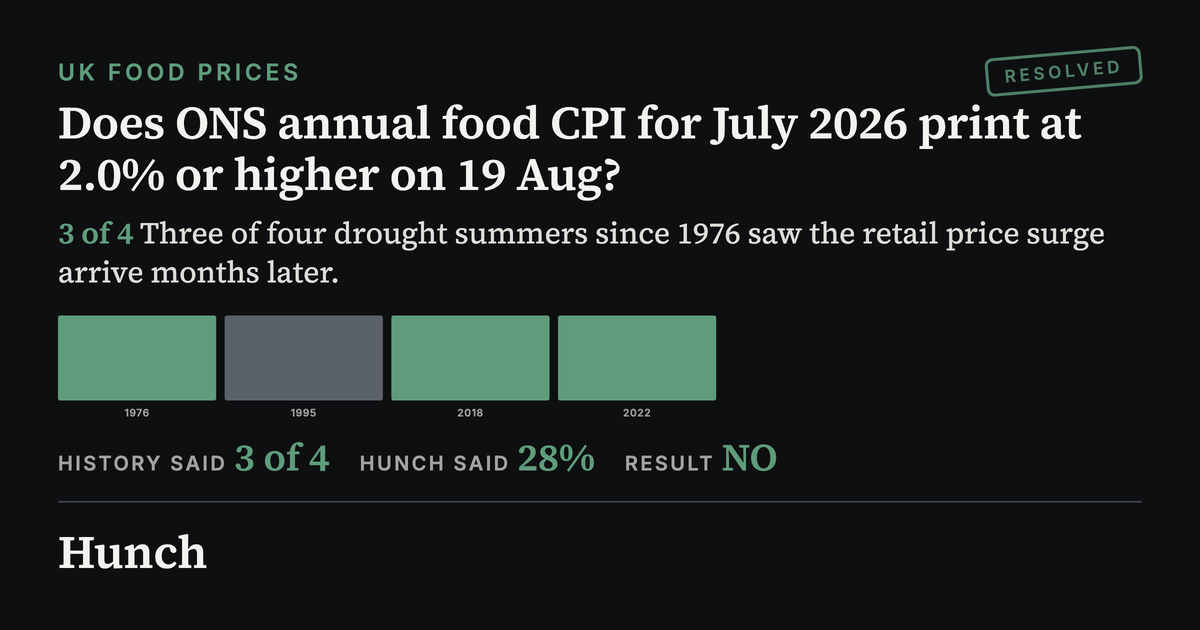
Britain has had four big drought summers since 1976. We checked how fast each one pushed up food prices in the shops. Usually it took months. The exception was 1995, the driest summer on record, when food inflation rose sharply by September.
Show the other 2 cases
The Read
History says shop prices react slowly. In three of the four drought summers, the big rise in food prices came five months or more later. Food inflation was falling in June, and most of what shoppers pay is set by supermarket contracts agreed months ago. The ONS also collects prices in the middle of the month, before the sharpest switch to imports in late July. That is why our estimate for a July figure of 2.0% or more is only 28%.
There are reasons to doubt this. Fresh vegetables are the part of the food basket where price changes reach shoppers fastest. Unlike 2018, Europe is dry too, so replacement imports are expensive. In 1995, the driest summer on record, food inflation jumped from 2.9% in July to 5.7% by September. The record is also small, only four summers.
The July figure on settles the first question. A figure of 2.0% or more would mean the usual delay has broken this time, and a faster rise in August and September would become more likely. A figure below 1.5% would mean supermarkets are absorbing even fresh vegetable prices, which no drought summer has shown before.
Disclaimer
Hunch works only from sources that are publicly available, and publishes on the basis of analysis of that material. We do not form an editorial opinion or take sides, we give a simpler and wider view of news that already exists. If information in a source we used was inaccurate, distorted, or later disputed but had already entered our analysis, Hunch accepts no liability for that. Predictions are not advice. Phase 1 markets use Hunch Points, not money.
Published by Hunch under the Editorial Code. Complaints and corrections: /contact/.