Edinburgh University staff strike to 30 October. Will forced job cuts be dropped?
About 3,000 staff at the University of Edinburgh began a five-week strike on 28 September. They want the university to rule out forced job cuts.
What happened
Lecturers and other staff at the University of Edinburgh began a five-week strike on over £140m of cuts and the threat of compulsory redundancies.
About 3,000 staff are on strike. They are members of the University and College Union (UCU) and will not return to work until . The union says the cuts could cost 1,800 jobs, and the university announced the closure of 90 courses this month.
The university will not rule out forced job cuts, known as compulsory redundancies. Its principal, Sir Peter Mathieson, said the union was “weaponising” students and that “the situation in the university is not sustainable”. The union says the money problem comes largely from the university’s building plans.
The dispute is not new. Staff struck in June, September and . In December the university promised no forced job cuts until the end of . The union called new strikes in March, saying the deal had been broken, which the university denies, and in May staff began a marking boycott. More than 950 staff have lost their jobs since early 2025, at least 800 of them by voluntary redundancy.
Money is tight across Scotland. A review set up by the Scottish government and the universities found a funding gap of about £200m a year. A week before Edinburgh, staff at the University of Dundee began their own five-week strike. Dundee has had £40m of emergency money from the Scottish government.
Sources: BBC (2, 3, 4), The Irish News, The Herald (2)
The Pattern
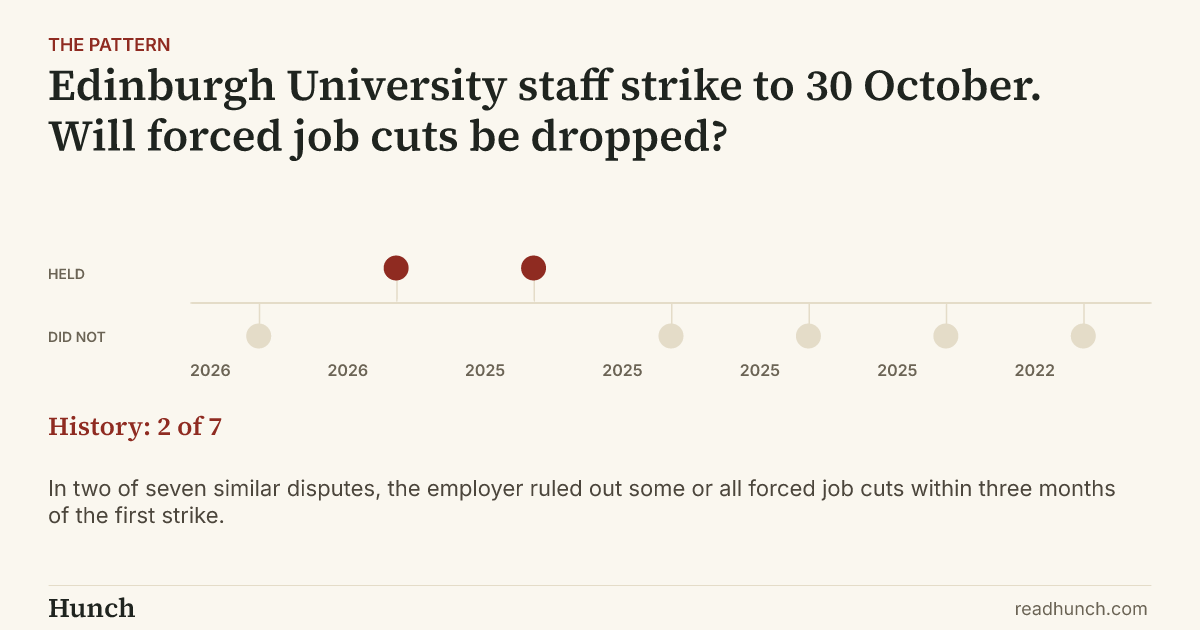
We looked for cases where an employer short of money cut jobs, a union answered with strikes that cost its own members their pay, and people outside the dispute, such as students or residents, paid the price. We kept the cases where the government or another public funder could pay. We found seven since 2022. Five are Scottish universities; the others are Birmingham’s bin strike and Network Rail. We counted from the first day of strikes.
Show the other 5 cases
The Read
History points to a long dispute. In two of the seven cases the employer ruled out forced job cuts within three months of the first strike: the University of the West of Scotland after about five weeks, and Heriot-Watt, for one department and for a limited time, after about twelve. In Dundee and Aberdeen, the two cases closest to Edinburgh, nobody gave way, and in Dundee the government paid instead.
Where a union stepped up its action early, it moved to longer strikes, as in Aberdeen and in Birmingham’s bin strike. Edinburgh’s staff have already done both of the obvious steps: a marking boycott in May and now their longest strike.
The record is small, and five of the seven cases are Scottish universities under the same government in the same two years. We counted from the first day of strikes, and Edinburgh’s staff first struck in , so this is not their first round. Edinburgh has also given way once before, with its promise of , which the union later said was broken.
Disclaimer
Hunch works only from sources that are publicly available, and publishes on the basis of analysis of that material. We do not form an editorial opinion or take sides, we give a simpler and wider view of news that already exists. If information in a source we used was inaccurate, distorted, or later disputed but had already entered our analysis, Hunch accepts no liability for that. Predictions are not advice. Phase 1 markets use Hunch Points, not money.
Published by Hunch under the Editorial Code. Complaints and corrections: /contact/.