Glasgow to sack and rehire 23,000 council staff. Will unions strike before January?
Glasgow City Council plans to fire and rehire more than 23,000 staff, meaning dismissing them and taking them back on new contracts from 1 January.
What happened
Glasgow City Council says it will dismiss all of its non-teaching staff, more than 23,000 people, and rehire them on new contracts from , after pay talks with unions broke down.
Talks with the GMB, Unison and Unite unions ended on Wednesday , when Unison refused to put the council’s latest offer to a vote of its members. The offer is a new pay and grading system. It replaces the old one, which was found to be unfair to women, and the council has already paid about £770m in equal pay claims. The council says 63% of staff will gain and 11% will lose, some by about £11,500 a year.
The unions are split. GMB and Unite were ready to put the offer to their members, but both said they would enter a dispute at once if the council went ahead. Unite promised the “full force of Unite”. Unison said it would not be pushed into a bad deal by deadlines and would only hold a vote on a better offer. The offer extends pay protection for staff who lose money from six to 12 months and adds £110m, which Unison says is back pay for past years, not help for those who lose. The council says it will withdraw the letters if all three unions agree to a vote.
is also the day a new UK employment law starts. From then, dismissing staff because they refuse new terms becomes automatically unfair. A council spokesman said there is still time to reverse the plan, but the council must act within days because the law changes in January, and some staff are owed 12 weeks’ notice. The GMB has written to every MP and Scottish Parliament member for Glasgow.
On the public spending watchdog, the Accounts Commission, said the council faces a £109.7m budget gap over the next two years. It said starting the new pay system by was critical to avoid more equal pay claims.
Sources: BBC (2, 3, 4), The Herald
The Pattern
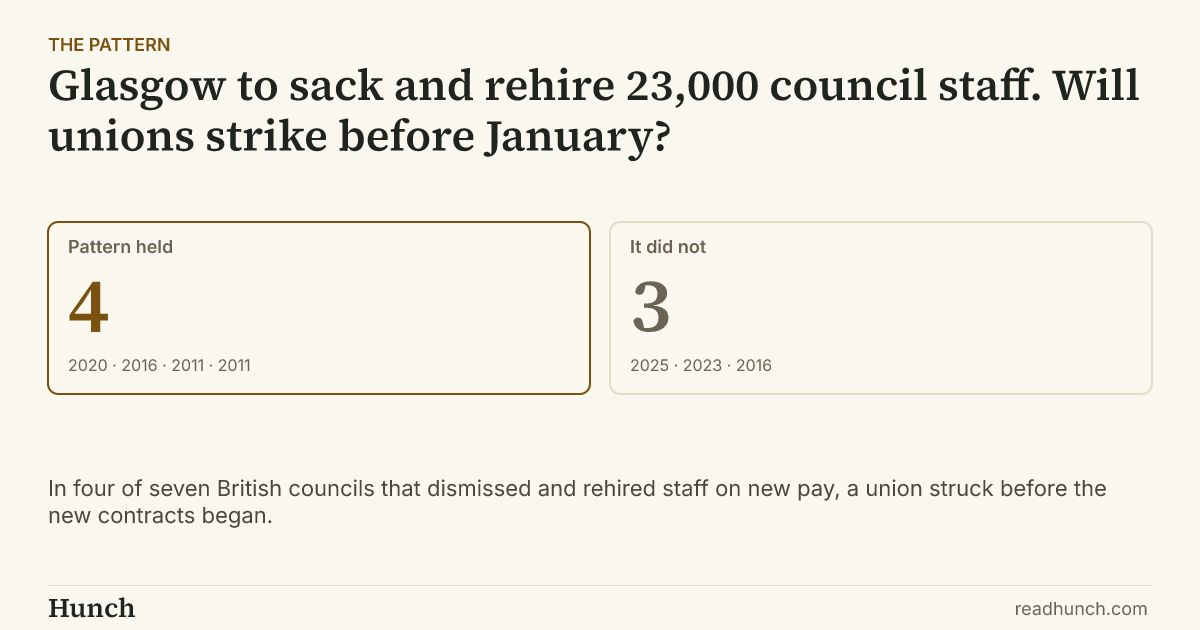
In four of seven councils, a union struck before new contracts began. We looked for British councils that formally decided to dismiss their own staff and take them back on worse pay for some, from a set date, after talks with unions failed. We found seven since 2011. In Devon in 2025 a deal came first and nobody struck.
Show the other 5 cases
The Read
History leans towards a strike. In four of the seven councils, a union that refused the deal struck before the new contracts started. Where unions were split, as in Shropshire and Durham, the council agreed terms with some unions and the one that held out went on strike. Glasgow’s unions are split in the same way.
The record is thin. There are only seven councils, and Glasgow’s 23,000 staff are more than three times the largest of them. Timing matters too. Unions that already had a strike vote struck within days, and the others took three to six months. No Glasgow union has announced a strike vote yet. None of the councils also faced a new law that closes this route on the day the new contracts start.
Two things will decide it: whether all three unions agree to put the offer to their members before the letters go out, and whether any of them opens a strike vote in October.
Disclaimer
Hunch works only from sources that are publicly available, and publishes on the basis of analysis of that material. We do not form an editorial opinion or take sides, we give a simpler and wider view of news that already exists. If information in a source we used was inaccurate, distorted, or later disputed but had already entered our analysis, Hunch accepts no liability for that. Predictions are not advice. Phase 1 markets use Hunch Points, not money.
Published by Hunch under the Editorial Code. Complaints and corrections: /contact/.