Northern Ireland teachers begin a work-to-rule. Past ones lasted over a month.
All five teaching unions in Northern Ireland will stop unpaid extra work from Monday 28 September, in a dispute over how much work teachers do.
What happened
The Northern Ireland Teachers’ Council, which represents the five teaching unions, said on that industrial action short of a strike over workload will begin on Monday .
The action follows failed talks on how to cut teachers’ workload. Under union instructions seen by BBC News NI, teachers stop unpaid extra work done out of goodwill. They go to only one meeting or parents’ event outside school hours each term. They also refuse to cover for absent colleagues beyond their contracts, and they stop supervising public exams.
The dispute is about how to carry out the 27 recommendations of an independent review of teacher workload. The unions won that review in the pay deal of .
The employers say eight of 11 open issues are agreed in principle. The Teachers’ Negotiating Committee, which speaks for the employers, asked for four more weeks. The unions said no.
Education Minister Paul Givan said he was disappointed and that there was room to reach a deal. Stormont has no agreed budget for this year. Since a deadline passed in August, officials have been spending up to 95% of last year’s money without ministers’ agreement.
The Pattern
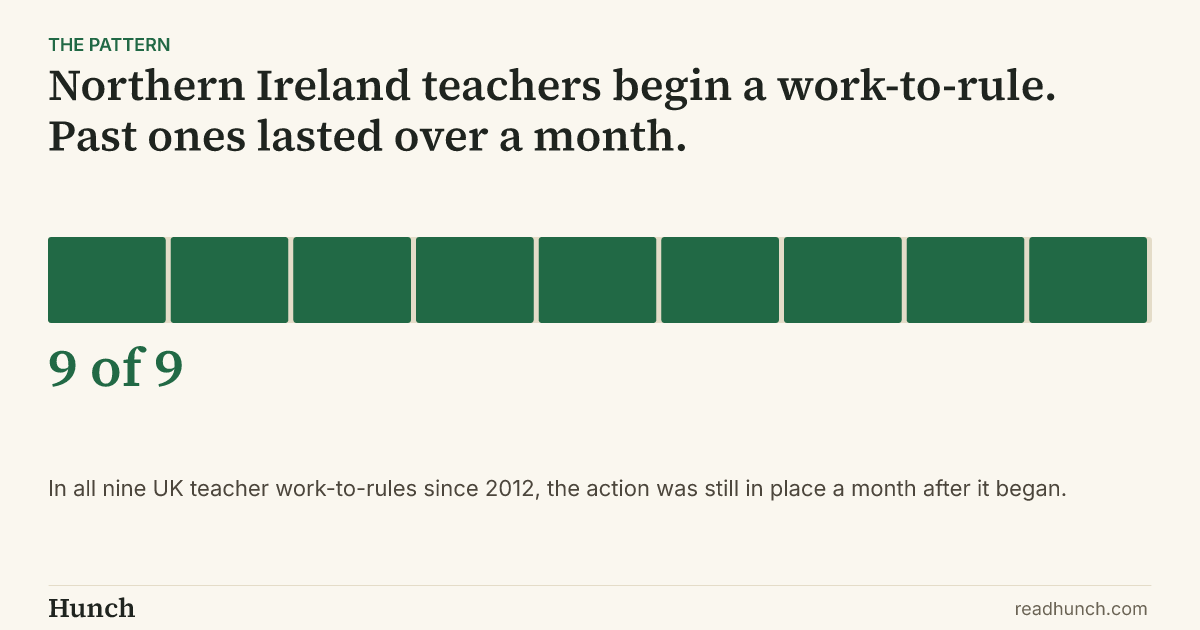
We looked for times since 2012 when teachers’ or head teachers’ unions across a whole UK nation started action short of a strike, such as a work-to-rule. For each we asked whether the action was still in place 31 days after it began. We found ten and use nine, because one has no known end date. The closest are shown first. All nine were still in place a month after they began. Four are in Northern Ireland with the same employer side, so they are not fully separate, and two of those, both in 2022, ended with one deal. The 2017 and 2022 Northern Ireland disputes ran mostly while Stormont had no working Executive. The 2025 case and this one have a minister in post.
Show the other 7 cases
The Read
The record says this kind of action lasts. In all nine cases it was still in place a month after it began, and eight of the nine ran past three months. Action short of a strike usually costs members no pay, which removes one reason to settle fast. The disputes in the record ended only when a new offer was put to members.
This case is closer to a deal than most. The employer side says eight of 11 issues are agreed in principle. The closest case in the record, with the same five unions and the same minister in 2025, ended on day 53 once a revised offer and a workload review were on the table.
Money weighs on the other side. Stormont still has no agreed budget, and the unions want a plan for all 27 recommendations that is paid for. Any deal would also go to union members before the action is called off.
Disclaimer
Hunch works only from sources that are publicly available, and publishes on the basis of analysis of that material. We do not form an editorial opinion or take sides, we give a simpler and wider view of news that already exists. If information in a source we used was inaccurate, distorted, or later disputed but had already entered our analysis, Hunch accepts no liability for that. Predictions are not advice. Phase 1 markets use Hunch Points, not money.
Published by Hunch under the Editorial Code. Complaints and corrections: /contact/.