Village votes on leaving UK over a site for 1,256 asylum seekers. Will anyone sue?
Piddington, 400 people near Bicester, voted on 15 September on leaving the UK. It protests a Home Office plan for 1,256 male asylum seekers next door.
What happened
Residents of Piddington, a village of about 400 people near Bicester in Oxfordshire, voted on Tuesday in a symbolic referendum organised by the parish council on whether the village should remain part of the UK, in protest at a Home Office plan to house up to 1,256 male asylum seekers at the nearby MoD Bicester site.
The vote has no legal effect. Piddington’s parish council, the smallest level of local government, agreed to hold it on , when 96 per cent of villagers backed the idea. It is a protest against a Home Office plan, announced on , to turn MoD Bicester, half a mile away, into basic housing for up to 1,256 men.
On the Home Office applied for permission under the Urgent Crown Development route, a fast planning process for urgent government projects. Public comments on the application close at midnight on .
The village has drawn in national politicians. On shadow home secretary Chris Philp, shadow minister Joy Morrissey and Reform UK MPs Sarah Pochin and Suella Braverman met about 20 women on the village green. Before that, 133 women of Piddington had written to all 266 female MPs to say they already lived in fear.
Cherwell District Council’s planning committee meets at 4pm on to agree the council’s response. Its leader, Lesley McLean, called the plan arbitrary in June. The draft response lists problems with transport, services, drainage and security, but does not mention legal action. A residents’ group opened a £20,000 fund on to pay for advice on a possible court challenge.
The decision sits with the Housing Secretary, not the council. That is Angela Rayner. The applicant is the Home Office under Shabana Mahmood. Asylum minister Anna Turley said on that the government would not drop the plan to use military sites. A letter to service personnel at the base put a provisional 270 asylum seekers on site by the end of the year.
The same field has been here before. The Labour government named it for an asylum centre in 2002. Cherwell fought the planning permission as far as the Court of Appeal, and the scheme was dropped in at a cost of £28m.
Sources: BBC (2), Independent, GOV.UK
The Pattern
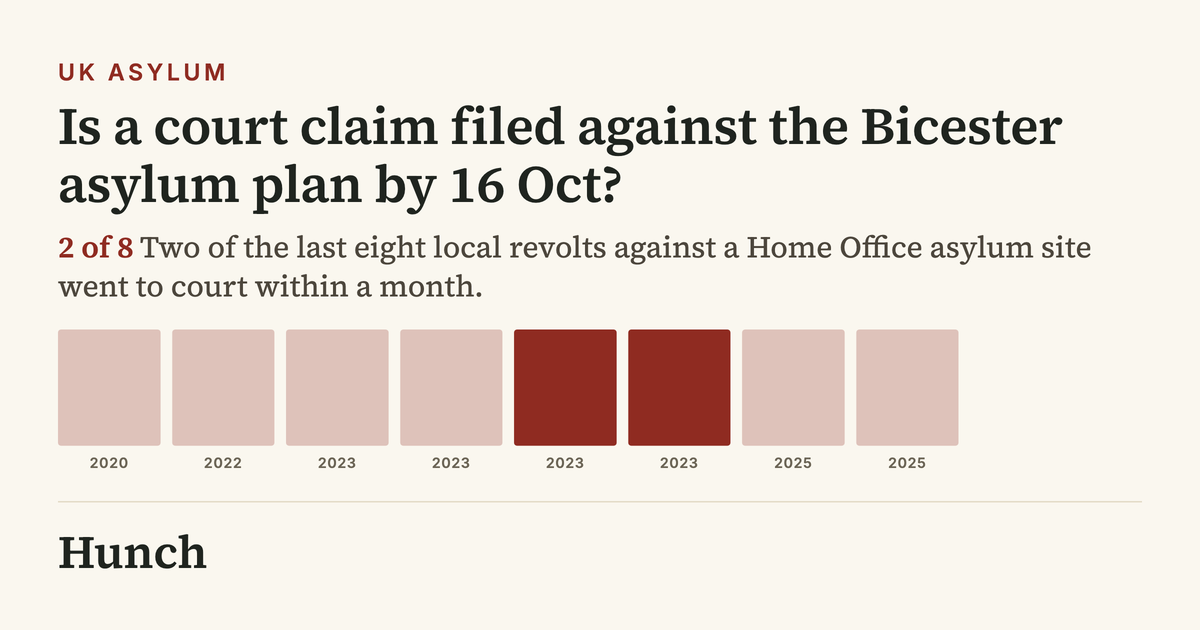
We found eight such fights since 2020. Each time the Home Office planned to house asylum seekers on a large former military site, or a similar one, and the local council or residents organised against it. We counted from the day the Home Office confirmed the site and asked whether a council or residents went to court within 31 days. The newest come first. Barnham and Linton-on-Ouse, named in with Bicester, are left out because 90 days have not yet passed.
Show the other 6 cases
The Read
History points away from a quick court case. In the eight earlier fights, only two councils went to court within a month: West Lindsey over RAF Scampton and Braintree over Wethersfield, both in 2023. Both acted within days of the announcement, and both lost within weeks. Bicester is 82 days past its announcement. So far there is a planning objection and a £20,000 fund for legal advice, which looks more like Northeye and Cameron Barracks, where no claim came.
The record may be too slow for this government. Crowborough went from confirmation to first arrivals in 86 days under emergency powers, with a residents’ claim already lodged. Manston was approved without a stage for public comments. A claim could still come by if Cherwell’s planning committee on turns its objections into an instruction to go to court, or if the residents’ group challenges the process before any decision, as Crowborough Shield did.
The Housing Secretary’s decision is the date to watch. The only similar urgent Home Office application, Manston, took 128 days to decide, which would put a decision, and any challenge to it, after . A decision within four weeks of the deadline would change that. For arrivals by , only two of the eight sites opened within 90 days, and Bicester has no permission, no water and no power yet. The figure of 270 by the end of the year is the Home Office’s own provisional number.
Disclaimer
Hunch works only from sources that are publicly available, and publishes on the basis of analysis of that material. We do not form an editorial opinion or take sides, we give a simpler and wider view of news that already exists. If information in a source we used was inaccurate, distorted, or later disputed but had already entered our analysis, Hunch accepts no liability for that. Predictions are not advice. Phase 1 markets use Hunch Points, not money.
Published by Hunch under the Editorial Code. Complaints and corrections: /contact/.