Scotland promises new council tax bands for costly homes. Most past plans stalled.
The Scottish Government's programme names a Council Tax (Scotland) Bill to bring in new tax bands for high-value homes by 1 April 2028.
What happened
The Programme for Government names a Council Tax (Scotland) Bill introducing new council tax bands for high-value residential properties by .
The new bands are due by . The Council Tax (Scotland) Bill is one of nine Bills in the government’s plan for its first year. It is meant to deal with a long-standing complaint: the most valuable homes can pay the same council tax as homes worth much less. The Bill would also update parts of the system and give councils some new powers they can choose to use.
Other Bills in the same plan include a Budget Bill, a Food Prices Bill and a Public Service Renewal Bill. The government describes the council tax Bill as a key part of a wider reform of the tax.
The problem is how homes are valued. Scottish council tax bands still rest on what homes were worth on . Band H, the top band, has no upper limit, so a city flat and a country mansion can sit in the same band. Adding bands at the top is the smaller possible reform. Valuing every home in Scotland again is the bigger one, and the Bill as described does not do that.
This time the change comes by Bill, which is different from the last time. In 2016 the higher bands were changed by an order, a shorter legal document that MSPs approve with a single vote. The order was made on and took effect on . It made bands E to H pay more compared with bands A to D, the first change to that ratio since the Local Government Finance Act 1992.
A full Bill takes longer to pass and gives opponents more chances to challenge it.
Sources: Scottish Government, BBC, legislation.gov.uk SSI 2016/368
The Pattern
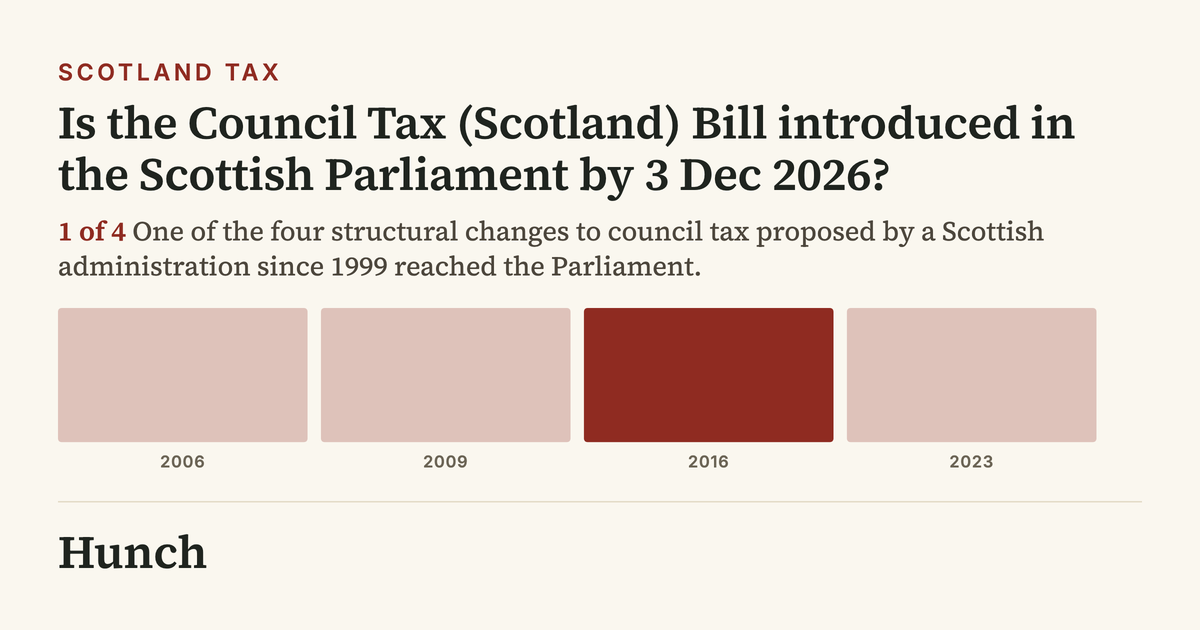
We found four plans since 1999 to change how council tax works. Each was a Scottish government’s own plan or a review it had ordered. Each was about the bands, how much each band pays, or replacing the tax, and not about the size of bills. We asked whether a Bill or order to make the change was put before the Scottish Parliament within 18 months. Freezes and caps are left out because they keep the tax as it is.
Show the other 2 cases
The Read
History leans against a quick Bill. Only one of the four earlier plans reached the Scottish Parliament, and that one, in 2016, was an order rather than a Bill. A Bill promised early in a new Parliament usually comes after a public consultation. The government has given itself until , which leaves room to consult first and bring in the Bill later. A question about home values is also rarely put to the public within a month of a new programme.
The record is small, and its cases are linked. The 2023 plan tried to repeat the 2016 change, and within a month it gave way to a council tax freeze, in a year when a freeze was the easier choice. So the record says more about whether a government will carry a visible tax rise into an election than about how hard the policy is.
A freeze is the thing to watch. If a minister announces a freeze or a cap on increases for 2027-28 by December, the government will have used the political room it needs to add bands at the top. A freeze and a new Bill in the same autumn would be hard to fit together unless something changes in between.
Disclaimer
Hunch works only from sources that are publicly available, and publishes on the basis of analysis of that material. We do not form an editorial opinion or take sides, we give a simpler and wider view of news that already exists. If information in a source we used was inaccurate, distorted, or later disputed but had already entered our analysis, Hunch accepts no liability for that. Predictions are not advice. Phase 1 markets use Hunch Points, not money.
Published by Hunch under the Editorial Code. Complaints and corrections: /contact/.