Scotland plans to merge its councils. Will a public consultation open this year?
The Scottish government has published a plan to replace Scotland's 32 councils with six to ten regional authorities and 120 to 160 community bodies.
What happened
The Scottish government published proposals to replace Scotland’s 32 councils with between six and ten regional authorities, supported by 120 to 160 smaller community authorities.
The Scottish government published its paper on . Six to ten regional authorities would run education, economic development, strategic planning, transport and services such as waste. The 120 to 160 community authorities would handle planning applications, licensing and town centre work.
Councillors would still be elected in the wards that exist now and would sit on both levels, so no new layer of politicians is created. The islands would get their own arrangements. The paper does not say how any of it would be paid for.
No consultation has opened and no bill exists. Deputy First Minister Jenny Gilruth called the proposals a starting point for debate and said they do not show the government’s final views. The paper has gone to Holyrood committees and to Cosla, the body that speaks for councils, before a public consultation.
There is a clock on it. In his programme for government on , John Swinney set three months for talks on public service reform, timed to feed the next Scottish budget. Scotland’s council elections are due next May.
The current map of 32 councils was created by the UK government in 1996. It replaced nine regional and 53 district councils.
Sources: BBC (2), Scottish government
The Pattern
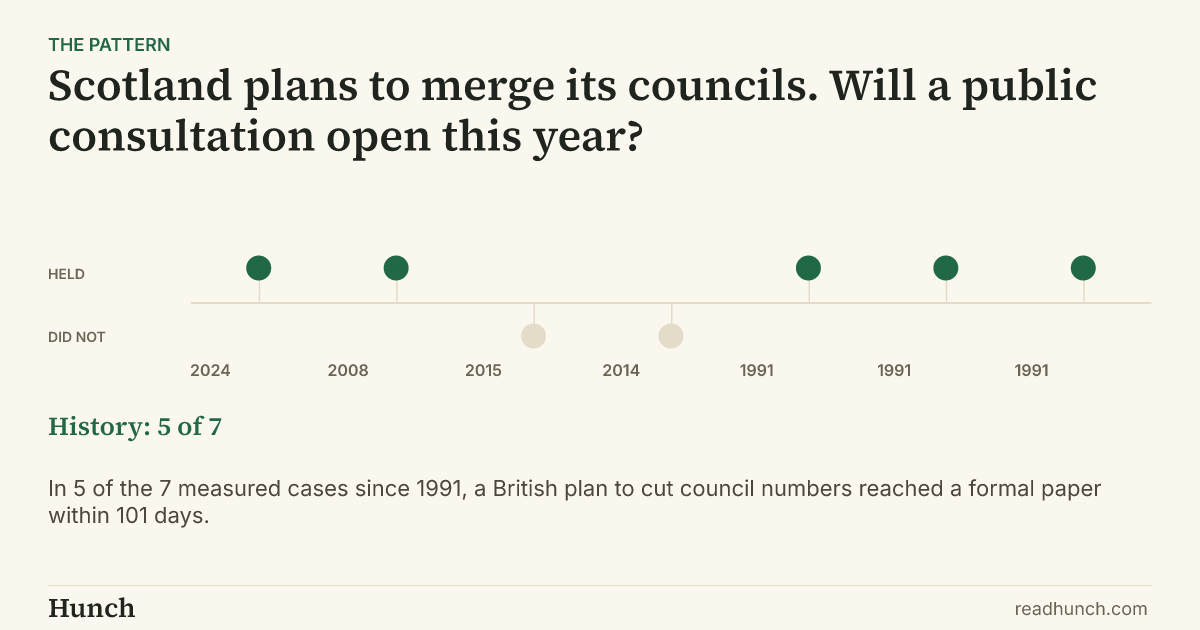
We looked for times when a UK government announced a plan to cut the number of councils before any consultation or bill carried it, and counted the days until a formal paper appeared. We found seven. England, Wales and Scotland were all announced in the Commons on , so those three count once. Two more come from the same Welsh reform programme. Five came before the Scottish Parliament, which now decides this. The closest cases come first. Two dates, and , are known only to the month, and we used the end of that month.
Show the other 5 cases
The Read
History says the plan will reach a formal paper. All seven plans here got one in the end, and five of the seven within 101 days. The speed depended on whether the government already had the paper in hand. England published its consultation 33 days after the 1991 announcement. Northern Ireland took 71 days in 2008, because the review behind it had run for six years. England in 2024 wrote to councils after 51 days, because the legal route was already open.
The two slow cases look most like this one. Leighton Andrews published a Welsh map in , called it a stage in discussion, and the draft bill took 160 days. The Welsh response to the Williams Commission took about 169 days to become a white paper. Both spent that time arguing with councils, which is what Cosla and the Holyrood committees have now been asked to do. The record is also small, and plans that were dropped are harder to find than plans that produced a paper.
A written statement naming a consultation date, or the paper appearing on the gov.scot consultation list, would make a December consultation more likely. Cosla refusing to take part would make it less likely. So would the government folding the question into the budget talks and calling those talks the consultation.
Disclaimer
Hunch works only from sources that are publicly available, and publishes on the basis of analysis of that material. We do not form an editorial opinion or take sides, we give a simpler and wider view of news that already exists. If information in a source we used was inaccurate, distorted, or later disputed but had already entered our analysis, Hunch accepts no liability for that. Predictions are not advice. Phase 1 markets use Hunch Points, not money.
Published by Hunch under the Editorial Code. Complaints and corrections: /contact/.