Scotland plans legal food price caps. Few laws that hit UK limits survived intact.
The Scottish Government has opened a consultation on legal price caps for basic foods and named a Food Prices (Scotland) Bill to bring them in.
What happened
The Scottish Government opens a consultation on legal price controls for essential food items, with a Food Prices (Scotland) Bill named in the 2026-27 legislative programme.
A public consultation on the plan is open until . Business Minister Tom Arthur opened it on and published a draft Bill with it. It asks how the price controls would work in practice and which shops and foods they would cover. Opening it was one of the government’s promises for its first hundred days.
Two days earlier, 23 business groups, including the Scottish Retail Consortium and the Food and Drink Federation Scotland, wrote to John Swinney asking him to drop the plan. They said a legal cap would not work against rising costs of production, refrigeration and transport.
The plan now has a Bill to carry it. The government’s programme for 2026-27, published the same day, names nine Bills, and the Food Prices (Scotland) Bill is one of them.
The limit comes from UK law. The Scottish Government says it has made a first check of how the plan fits with the United Kingdom Internal Market Act 2020, a UK law meant to keep trade open between the four nations. It says it will talk to the UK Government once the consultation ends.
The same Act caused problems for Scotland’s deposit return scheme and its ban on single-use plastics. Only a UK minister can grant an exception from it. So the order of events is a check, then a consultation, then talks with the UK, then a Bill.
Sources: Scottish Government (2), BBC
The Pattern
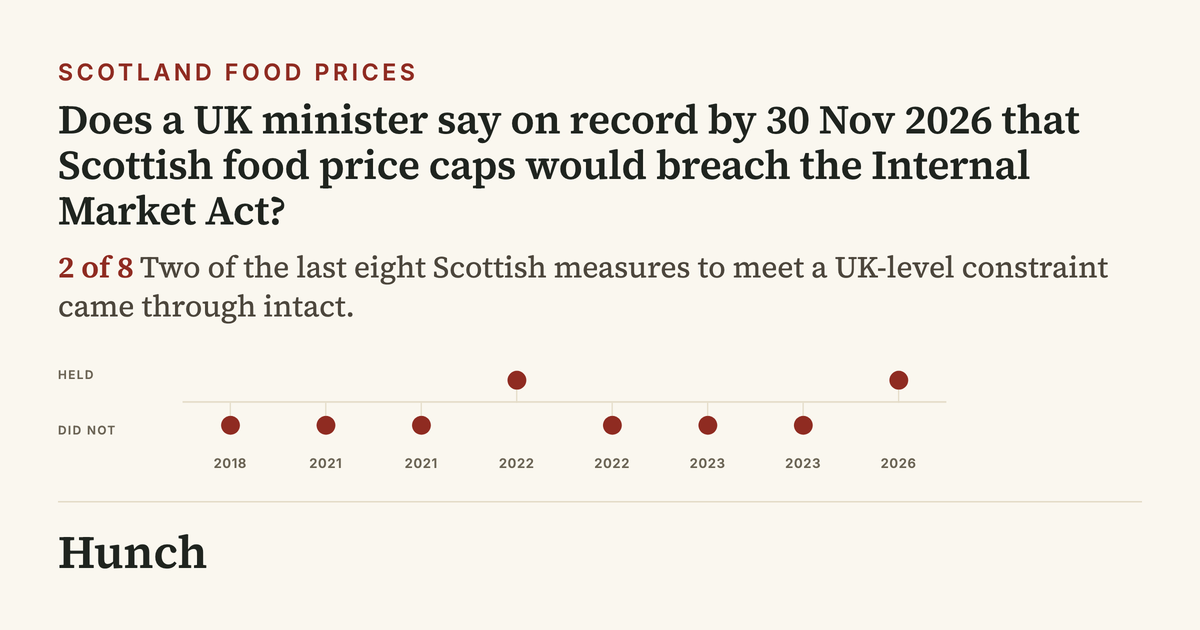
We found ten Scottish measures since 2012 that needed UK clearance. Each was passed by the Scottish Parliament, or sent to court before it was introduced. It could only work as passed if the UK Supreme Court found it within Holyrood’s powers, if no UK order blocked it under section 35 of the Scotland Act 1998, or if the UK granted an exception from the Internal Market Act. We asked whether it came through in full. The last eight are shown.
Show the other 6 cases
The Read
History leans towards a clash with UK law. Six of the last eight Scottish measures that needed UK clearance were blocked, cut back or narrowed. Food prices touch the Internal Market Act more directly than gender recognition or children’s rights did. The closest case is the deposit return scheme, which got an exception from the Act but lost glass.
Timing is the weak point. The section 35 order, the court cases and the deposit return decision all came after the Scottish Parliament had passed something. This time there is only a consultation, closing on , and the Scottish Government says it will talk to the UK only after that. A UK minister has little reason to rule on a Bill that does not yet exist, and a written UK reply within a month is unlikely for the same reason. The two full exceptions on record, for plastics and glue traps, came late.
A UK minister’s statement on the Internal Market Act before the end of November would answer the question. If the consultation closes with no UK statement, the argument moves to 2027, for reasons of timing that this record does not measure.
Disclaimer
Hunch works only from sources that are publicly available, and publishes on the basis of analysis of that material. We do not form an editorial opinion or take sides, we give a simpler and wider view of news that already exists. If information in a source we used was inaccurate, distorted, or later disputed but had already entered our analysis, Hunch accepts no liability for that. Predictions are not advice. Phase 1 markets use Hunch Points, not money.
Published by Hunch under the Editorial Code. Complaints and corrections: /contact/.