Scotland plans to merge its 14 health boards into 2. Most past mergers became law.
The Scottish Government's programme, published on 1 September, promises to replace Scotland's 14 regional health boards with 2 strategic boards.
What happened
The Programme for Government 2026 to 2031 commits to replacing the 14 territorial health boards with two strategic health boards and to substantially reducing the number of public bodies.
By 2031, no patient should wait longer than 26 weeks for treatment. That is the promise tied to the merger. The government says two boards in place of 14, with other steps, will free up time and capacity for treatment. John Swinney called it the most important change to how the NHS is organised since devolution.
The health boards are one part of a wider plan to cut the number of public bodies. The same programme promises to remove duplication in public services and to bring the national environment bodies into one body. It also aims to agree, within three months, a shared direction for reforming local government, including social care.
The law to carry all this is the Public Service Renewal (Scotland) Bill, one of nine Bills planned for 2026-27.
Work on the new health board structure began last November. It splits the country into east and west, with the heads of NHS Greater Glasgow and Clyde and NHS Lothian in charge.
No law has changed yet. The two new boards have no names, and the government has not said what happens to the boards for Orkney, Shetland and the Western Isles. Health boards are set up by law, so every step from here will leave a public document, and the first ones are due long before any board closes.
On Swinney told BBC Radio Scotland there would be no compulsory redundancies, although the number of public sector jobs would need to fall. The union Unite called the plan a slash and burn programme for the NHS.
Sources: Scottish Government, BBC (2)
The Pattern
We found nine Bills since 1999 that merged local public bodies. In each, the Scottish Executive or Scottish Government asked the Scottish Parliament to abolish a set of area bodies, or to merge them into one national body or into fewer bodies. We asked whether the change became law in the form first proposed. Changes made without a new Act, such as the 2013 college mergers, are left out because they are easier. So are plans that never became a Bill.
Show the other 6 cases
The Read
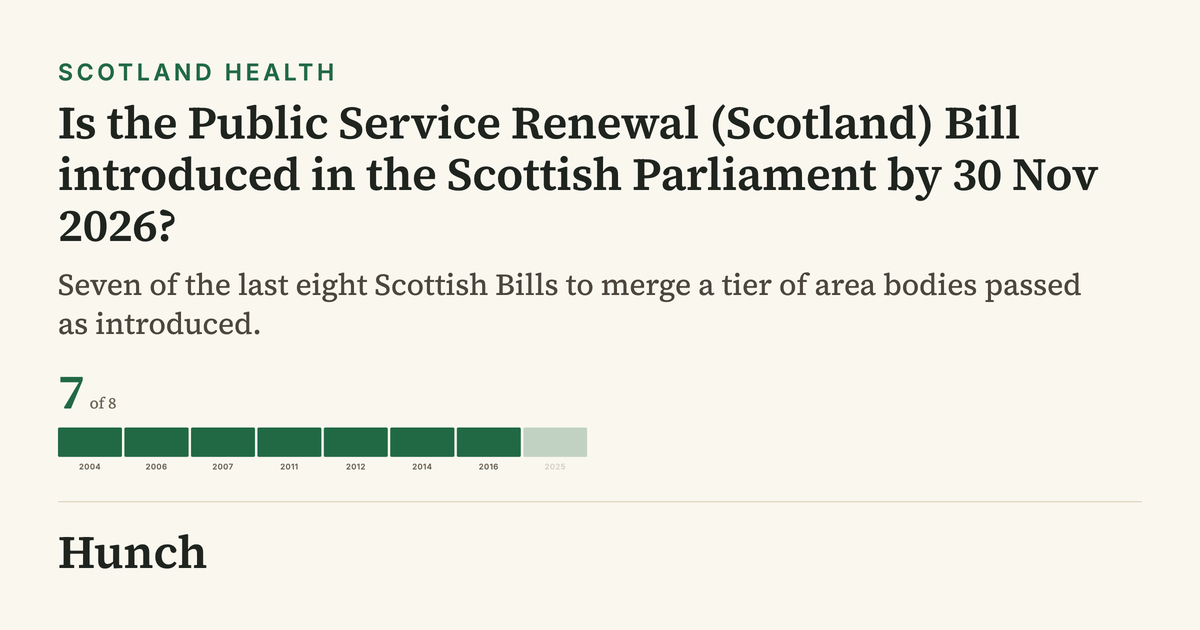
History says Scotland usually gets these mergers into law. Seven of the last eight Bills like this passed in the form first proposed. In 2012, eight police forces became one, a bigger merger than 14 health boards into two, and it passed as planned. The timing of this Bill is less sure. The Budget Bill goes first every year, and the Public Service Renewal Bill must also carry the merger of the environment bodies, so a Bill by is far from certain.
The newest case is the closest one, and it failed. The National Care Service plan also promised to move services from local bodies into a national one. It also had a named Bill and a government behind it. The national service was taken out of the Bill, and what passed were the parts that did not move anybody. Health boards employ people, hold budgets and have local political support, which makes them harder to move.
A published consultation or plan on the merger by the end of November, and the Bill itself, will show how fast this is moving. Naming the two boards means telling 14 chairs and their staff which side of the line they are on, and on Swinney would not give a number for job losses.
Disclaimer
Hunch works only from sources that are publicly available, and publishes on the basis of analysis of that material. We do not form an editorial opinion or take sides, we give a simpler and wider view of news that already exists. If information in a source we used was inaccurate, distorted, or later disputed but had already entered our analysis, Hunch accepts no liability for that. Predictions are not advice. Phase 1 markets use Hunch Points, not money.
Published by Hunch under the Editorial Code. Complaints and corrections: /contact/.