Scotland drafts an independence vote Bill. The UK refused its last three requests.
The Scottish Government published a draft Independence Referendum Bill on 28 August. It can only go ahead once the UK Government transfers the power.
What happened
The Scottish Government publishes a draft Independence Referendum Bill with the question “Should Scotland be an independent country? Yes or No”, which cannot be introduced until referendum powers are devolved.
The First Minister published the draft Bill on and called it simple, straightforward and direct. It sets out who can vote, and a date will be added when it is introduced. It will be introduced once the Scottish Parliament has the power to hold the vote. Publishing it was one of the government’s promises for its first hundred days.
John Swinney said the largest number of pro-independence MSPs in history had voted in May to ask for referendum powers to be handed to the Scottish Parliament. He said he would have more to say on Scotland’s constitutional future in the coming weeks.
Since 2022, a new vote needs the UK government’s agreement. The UK Supreme Court ruled that year that any further referendum requires it. The agreement takes the form of an order under section 30 of the Scotland Act 1998. Downing Street described that order as passing power from Westminster to Holyrood when David Cameron and Alex Salmond signed the Edinburgh Agreement.
The UK answer came the same day. A UK government spokesperson said the Prime Minister had told the First Minister at their first meeting that another referendum was off the table, because it would take attention away from growing the economy and helping families with the cost of living. Downing Street said the same in July, after Andy Burnham met Swinney before the Commonwealth Games opening ceremony.
A spokesperson’s words are not a formal reply. The record below shows how each earlier request was answered, and how fast.
Sources: Scottish Government, BBC, UK Government
The Pattern
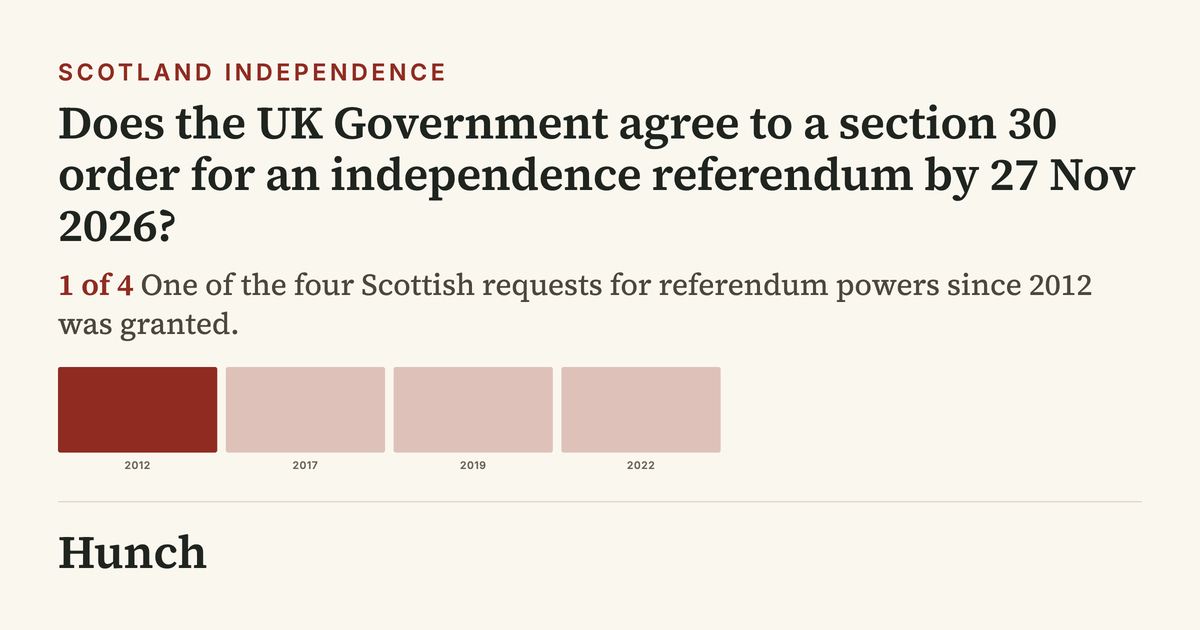
We found four formal requests for the power since 2012. In 2012, 2017, 2019 and 2022, the Scottish Government asked the UK Government for the power to hold an independence referendum, by letter, by agreement or by a published plan. We asked whether the UK agreed to hand over that power within 18 months. Section 30 orders on other subjects, fifteen in all, are left out. They show the legal tool in use, and this record is about the requests.
Show the other 2 cases
The Read
History points to a refusal. Only one of the four requests was granted, in 2012, and both governments wanted that vote and signed an agreement before any order was made. Nothing in the exchange looks like that. The Prime Minister’s position was stated in July and repeated in August.
The record is small and comes mostly from one side. All three refusals came from the same party at Westminster, and this is the first request put to the current Prime Minister. This request also rests on a May vote by the largest group of pro-independence MSPs yet. The 2017 request also had a majority at Holyrood behind it, and it was refused.
A UK statement that discusses the terms of a vote, rather than the principle, would change the picture. A formal UK reply may not come at all. The 2019 and 2022 requests got letters within four weeks, which became public because the First Minister published them. This time the refusal was given to journalists on the day the Bill came out. Swinney controls the timetable of the Scottish Parliament and has said more is coming.
Disclaimer
Hunch works only from sources that are publicly available, and publishes on the basis of analysis of that material. We do not form an editorial opinion or take sides, we give a simpler and wider view of news that already exists. If information in a source we used was inaccurate, distorted, or later disputed but had already entered our analysis, Hunch accepts no liability for that. Predictions are not advice. Phase 1 markets use Hunch Points, not money.
Published by Hunch under the Editorial Code. Complaints and corrections: /contact/.