Wales's minority government needs votes for a £27bn budget. Recent deals came late.
Wales's First Minister Rhun ap Iorwerth said talks with all opposition parties have begun. Next year's budget will be smaller after inflation.
What happened
The First Minister says next year’s Welsh Government budget will be lower in real terms than this year’s, marks the First 100 Days Progress Report, and says he will press the Prime Minister on fairer funding in October.
Rhun ap Iorwerth, Wales’s First Minister, said his government began talks with opposition parties over the summer to find common ground before the annual budget. He said it would also tighten the way it works with other parties. Labour confirmed it had already taken part. Reform said a meeting with the Finance Minister was planned later in September. The Conservatives said nothing formal was in the diary.
The talks follow a defeat on . Plaid Cymru’s £300m supplementary budget, a mid-year change to spending that included money for NHS waiting times and childcare, fell by 49 votes to 44. Labour demanded £100m for children with additional learning needs, and Reform and the Conservatives also refused to support it. It was the first time a Welsh government had lost a vote on a supplementary budget.
Plaid Cymru holds 43 of the 96 seats in the Senedd, the Welsh parliament, six short of a majority. The May election left Reform on 34, Labour third, the Conservatives on 7, the Greens on 2 and the Liberal Democrats on 1.
Two budget votes are now ahead. The First Minister said the supplementary budget would have to come back. The £27bn annual budget for 2027-28 must pass in the winter months.
Plaid cannot reach 49 votes with the Greens and the one Liberal Democrat alone, so in practice it needs Labour or the Conservatives. The question is whether a deal comes before the draft budget is published, or, as in every recent minority budget in Wales and Scotland, only once a vote is close.
Sources: Welsh Government, BBC (2, 3, 4, 5)
The Pattern
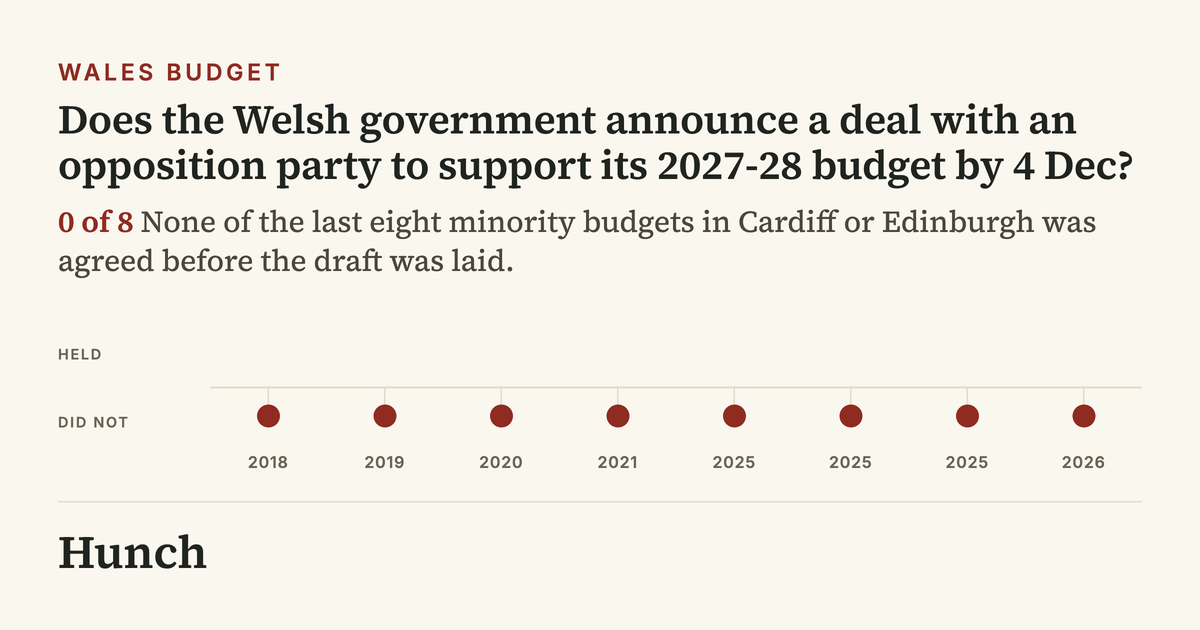
In ten budget rounds since 2009, no deal came before the draft. We looked at every year since 2009 when the government in Wales or Scotland had no majority and needed at least one opposition party to pass its annual budget. We left out the years when a standing agreement had already secured the votes: the Bute House Agreement in Edinburgh and the Labour and Plaid Co-operation Agreement in Cardiff, both from 2021 to 2024. We asked whether a deal was announced by the day the draft budget was published. The last eight rounds are shown.
Show the other 6 cases
The Read
History points to a late deal. Every minority budget in Wales and Scotland since 2009 passed in the end, and each time a party won something in return after the draft was public. In Edinburgh the deal came on the day of the first key vote in 2017, 2018, 2019 and 2026, and a week before the final vote in 2020. The two Welsh deals of 2025 came five and ten weeks after the draft. Starting talks in September is what the others did too, and it does not bring a deal earlier than the draft usually allows.
The supplementary budget could change this. It is the one vote the government has already lost. Labour is already in talks and has named its price of £100m. A deal that settles the dispute over additional learning needs could be widened to the annual budget before the draft is published.
Against that, Plaid needs the votes of a whole party group. Reform has not yet met the Finance Minister, and the Conservatives say nothing is in the diary. For that reason our first market puts an early deal below one in four. A deal announced before the draft budget is published would be the first break in this record.
Disclaimer
Hunch works only from sources that are publicly available, and publishes on the basis of analysis of that material. We do not form an editorial opinion or take sides, we give a simpler and wider view of news that already exists. If information in a source we used was inaccurate, distorted, or later disputed but had already entered our analysis, Hunch accepts no liability for that. Predictions are not advice. Phase 1 markets use Hunch Points, not money.
Published by Hunch under the Editorial Code. Complaints and corrections: /contact/.