Wales puts £145m into its longest NHS waits. Such cash often came before a fall.
The Welsh Government set out on 2 September how £145m will end 2-year NHS waits. Health boards get paid only when they show treatments were done.
What happened
The Welsh Government sets out how £145 million of extra NHS investment this year, £100 million for waiting times, £25 million for surgical and diagnostic hubs and £20 million for maintenance, will be used to end two-year waits and bring the list to pre-pandemic levels by the end of the Senedd term.
The Welsh Government’s plan for the £145m aims to end two-year waits for treatment and to bring the whole waiting list back to pre-pandemic levels before the end of this Senedd term. Health boards will add weekend operating lists in the specialties with the longest waits and review referrals earlier.
Routine follow-up appointments will be replaced by contact when the patient asks for it. The longest waiters will be treated first unless there is a medical reason not to.
The money itself was announced on in the supplementary budget. Health Minister Mabon ap Gwynfor said then that it would tackle long waits and speed up diagnosis.
What is new is the condition. Boards will be paid only when they can show treatments are finished. The minister said the money is tied to boards changing how they work for good, so that progress does not slip back as it has before. On he told the Senedd that two-year waits would be gone within a matter of months, without saying how many.
The figures are published every month. Official statistics from showed just under 698,400 open pathways in , the third monthly rise in a row. A pathway is one patient’s wait for treatment. Just under 4,100 had waited more than two years, 94.2 per cent below the peak of and 126 fewer than in May.
Early figures for July showed a further rise, both in the total and in the two-year count. The two-year figure had fallen for ten months to just under 2,600 in March, then rose to 3,694 in April.
Sources: Welsh Government (2), BBC (2, 3)
The Pattern
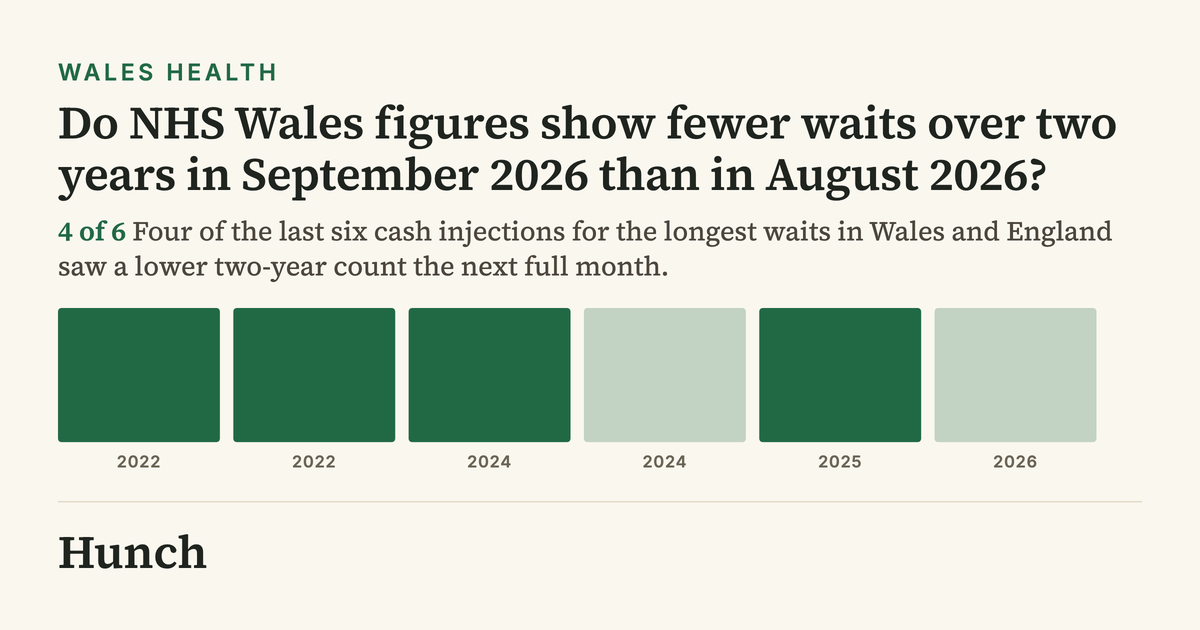
We looked at every time since 2022 when the Welsh Government, or the UK government for England, put a named sum or plan into the longest waits. We compared the number waiting more than two years in the last full month before the announcement with the first full month after it. Six rounds qualify, and all six are shown. Scotland and Northern Ireland publish these figures only every three months, so they are left out.
Show the other 4 cases
The Read
History leans towards a fall, but not cleanly. Four of six funding rounds were followed by fewer two-year waits in the first full month. The two that were not have something in common with today: the count was already rising when the money arrived. Between March and it went from just under 2,600 to just under 4,100, and the early July estimate points up again.
Two rules make this plan different from the six before it. Boards are paid for finished treatments, and the longest waiters go first unless a doctor says otherwise. That is the step most likely to move the two-year number, even if the total list keeps growing. The earlier Welsh money went mostly on buying capacity from outside the NHS, and the minister has said so.
The money cannot show up in the July figures, so our markets on the September release are about the trend, and the November one is about the plan. What would break the pattern is what broke it in 2024 and 2026: more patients referred than the extra work can treat. That would show first in the total list, which has now risen three months in a row.
Disclaimer
Hunch works only from sources that are publicly available, and publishes on the basis of analysis of that material. We do not form an editorial opinion or take sides, we give a simpler and wider view of news that already exists. If information in a source we used was inaccurate, distorted, or later disputed but had already entered our analysis, Hunch accepts no liability for that. Predictions are not advice. Phase 1 markets use Hunch Points, not money.
Published by Hunch under the Editorial Code. Complaints and corrections: /contact/.