Kimi Antonelli's F1 lead fell to 25 points. In four rule changes, the top team won.
Charles Leclerc won the British Grand Prix. Championship leader Kimi Antonelli, 19, had a wheel-shield failure and finished sixteenth.
What happened
Charles Leclerc won the British Grand Prix from George Russell and Lewis Hamilton as Antonelli’s wheel-shield failure dropped him to sixteenth, out of the points, and cut his championship lead to 25 points.
Charles Leclerc passed Kimi Antonelli, who started first, at the first corner and led the British Grand Prix from there. It was his ninth career win. The race ended behind the safety car after Max Verstappen spun into the gravel on lap 48.
On Saturday Antonelli’s lead was 43 points. The 19-year-old Mercedes driver won the sprint, a shorter Saturday race, ahead of Hamilton and Lando Norris. He became the youngest sprint winner in the sport’s history, and his lead over his teammate George Russell grew.
On Sunday a suspected failure of the left-front wheel shield on lap 41 forced two extra pit stops. With a five-second penalty for going beyond the track limits, he finished sixteenth, out of the points. Russell’s second place cut the gap to 25 points.
The 2026 rules brought new engines, active aerodynamics, where wings move during a lap, and 50% sustainable-fuel engines. The first season under them has so far belonged to Mercedes and its teenager. Antonelli is the youngest championship leader in F1 history, beating the previous record by almost three years. Two races remain before the summer break, at Spa-Francorchamps in Belgium on and the Hungaroring in Hungary on .
Sources: Formula1.com, Sky Sports
The Pattern
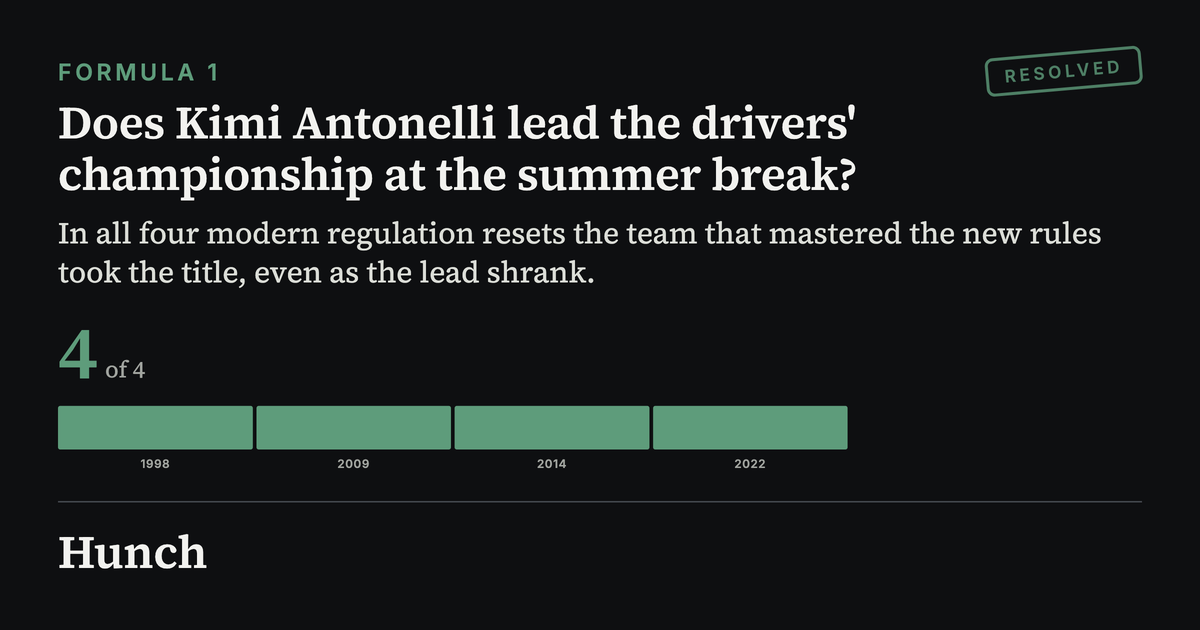
Formula 1 rewrites its rules roughly once every ten years. We looked at the four big rule changes since 1998 and asked one thing: was the driver whose team best understood the new rules still in front when the season ended, however far his lead fell on the way?
Show the other 2 cases
The Read
History says Silverstone changes little. Antonelli’s lead was built on five wins and the fastest car under the new rules, and a wheel-shield failure says nothing about speed. Even after scoring nothing he is 25 points ahead of Russell, with two races before the break. Russell must outscore him by more than a race win in a fortnight, in the same car. After all four earlier rule changes the early pace-setter became champion, and our market’s 74 per cent rests on that.
The threat is no longer only inside Mercedes. Ferrari finished first and third at Silverstone, which suggests upgrades are closing the gap that made the spring look easy. Antonelli is 19 and in his first title fight, and there is no record yet of how he handles pressure. Button’s 2009 season shows a lead under new rules can shrink to a handful of points. Button, though, was experienced and had no teammate scoring at Russell’s rate.
Belgium and Hungary will decide it. Two bad Sundays would start the break with a different name on top.
Disclaimer
Hunch works only from sources that are publicly available, and publishes on the basis of analysis of that material. We do not form an editorial opinion or take sides, we give a simpler and wider view of news that already exists. If information in a source we used was inaccurate, distorted, or later disputed but had already entered our analysis, Hunch accepts no liability for that. Predictions are not advice. Phase 1 markets use Hunch Points, not money.
Published by Hunch under the Editorial Code. Complaints and corrections: /contact/.