Tigst Assefa chases the marathon world record in Berlin. Will she take it back?
Ethiopia's Tigst Assefa runs the Berlin Marathon on Sunday 27 September. The women's world record is 2:09:56. Her own best is 2:11:53.
What happened
Tigst Assefa, who set a world record of 2:11:53 in Berlin in 2023, returns to the BMW Berlin Marathon on Sunday as the heavy favourite, aiming to run even faster.
Assefa won in Berlin in 2022 and 2023. Seven women in this year’s field have run under 2:20, but World Athletics calls Assefa the heavy favourite.
Before the race she said: “I am very well prepared and want to run a personal best.” Her last race was the London Marathon in April, which she won in 2:15:41, a world record for races with women only.
The world record is 2:09:56, set by Ruth Chepngetich in 2024. She ran it in Chicago. Chepngetich is now serving a three-year doping ban, but the record stands because it was set before the period the ban covers.
Sources: World Athletics, Al Jazeera
The Pattern
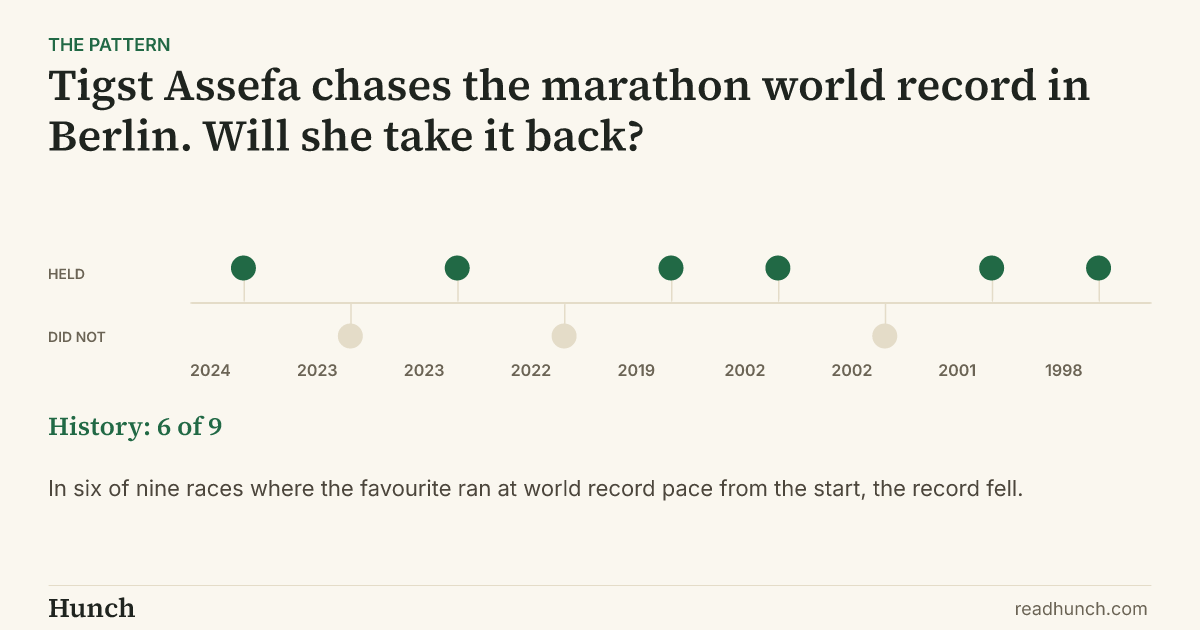
We looked for women’s marathons where the clear favourite did not hold the world record, had a slower best of her own, and ran at record pace from the start with male pacemakers, in cool weather. We found nine since 1998, and the record fell in six. Two more attempts, in London in 2018 and Chicago in 2021, were run in heat of 20 to 22C and both missed by more than eight minutes.
Show the other 7 cases
The Read
History points to a record. In six of the nine races the favourite ran at record pace from the start and broke it, by 19 seconds to more than two minutes. Assefa needs to run 1.5% faster than her best, which is less than most of those who succeeded improved.
There are reasons for doubt. Ruth Chepngetich appears three times in the nine races. Assefa has not run with male pacemakers since 2023; her two London wins were in women-only races. Before this race she spoke of a personal best, not the record.
Halfway will tell little. All three misses were still on record pace at halfway and lost it after 30 to 35km.
Disclaimer
Hunch works only from sources that are publicly available, and publishes on the basis of analysis of that material. We do not form an editorial opinion or take sides, we give a simpler and wider view of news that already exists. If information in a source we used was inaccurate, distorted, or later disputed but had already entered our analysis, Hunch accepts no liability for that. Predictions are not advice. Phase 1 markets use Hunch Points, not money.
Published by Hunch under the Editorial Code. Complaints and corrections: /contact/.