England drop cricketer Brydon Carse after a night out. Will he make the next squad?
The ECB, England's cricket board, dropped Brydon Carse for the Lord's Test on 24 August. It sent a night out in Derby to the Cricket Regulator.
What happened
The ECB confirms the Cricket Regulator will investigate events in Derby on Saturday night and makes Brydon Carse unavailable for the second Test while the investigation runs, with Sonny Baker taking his place.
The ECB referred the night out to the Cricket Regulator itself. Carse stays out while the investigation runs and the full facts are found. Footage had shown the bowler in handcuffs being led away by police outside a nightclub, after Durham’s players celebrated a County Championship win at Derbyshire.
Derbyshire Police said a man in his 30s was arrested on suspicion of being drunk and disorderly. The arrest was cancelled shortly afterwards, when he agreed to leave the area.
Carse was in the squad for the three-day win at Headingley but did not play, and was released to play for Durham, where he took two wickets and made 26. He was England’s leading wicket-taker in the 4-1 Ashes defeat and has not played for England since because of injury.
The second Test starts at Lord’s on Thursday . The third, at Edgbaston, starts on , sixteen days after the incident.
It is the second such case this summer. Ben Stokes and Gus Atkinson were left out of the second Test against New Zealand in June for breaking the team’s midnight curfew after the win at Lord’s. The ECB said neither would be considered until its investigation ended.
Both were back for the third Test at Trent Bridge. Stokes got a written warning from the ECB, and the Cricket Regulator found no case to answer. Joe Root, now Test captain, removed the curfew less than two weeks before the night in Derby.
Sources: ECB, Sky Sports, Guardian (2)
The Pattern
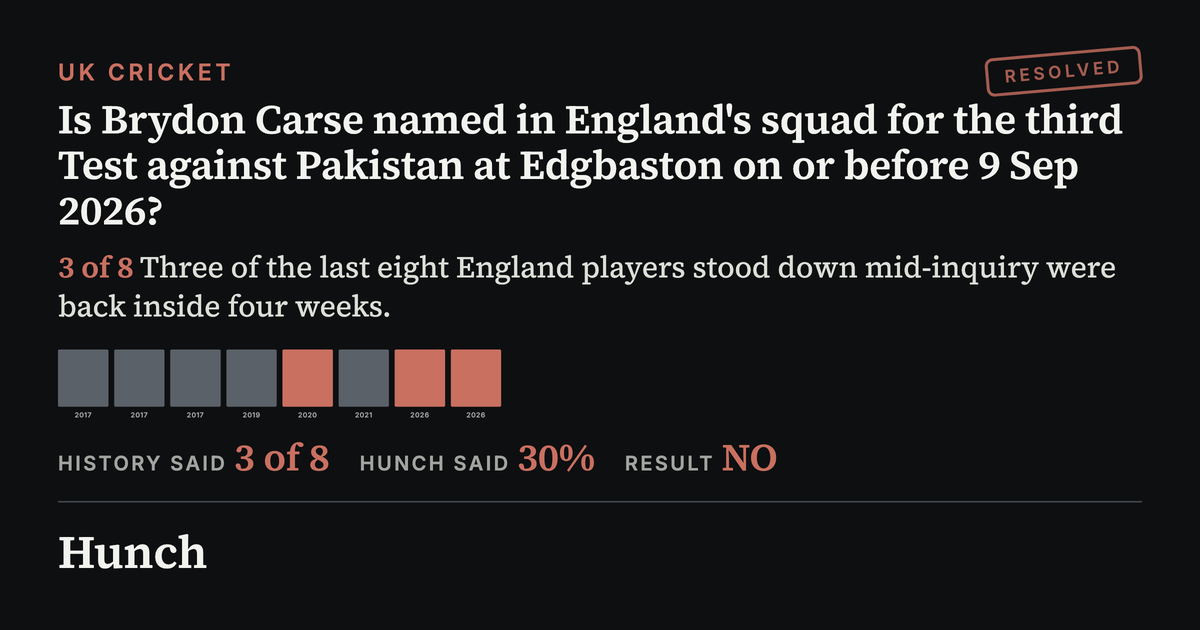
We looked at every time since 2017 that the ECB, as the players’ employer, took a player out of an England or England Lions squad while an inquiry into his conduct was still open. The inquiry could be the ECB’s own, the Cricket Discipline Commission’s, the Cricket Regulator’s or the police’s. Injuries, rest, normal selection and bans after a finished process are left out. We asked whether the player played for England, or the Lions, within four weeks. We found eight cases. Two pairs, Stokes and Hales in 2017 and Stokes and Atkinson in 2026, were single decisions.
Show the other 6 cases
The Read
History splits on one thing: who decides. Archer, Stokes and Atkinson broke team rules, faced an ECB hearing within days, took a fine or a warning and were back for the next Test. Robinson, Hales twice, Stokes in 2017 and Duckett each faced a process the ECB did not control, or a punishment that lasted past the next team selection. None of them returned within two months. Carse’s case has gone to the Cricket Regulator. It found no case against Stokes in June, but it decides separately and on its own timetable, which is why our first market sits below three in eight.
The case for a quick return is that the police part ended the same night. An arrest cancelled with no charge is closer to Archer’s position than to Stokes’ in 2017. If the regulator finds nothing to answer, there is no reason left to keep a fit fast bowler out of the last Test of the summer.
Watch the ECB news page more than the squad announcement. A clearance published in the first week of September would move our first market before the selectors do. A statement that the investigation continues would settle it the other way.
Disclaimer
Hunch works only from sources that are publicly available, and publishes on the basis of analysis of that material. We do not form an editorial opinion or take sides, we give a simpler and wider view of news that already exists. If information in a source we used was inaccurate, distorted, or later disputed but had already entered our analysis, Hunch accepts no liability for that. Predictions are not advice. Phase 1 markets use Hunch Points, not money.
Published by Hunch under the Editorial Code. Complaints and corrections: /contact/.