The Senate backs a college sports bill 77 to 22. The House waits until November.
The US Senate has passed a bill on pay and transfers for college athletes. The House has not voted and returns after the 3 November elections.
What happened
The Senate passed the Protect College Sports Act 77 to 22 on Monday night. The bill still has to pass the House, which is in recess until after the November elections.
The US Senate passed the Protect College Sports Act by 77 votes to 22 on Monday . Ted Cruz, a Republican, wrote the bill with Maria Cantwell, a Democrat. Donald Trump wrote after the vote: “This is a really big deal.” Cruz said: “President Trump is eager to sign this legislation.”
The bill sets national rules for college sport. Schools could pay players up to about $49m a year, up from about $21.5m under a 2025 court settlement. Players could change school once without penalty, and conferences could have no more than 20 schools. The NCAA, which runs college sport, would get limited protection from competition law to enforce these rules.
Senator Chris Murphy and all four Black Democratic senators voted against it. The NAACP, the Congressional Black Caucus and the AFL-CIO union group also oppose it, partly because it does not settle whether players are employees who can bargain as a union. ESPN reports that this question is a significant hurdle in the House.
The House has not voted. Over the last year it failed several times to bring its own college sports bill to a vote, and it is now away until after the elections. The House calendar has it sitting again from to . Speaker Mike Johnson’s office did not answer ESPN’s questions about the bill.
The stopgap funding bills passed this summer run only to early or mid December, so the House must also settle government funding in those weeks. The current Congress ends at noon on . A bill that has not passed both houses by then must start again.
Sources: The Guardian (2), ESPN, GovTrack, S. 4668, House calendar, US Constitution, 20th Amendment
The Pattern
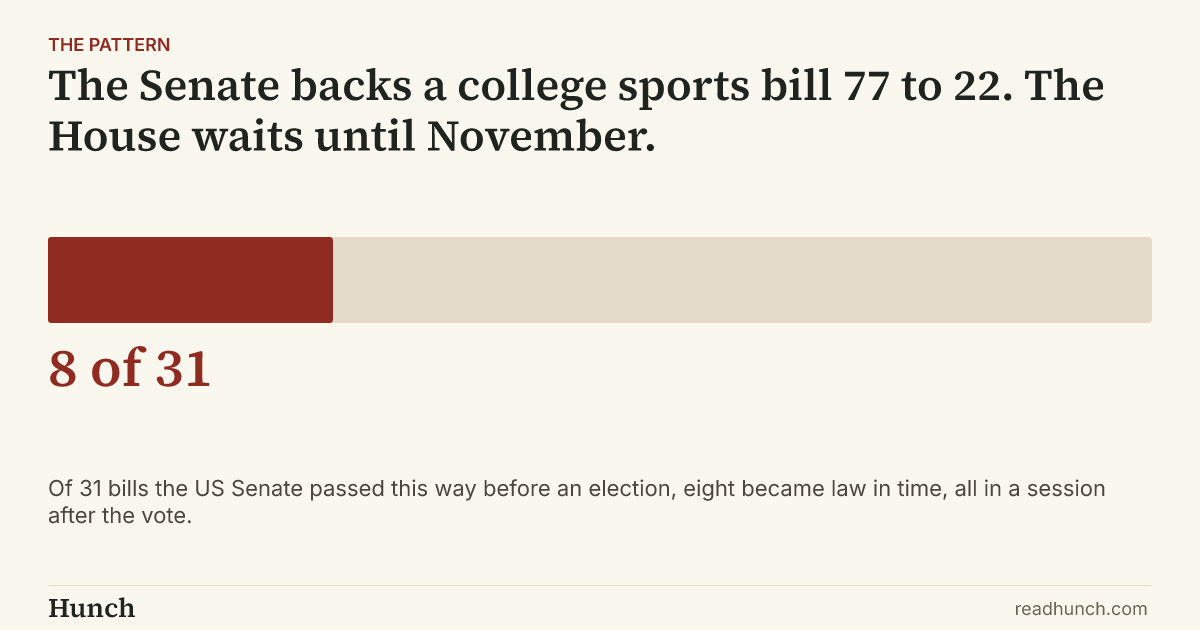
We looked for cases where the US Senate passed a bill between and election day, by at least two votes to one and with most members of both parties in favour, while the House had not passed it or its own version before the election. We found 31, from 1970 to 2000. Eight became law before that Congress ended. Below are the eight laws and two bills that died.
Show the other 8 cases
The Read
History is against the bill, but not by as much as it looks. Eight of 31 such bills became law in time. Every one of the eight passed in a House session held after the election. Without such a session the record is 0 of 13, and with one it is 8 of 18. This year the House calendar has a session from to .
The laws came late. The House’s final vote was in December in all eight, and the signatures came between and . Three of the eight became law inside a different bill: the House’s own bill with the Senate text put in, or a year-end budget law. Presidential support did not decide much. All five bills we studied closely had the President’s public support, and two became law.
The record has weak points. The 31 bills come from nine election years, and bills in the same year often shared one fate: all eight in 1972 died when Congress closed without a session after the election. There is no case after 2000. For nine bills from 1974 to 1984 we checked only whether the bill itself became law, not whether its text passed inside another law. We counted the 1970 family medicine bill, S. 3418, as not law, because the President blocked it at the end of that Congress.
Disclaimer
Hunch works only from sources that are publicly available, and publishes on the basis of analysis of that material. We do not form an editorial opinion or take sides, we give a simpler and wider view of news that already exists. If information in a source we used was inaccurate, distorted, or later disputed but had already entered our analysis, Hunch accepts no liability for that. Predictions are not advice. Phase 1 markets use Hunch Points, not money.
Published by Hunch under the Editorial Code. Complaints and corrections: /contact/.