JJ Gabriel, 15, asks to leave Manchester United. Will he join a new club by 16 Oct?
JJ Gabriel, 15, is in Manchester United's academy. He wants the club to cancel his registration, the record that ties him to United, and let him go.
What happened
On BBC Sport reported that JJ Gabriel, Manchester United’s 15-year-old striker, has sent the club formal notice that he wants his registration cancelled with immediate effect, a request United can challenge.
JJ Gabriel is a 15-year-old striker in Manchester United’s academy. A registration is the record that ties a young player to one club, and without it he is free to join another.
Gabriel was the Premier League’s Under-18 player of the year last season while still 14. Last week he scored a hat-trick on his Uefa Youth League debut, and he had been expected to play against Brighton in the Carabao Cup on Wednesday.
United can say no. Under Premier League youth rules, a registration can only be cancelled if the club, the player and a parent all agree. If they do not, the Premier League makes a decision both sides must accept. Gabriel’s registration runs to the end of the season. Chief executive Omar Berrada and director of football Jason Wilcox are talking directly to his family.
Gabriel turns 16 on . Until then he cannot sign a scholarship, the first contract for academy players, with any club. He cannot sign a professional contract until he is 17.
The club says it does not know what caused the break. Gabriel did not train with Michael Carrick’s squad at the end of last week, amid problems between his family and the club. He has told United he would rather leave than play for it again at any level.
He played eight minutes in pre-season, against Atletico Madrid on , while academy team-mates and an 18-year-old newcomer from Tottenham played more. He could have joined Manchester City in the summer of 2025. He stayed after United promised him a route to the first team.
Sources: BBC, Independent, Sky Sports, The Athletic
The Pattern
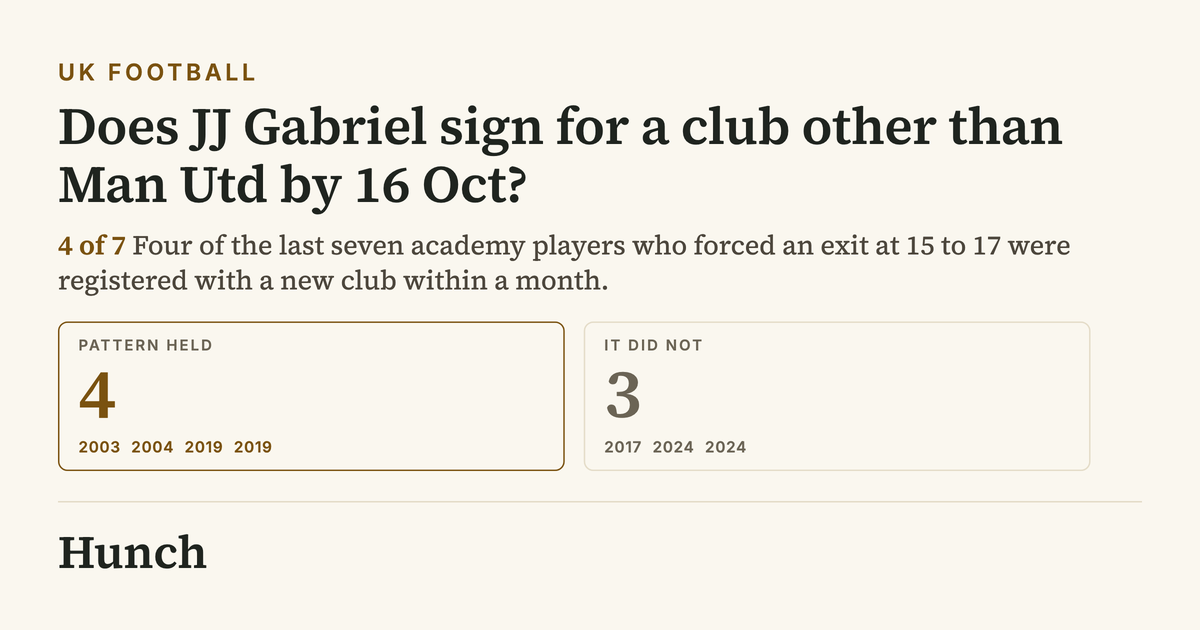
We found seven young players who forced their way out. All were aged 15 to 17 at top academies in England or Spain since 2003, and left against their club’s wishes by refusing a deal, sending a notice or walking out of a youth deal. We counted the days until a new club registered them. Four were at a new club within a month of the first news. The three English cases since 2017 took six to eleven weeks.
Show the other 5 cases
The Read
The notice puts pressure on United. A registration is what lets United hold Gabriel until June, and a formal request to cancel it forces a choice: agree, or take the case to the Premier League. On the player’s side are a family United says it cannot read, a pre-season of eight minutes while others played more, and clubs linked with him, Manchester City and Arsenal among them. On United’s side are a Carabao Cup tie on Wednesday that was meant to be his debut, and Berrada and Wilcox, who talked him into staying in 2025. Nobody can sign him to a scholarship before .
History says four in seven, but this case is harder. In the four quick moves, the news and the signing came together, or the boy’s old deal had already ended. Gabriel’s has not, and United can fight it. The three English cases since 2017 that look most like his, a refused deal made public before a new club could register the player, took 42, 57 and 78 days. Rio Ngumoha is the closest: news in July, no signing until his 16th birthday, registered about a week after it. Gabriel turns 16 on , ten days before this question closes.
The other way this ends is a deal to stay, which Chelsea could not get. United has not given up, both executives are talking to the family, and a Carabao Cup debut would change the mood. A move by fails if United refuses and the Premier League takes more than a month to decide, which is normal. A move by December fails if the League sides with United and Gabriel stays registered until June. None of the seven cases ended that way, but none of them had a club refusing to release a player still under registration.
Sources: BBC, Sky Sports, The Athletic
Disclaimer
Hunch works only from sources that are publicly available, and publishes on the basis of analysis of that material. We do not form an editorial opinion or take sides, we give a simpler and wider view of news that already exists. If information in a source we used was inaccurate, distorted, or later disputed but had already entered our analysis, Hunch accepts no liability for that. Predictions are not advice. Phase 1 markets use Hunch Points, not money.
Published by Hunch under the Editorial Code. Complaints and corrections: /contact/.