Elena Rybakina is tennis world No 1. Since 2019 most new No 1s lasted four weeks.
Elena Rybakina becomes the women's tennis world No.1 on Monday, ending Aryna Sabalenka's 99-week reign. The two meet in the US Open final.
What happened
A day after her quarter-final win confirmed she will become world No.1, Elena Rybakina recovered from a set down to beat Coco Gauff 3-6 6-4 6-4 in the US Open semi-finals and set up a title match with the outgoing No.1, Aryna Sabalenka, on Saturday .
The US Open final on Saturday is the fourth Grand Slam final of Rybakina’s career and her first in New York. It was the second time in a month that she beat Coco Gauff after losing the first set, after their Canadian Open match in August.
Rybakina becomes world No 1 on Monday . The WTA, which runs the women’s tour, announced it on . She is the 30th woman to reach the top and the first player, man or woman, from Kazakhstan.
She takes the top spot from Sabalenka, who has led the rankings without a break since . That run of 99 weeks is the sixth longest in the tour’s history. Changes at the top are rare: this is the first since 2024 and only the ninth since the start of 2019.
The next four weeks are busy. The Singapore Tennis Open, a WTA 500 event, starts on . The China Open in Beijing, a WTA 1000 event with 96 players, starts on , and both Sabalenka and Rybakina have entered. Beijing is one of the biggest chances of the year to win or lose ranking points, and it falls inside the four weeks this Echo looks at.
Sources: WTA (2, 3), Guardian, BBC
The Pattern
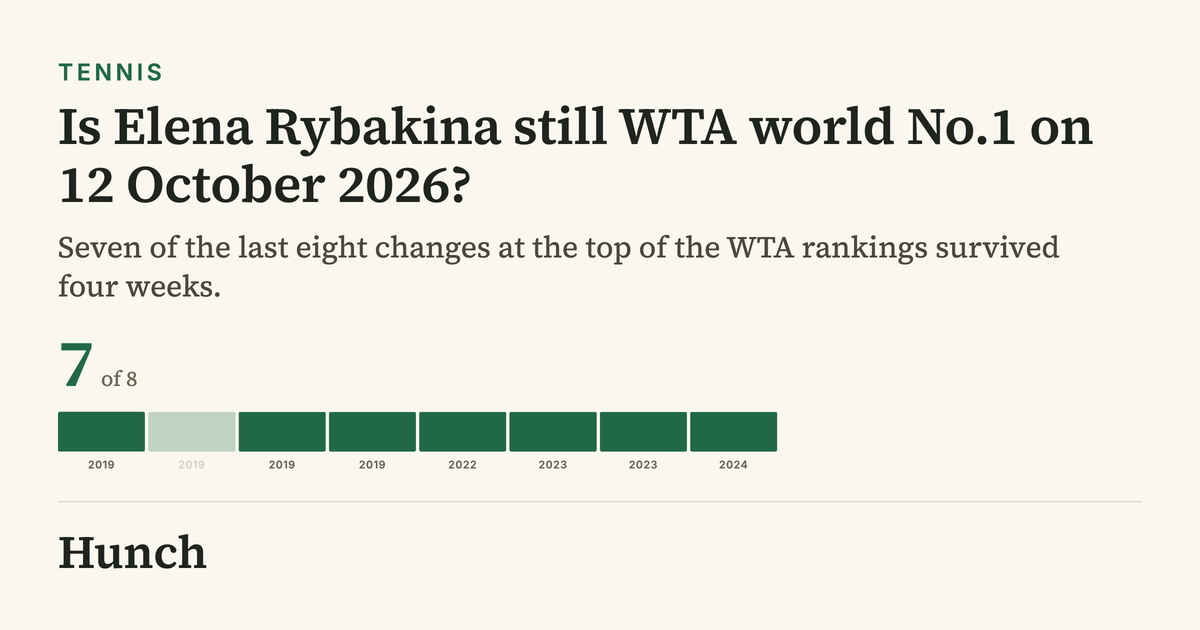
Since the women’s No 1 has changed eight times. For each change we checked whether the new No 1 was still top in the rankings published four weeks later. Here are all eight, newest first.
Show the other 6 cases
The Read
History says the new No 1 usually stays. Seven of the eight changes since 2019 were still in place four weeks later, and four of them lasted a year or more. Rybakina’s move to the top is also already confirmed: the WTA announced it after her quarter-final, so Saturday’s final changes the gap between the two players but not who is first on Monday.
The warning is 2019, when the top spot changed hands three times in eleven weeks and Osaka’s second spell lasted exactly four weeks. Only one WTA 1000 event falls inside this window, but Sabalenka has entered it. Rybakina has also been managing a left ankle problem since she stopped during her Cincinnati quarter-final last month.
The ranking forecast fails if Sabalenka wins in New York and then goes deep in Beijing while Rybakina loses early. The three-set market fails if either player’s serve dominates the final, as Rybakina’s did against Osaka in the fourth round.
Disclaimer
Hunch works only from sources that are publicly available, and publishes on the basis of analysis of that material. We do not form an editorial opinion or take sides, we give a simpler and wider view of news that already exists. If information in a source we used was inaccurate, distorted, or later disputed but had already entered our analysis, Hunch accepts no liability for that. Predictions are not advice. Phase 1 markets use Hunch Points, not money.
Published by Hunch under the Editorial Code. Complaints and corrections: /contact/.