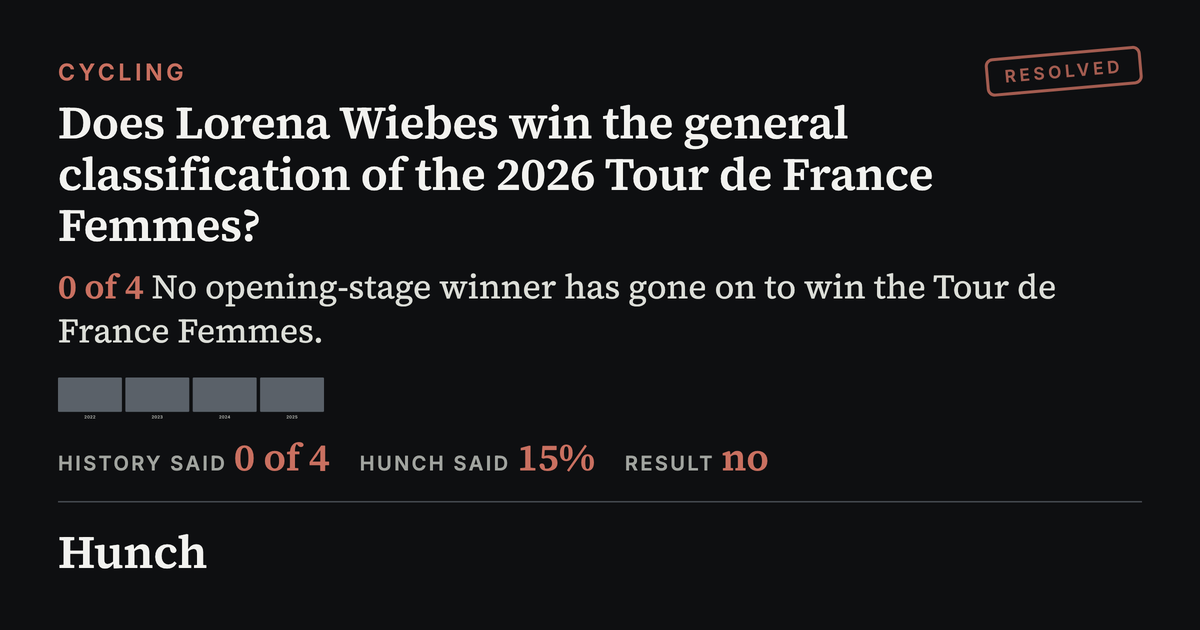
Lorena Wiebes wins stage 1 of the women's Tour. No stage 1 winner has won it yet.
Lorena Wiebes beat Kim Le Court in an uphill sprint in Lausanne on 1 August to take the first yellow jersey of the 2026 Tour de France Femmes.
What happened
Lorena Wiebes won the opening stage of the Tour de France Femmes in Lausanne, beating Kim Le Court and Demi Vollering in an uphill sprint to take the race’s first yellow jersey.
Lorena Wiebes leads the race by 4 seconds after stage 1. The Dutch rider (SD Worx–Protime) won the 138km stage in Lausanne on , her tenth Tour stage win, and took the yellow jersey worn by the race leader.
With time bonuses, seconds taken off for finishing near the front, she leads Kim Le Court (AG Insurance–Soudal) by 4 seconds and Demi Vollering (FDJ–Suez) by 6 seconds overall.
It was not a normal bunch sprint. The last climb, the Côte Saint-François, is 2.6km at 4.6%, and only ten riders finished in the same time as Wiebes. There were crashes, and Laura Tomasi became the first rider to leave the race.
The surprise was that a pure sprinter beat the riders chasing the overall title on a short, steep finish. The signal for the overall race is that two of those riders, Le Court and Vollering, took the other bonus seconds.
The race ends in Nice on , and the route leaves a sprinter little room to keep yellow. Nine stages cover 1,175km with close to 19,000m of climbing. There is an individual time trial, the race’s first climb of Mont Ventoux on stage 7, and a last-day circuit over the Col d’Èze that finishes on the Promenade des Anglais.
The field has every living winner of the race: defending champion Pauline Ferrand-Prévot (Visma–Lease a Bike), 2023 winner Vollering and 2024 winner Katarzyna Niewiadoma. Le Court and Puck Pieterse, fourth in Lausanne, are also riding.
Sources: The Guardian, BBC, letour.fr official route
The Pattern
No first-stage winner has won the women’s Tour since 2022. The Tour de France Femmes has had four editions since it restarted that year. Each opened with a stage winner in yellow, and each time someone else won in the end. What happened to that rider depended on the kind of first stage.
Show the other 2 cases
The Read
History treats Lausanne as a sprint result. In all four editions, the first stage did not pick the winner. In the two that opened with a flat sprint, a rider like Wiebes dropped out of the fight for the title at the first big climb. The real signal from stage 1 is behind her. Le Court and Vollering took bonus seconds on a finish that suited climbers, while Ferrand-Prévot and Niewiadoma took none. The 34% on Vollering reflects two second places since her 2023 win and a route, with Ventoux and a time trial, that suits her better than anyone. Ferrand-Prévot’s 27% reflects her title defence and a mixed 2026 season.
The record is thin, only four editions, and this race has been won by 4 seconds before. In 2024 the bonus seconds from the first week decided the winner, so Lausanne’s 10, 6 and 4 seconds could still decide the podium in Nice. History also says nothing about which climber wins. A win from a breakaway, or a Ferrand-Prévot peak timed like last year’s, would upset the Vollering price without going against the history.
Mont Ventoux on stage 7 should answer most of the question. If Wiebes is still close to the lead after it, history is wrong this time.
Disclaimer
Hunch works only from sources that are publicly available, and publishes on the basis of analysis of that material. We do not form an editorial opinion or take sides, we give a simpler and wider view of news that already exists. If information in a source we used was inaccurate, distorted, or later disputed but had already entered our analysis, Hunch accepts no liability for that. Predictions are not advice. Phase 1 markets use Hunch Points, not money.
Published by Hunch under the Editorial Code. Complaints and corrections: /contact/.