UK AI testers sign a Microsoft deal. Few such deals since 2023 led to public tests.
The UK's AI Security Institute has agreed a partnership with Microsoft to test high-risk AI abilities and check the safeguards around them.
What happened
AISI announced a partnership with Microsoft to develop methods for evaluating high-risk AI capabilities and the effectiveness of safeguards, plus research into how conversational AI behaves in sensitive contexts.
On the AI Security Institute announced a deal with Microsoft. The institute (AISI) is the UK government body that tests the most advanced AI models. Together they will develop better ways to test dangerous AI abilities and to check whether the safeguards against them work. The deal also covers research on how society copes with AI, including how chatbots deal with users in sensitive situations.
The deal adds to a line of formal access deals with AI labs that began at the Bletchley summit in 2023. The line survived the institute’s change of name in , from Safety to Security, when the government narrowed its work to risks with security implications.
Microsoft is an unusual partner. It does not mainly build the most advanced models. It is the company that puts OpenAI’s models into Azure, Copilot and business software. That puts the focus of the work on whether safeguards work, more than on raw ability.
The deal came in a tense fortnight for the institute’s own research. AISI estimates that the length of cyber tasks AI can complete on its own is doubling every 4.7 months, much faster than its estimate of 8 months, and recent models are ahead even of that trend. The question every such deal has faced is whether access leads to published test results, and how fast.
The Pattern
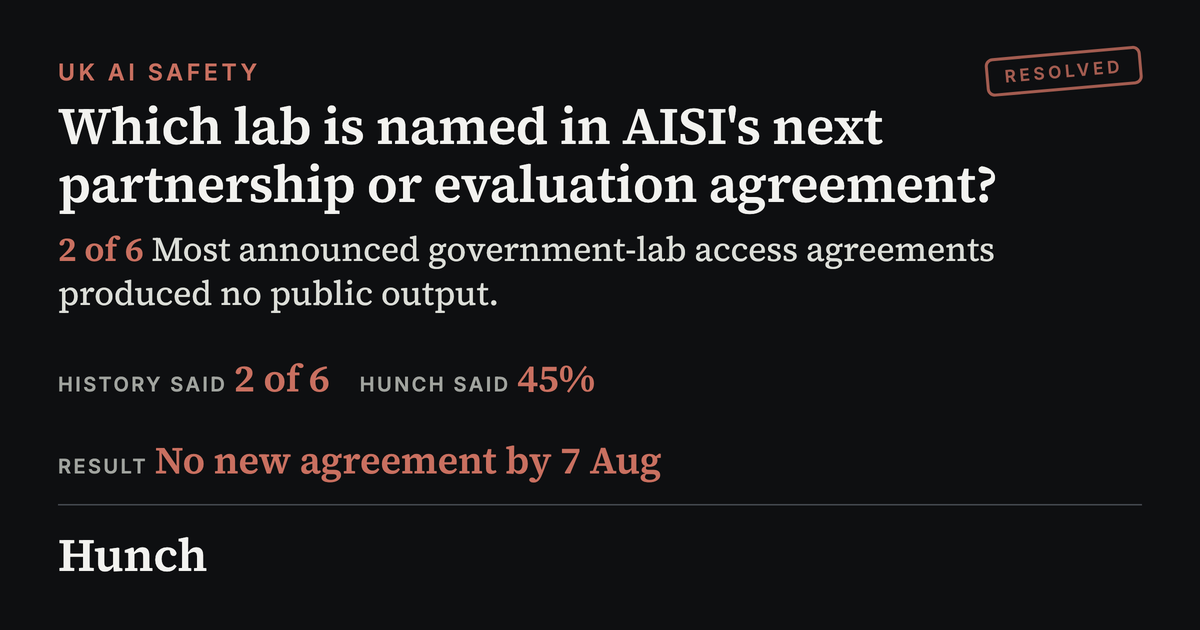
Few of these deals led to test results made public. Since the Bletchley summit in 2023, governments and leading AI labs have announced a steady run of testing deals and partnerships. We looked at how many led to a test of a model, made public, before the model’s release. About two of six did. The joint UK and US tests delivered, while several promises made at Bletchley produced nothing public.
Show the other 2 cases
The Read
History gives a fair chance of new published work soon, but not a strong one. AISI publishes research at a steady pace, and its cyber work shows an institute under pressure to prove it matters as AI improves. On its recent pace, a five-week window that catches a study on a named model is close to a coin flip. On a new partnership, history argues for patience. Deals like this come around summits and Budgets, and none falls inside the window. That is why ‘no new agreement’ has the largest share.
The doubts run both ways. Against published work: since the 2025 change of name AISI publishes less, and the most sensitive tests, exactly the ones a Microsoft deal allows, are the least likely to appear within weeks. For a surprise: AISI’s own 4.7-month doubling figure is a reason to hurry that ministers have already used. A government that wants to look ahead of events before the summer break has one clear option, to announce the next lab deal early.
Disclaimer
Hunch works only from sources that are publicly available, and publishes on the basis of analysis of that material. We do not form an editorial opinion or take sides, we give a simpler and wider view of news that already exists. If information in a source we used was inaccurate, distorted, or later disputed but had already entered our analysis, Hunch accepts no liability for that. Predictions are not advice. Phase 1 markets use Hunch Points, not money.
Published by Hunch under the Editorial Code. Complaints and corrections: /contact/.