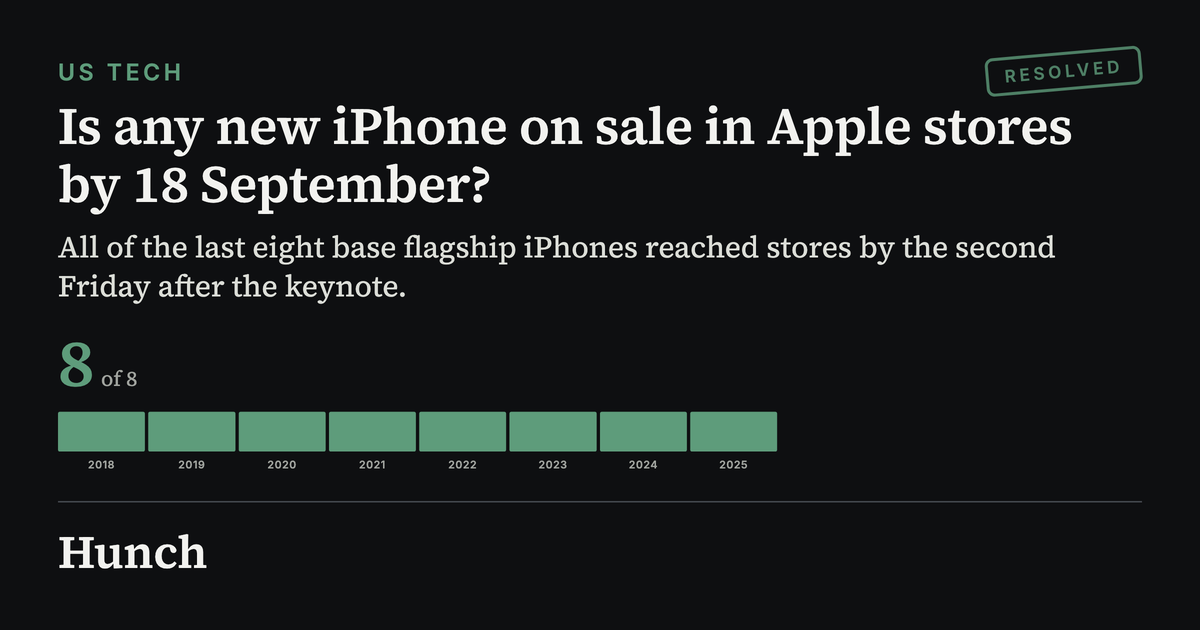
New iPhones on 9 September. Since 2018 the main model reached shops within 11 days.
Apple invited the press to Apple Park on 9 September under the line 'Surprise and shine'. It is the first launch under chief executive John Ternus.
What happened
Apple set as the date of its next iPhone launch event, the first major product event under new chief executive John Ternus; Bloomberg reported the same day that a first foldable iPhone is expected alongside the iPhone 18 Pro.
Apple shows its new iPhones on Wednesday . The invitations went out on for an event at Apple Park, streamed live from 10am Pacific time. It is the first big product event under chief executive John Ternus. Bloomberg reported that Apple would use it to show its first folding iPhone and the iPhone 18 Pro, and possibly new Apple Watches and a new Apple TV.
What happens after the event is easier to predict. Last year Apple announced the iPhone 17 on Tuesday , took orders from Friday and put the phone in stores on Friday . The phone reached stores on the second Friday after the event in every year from 2018 to 2024 as well. For an event on Wednesday , that Friday is .
New shapes of phone are where this timing has broken before. In 2022 the larger iPhone 14 Plus reached stores three weeks after the other models, and in 2020 the whole range moved to an October event. A folding phone is a bigger change than either.
Sources: Reuters, Bloomberg, Apple (2, 3, 4, 5)
The Pattern
The last eight iPhone launches all reached stores in time. We looked at fourteen launches since 2012, using Apple’s own press releases. For each we measured the days between the event and the day the main new model was in Apple stores. The test was the second Friday after the event, at most eleven days later. Thirteen of the fourteen made it.
Show the other 6 cases
The Read
History says whatever Apple announces on will be in stores on , the second Friday. That happened every year since 2018, and in thirteen of fourteen years since 2012. The invitations are already out. The first market opens at 80 because the one miss, in 2015, was an ordinary yearly update with no clear cause.
The foldable questions go against the record. The new shapes in the record, the X in 2017, the XR in 2018, the 12 mini in 2020 and the 14 Plus in 2022, all missed the second Friday by weeks. Bloomberg’s reporting gives the foldable a place on stage, and a new chief executive may still choose to ship everything at once. But the foldable reaches pre-order or stores in time only if Apple breaks its own habit of holding back the unfamiliar model.
Disclaimer
Hunch works only from sources that are publicly available, and publishes on the basis of analysis of that material. We do not form an editorial opinion or take sides, we give a simpler and wider view of news that already exists. If information in a source we used was inaccurate, distorted, or later disputed but had already entered our analysis, Hunch accepts no liability for that. Predictions are not advice. Phase 1 markets use Hunch Points, not money.
Published by Hunch under the Editorial Code. Complaints and corrections: /contact/.