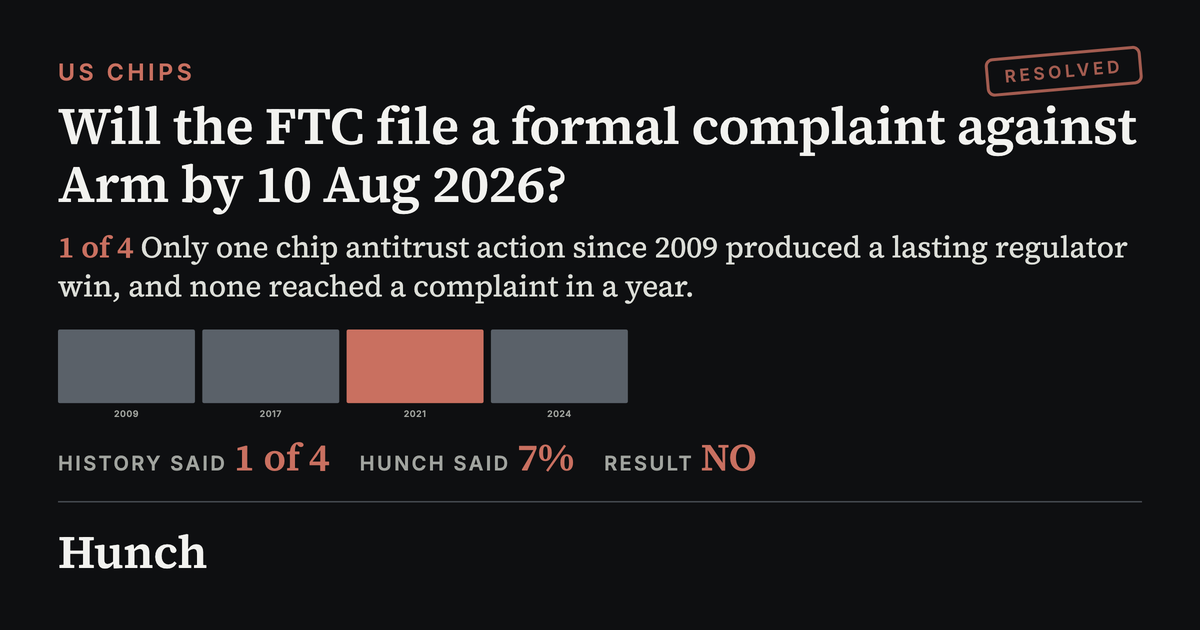
US probes Arm's chip licences. Since 2009 none became a complaint within a year.
The US Federal Trade Commission is investigating whether the way Arm licenses its chip designs is an attempt to build a monopoly.
What happened
Arm faces a US antitrust probe over the licensing of its chip technology, with the FTC examining whether the company is trying to monopolise parts of the semiconductor market.
The US competition regulator is looking into how Arm sells licences. Bloomberg reported on that the Federal Trade Commission (FTC) is checking whether Arm, which is based in the UK, would refuse licences, or offer worse ones, for the processor (CPU) designs its customers depend on, while it pushes into making its own chips.
The probe touches an obvious conflict. In March, chief executive Rene Haas showed the AGI CPU, Arm’s first flagship processor for data centres, at the company’s ‘Arm Everywhere’ event. He told investors that by 2031 the chip line could bring in six times the roughly $4 billion Arm earned in 2025. The shares jumped 16 per cent that day, and analysts called it the biggest change in the company’s history.
That change is what worries Arm’s customers. Arm built its business on selling neutral designs to everyone, including Apple, Qualcomm, Nvidia and Amazon. An Arm that makes its own chips competes with its own customers. The company already fought one licensing battle, with Qualcomm, and a Delaware jury largely sided with Qualcomm in . The FTC inquiry is at an early stage and may not lead to a formal case.
The Pattern
Competition cases against chip companies move slowly. We looked at four big cases against chip firms since 2009. Years passed between the first probe and a formal complaint. When complaints came, they were as likely to be overturned on appeal as to stick.
Show the other 2 cases
The Read
History says the probe changes little before the autumn. Probes of chip firms have taken one to three years to become formal complaints, when they did at all, and the Nvidia probe has had no case for over a year. In the short term the live question is Arm’s own business. The company told investors to expect about $1.18bn in revenue for the January-to-March quarter and has beaten the middle of its own forecast in most quarters since it listed. So the earnings market carries the real near-term signal.
The case against is that Arm is an easier target than Qualcomm ever was. Its designs sit inside an estimated 99 per cent of smartphones. The Delaware trial it lost to Qualcomm left evidence about its licensing on the public record. And the AGI CPU gives the FTC a simple story: a supplier with a monopoly starting to compete with customers who cannot easily leave. A probe with a clear story and evidence already gathered can move faster than past cases, and even a formal complaint within months would quickly change how investors value Arm’s licensing business.
Disclaimer
Hunch works only from sources that are publicly available, and publishes on the basis of analysis of that material. We do not form an editorial opinion or take sides, we give a simpler and wider view of news that already exists. If information in a source we used was inaccurate, distorted, or later disputed but had already entered our analysis, Hunch accepts no liability for that. Predictions are not advice. Phase 1 markets use Hunch Points, not money.
Published by Hunch under the Editorial Code. Complaints and corrections: /contact/.