Hackers sent a threat to Asos through its own app. Will it confirm a data theft?
Asos app users got a message on 6 October from hackers who say they took the company's data. Asos says names and contact details may have been seen.
What happened
Asos app users received a push notification from hackers: “Dear ASOS DPO and IT, we have fully compromised the Snowflake instance. Engage with us, or we will leak it.”
Asos app users received a message on their phones on from people who say they have hacked the online fashion retailer. It read: “Dear ASOS DPO and IT, we have fully compromised the Snowflake instance. Engage with us, or we will leak it”. Snowflake is a company that stores data online for many firms.
The message linked to the Telegram channel of a new group calling itself Xuanye Group, created the same day. Its posts say customer data is “safe on our server” and will not be touched for a set period.
Asos says it is investigating unauthorised activity on outside platforms it uses to message customers. It says names and contact details may have been accessed, but it does not believe card details or passwords were. Its shares fell more than 14% and were later about 11% down.
Asos publishes its results for the year on .
Sources: BBC, The Guardian, Asos
The Pattern
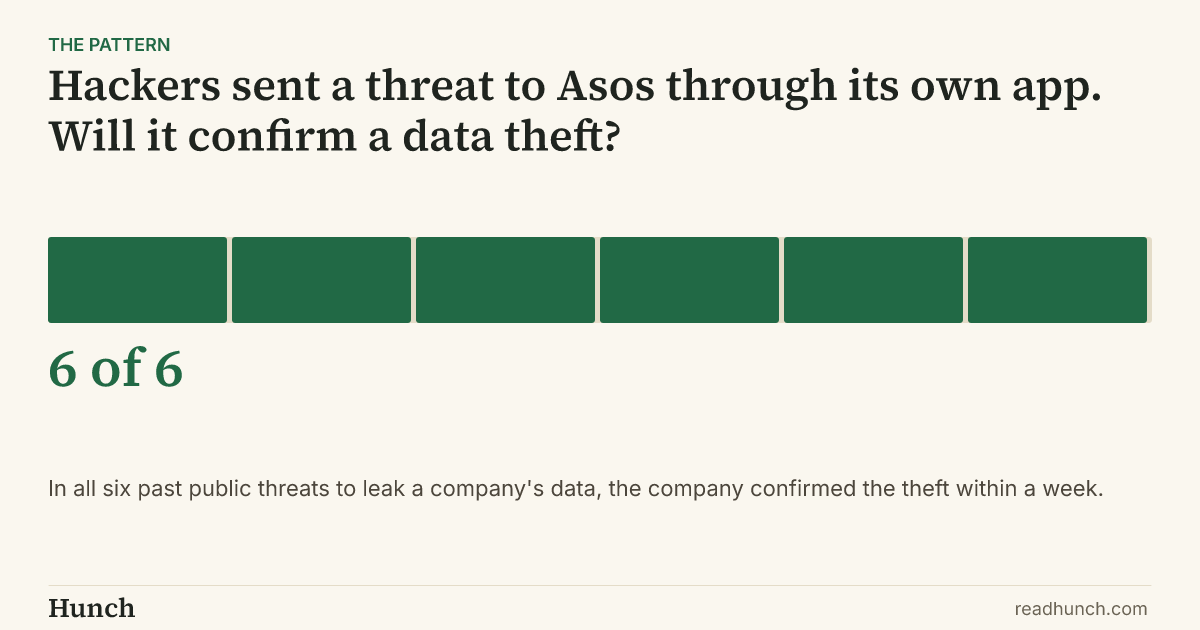
We looked for cases where hackers publicly threatened to leak a company’s data while the company had not yet confirmed any theft. We found six such threats from 2015 to 2025 in BBC News and Guardian reports. All six companies confirmed the theft within a week, and in three the hackers posted the data within a month.
Show the other 4 cases
The Read
Companies in this list did not stay quiet for long. All six confirmed the theft, within 0 to 7 days. The two that took longest, five and seven days, spoke after the hackers had already put data on their own website.
There are reasons for doubt. Hackers threaten companies every week, and BBC News and The Guardian write about the loud ones. Three of the six were outside the UK. Asos has already said more than most of them did at this point: names and contact details may have been accessed. That is still not a statement that data was stolen.
Posting the data is a closer question. Hackers posted it within a month three times, after 1, 21 and 30 days. In Australia in 2022, posting began two days after the insurer said it would not pay. Asos has not said whether it will pay.
Sources: BBC, The Guardian (2, 3)
Disclaimer
Hunch works only from sources that are publicly available, and publishes on the basis of analysis of that material. We do not form an editorial opinion or take sides, we give a simpler and wider view of news that already exists. If information in a source we used was inaccurate, distorted, or later disputed but had already entered our analysis, Hunch accepts no liability for that. Predictions are not advice. Phase 1 markets use Hunch Points, not money.
Published by Hunch under the Editorial Code. Complaints and corrections: /contact/.