BT is buying TalkTalk to save it. Will Lisa Nandy approve without a long inquiry?
BT agreed on 5 October to buy TalkTalk, which was close to collapse. Culture Secretary Lisa Nandy says she will make the final decision on the deal.
What happened
Lisa Nandy issued a public interest notice on BT’s purchase of TalkTalk and asked the Competition and Markets Authority to report to her by .
BT agreed on to buy TalkTalk out of administration, the process for a company that cannot pay its debts. BT says the deal will cost it about £400m, including £100m TalkTalk owes BT’s Openreach network. TalkTalk has 1.5 million home customers and about one million business customers through its PXC arm.
The same day, Culture Secretary Lisa Nandy used the Enterprise Act 2002 to take the final decision for herself. The Competition and Markets Authority (CMA), the UK competition watchdog, must report to her by . She can then approve the deal, approve it with conditions or send it for a longer inquiry.
The notice will allow the Secretary of State to consider the wider public interest once the CMA has reported on competition concerns.
Department for Culture, Media and Sport,
Nandy said a TalkTalk failure would put hospitals, schools and emergency care at risk: “These are unprecedented circumstances that require action now.” The government will also ask Parliament to add a new reason for stepping into deals: keeping phone and broadband services running.
Rivals are against the deal. BT has 32.5% of UK broadband customers and TalkTalk 6.6%, according to Opensignal. Virgin Media O2 called it “a stitch-up masked as a rescue deal in the public interest”. BT says it was “the only viable option” to keep TalkTalk going.
Sources: GOV.UK, BBC, The Guardian
The Pattern
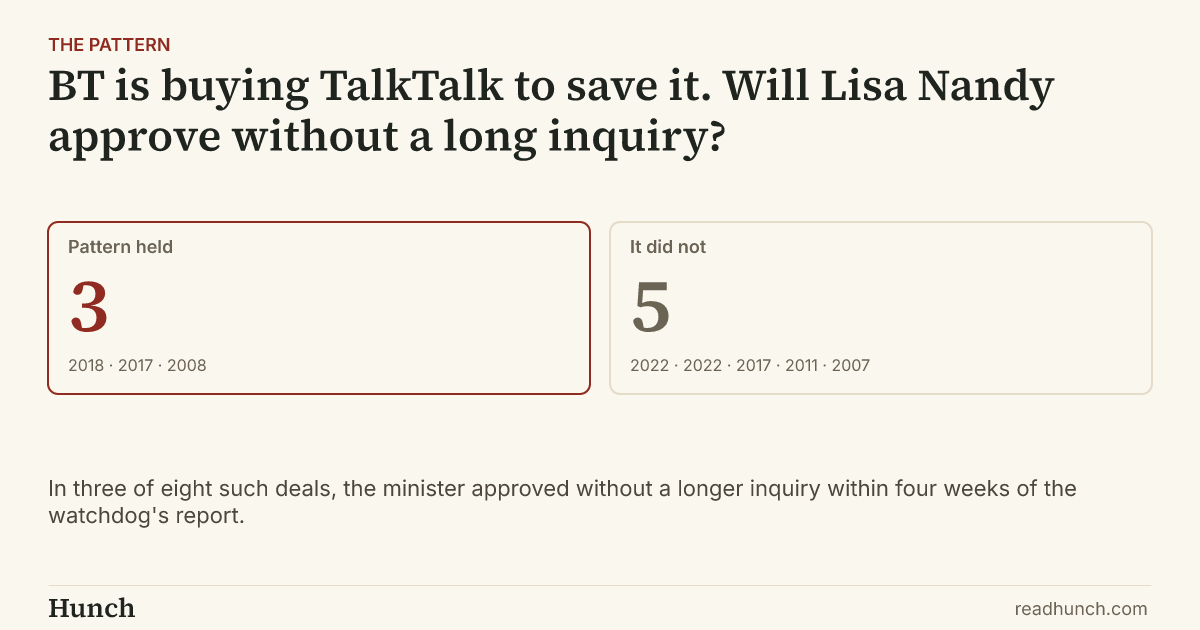
We looked for cases where a UK minister took a merger decision away from the competition watchdog on public interest grounds, and the watchdog named a market where both companies worked. We found eight since 2007 among 21 such interventions on gov.uk. Each was a different deal, and two of them involved Sky.
Show the other 6 cases
The Read
Six of the eight past deals were allowed in some form, but only three were approved without a longer inquiry inside four weeks of the watchdog’s report. The closest match is Lloyds TSB buying HBOS in 2008: the bank being bought was failing, the government added a new legal reason to step in, and approval came in seven days despite a warning about competition.
There are reasons for doubt. Every earlier deal was decided on finance, media or national security grounds, never on keeping phone lines running, because that reason is new. BT is also the biggest buyer of the eight, and in 2022 two deals that needed promises from the buyer took four and six months. The watchdog’s report due on comes first.
Disclaimer
Hunch works only from sources that are publicly available, and publishes on the basis of analysis of that material. We do not form an editorial opinion or take sides, we give a simpler and wider view of news that already exists. If information in a source we used was inaccurate, distorted, or later disputed but had already entered our analysis, Hunch accepts no liability for that. Predictions are not advice. Phase 1 markets use Hunch Points, not money.
Published by Hunch under the Editorial Code. Complaints and corrections: /contact/.