California's under-16s lose autoplay on 1 January unless a judge pauses the law.
Google, Meta and TikTok sued California on 4 November to stop a law that bans personal feeds and autoplay for children under 16.
What happened
Google, Meta and TikTok have sued California to block a law that bans features such as autoplay for children under 16. The law takes effect on unless a judge puts it on hold.
On Google, Meta and TikTok each sued California to stop a new law on children’s apps. The law, Assembly Bill 1709, bans platforms from giving children under 16 features that can lead to compulsive use, such as personal recommendations and autoplay, which starts the next video without a click. It also says children’s accounts with those features must be deleted.
The law takes effect on , unless a judge voids it or puts it on hold.
The Guardian,
The companies say the law breaks free speech protections in the US constitution. They also say it breaks Section 230, a federal law that protects platforms from blame for what their users post. Each company asks the court to stop the law only for its own services, not for every platform.
Rob Bonta, California’s attorney general, is the only person the companies are suing. His office said on that it was reviewing the lawsuits and is “committed to defending California’s commonsense laws to protect kids online”. Governor Gavin Newsom signed the law on .
If no judge acts by , the law starts the next day. From then the three companies must switch off personal recommendations and autoplay for children under 16 in California, or delete those children’s accounts. On Google asked the court for a quick order to stop the law, and Meta’s court papers show an entry for the same kind of order. The state must answer Google by . On no hearing date was set.
Sources: The Guardian, US District Court (2, 3, 4), Governor of California, US District Court (2)
The Pattern
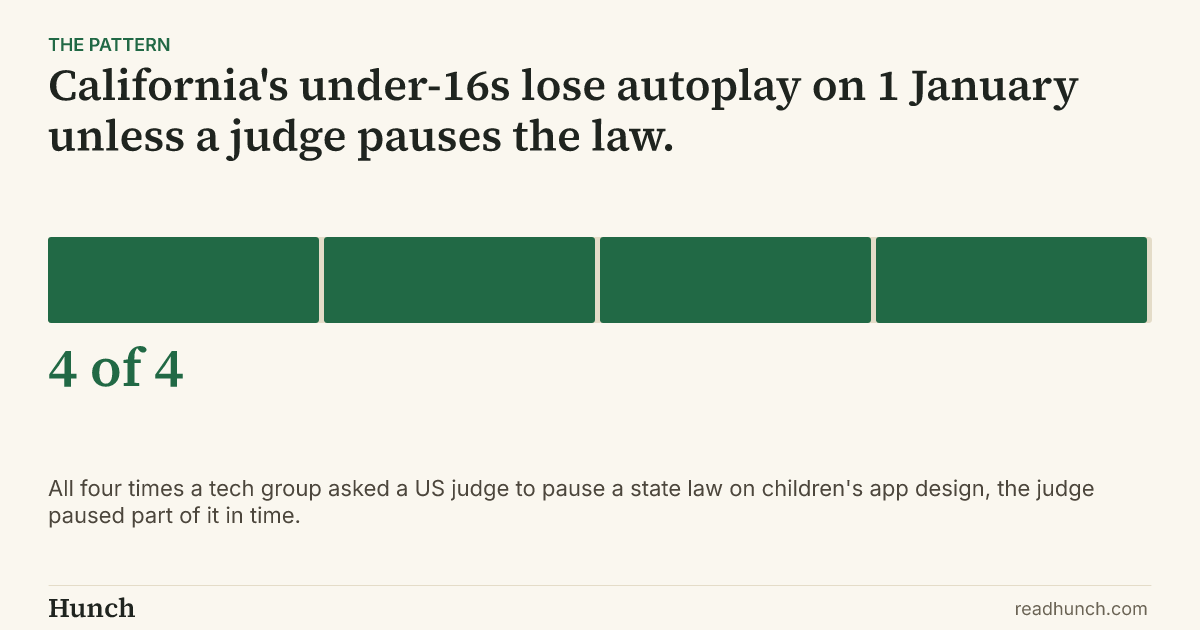
We looked for cases where a group of tech companies asked a US federal court to pause a state law on how online services work for children, at least 14 days before the law started. We found four since 2022, in California, Utah and Arkansas. Each time we checked whether the court paused at least part of the law before its first day.
Show the other 2 cases
The Read
All four earlier requests came from NetChoice, an industry group, and not from the companies themselves. In the US appeals court for California ruled that the group could not fight the feed rules for its members without them taking part. So the companies now sue alone, and they have tried that once already. On Judge Edward J. Davila refused to pause California’s earlier feed law for Meta, TikTok and YouTube, ruling that they “have not shown that their personalized feeds convey an expressive message or reflect human editorial judgment”. On the state asked the court to give the Google and Meta lawsuits to Judge Davila too. He decides that request himself. TikTok’s lawsuit is in a different court in Los Angeles.
There are reasons the companies could still win part of it. The new law also covers autoplay and deleting accounts, which the earlier law did not, and the companies now also rely on Section 230, which the August ruling did not decide. Google’s request for a quick order starts with Section 230 and accepts that its free speech argument on feeds goes against the August ruling. In the appeals court applied Section 230 to Facebook’s recommendations, though two of its judges asked the full court to look again at that reading. In a federal court in San Jose used Section 230 to pause part of another California law, on online marketplaces. One paused part for one company is enough to stop the law in part.
Time is the hard part. The August ruling came about nine months after YouTube sued. This time the law starts on a fixed day, and the rules of the San Jose court put a normal hearing on Google’s request no earlier than about . In California in 2024 NetChoice sued about seven weeks before the start, close to the eight weeks now, and the judge ruled one day before that start.
Sources: US Court of Appeals (2), US District Court (2, 3), US District Court (2), US District Court, The Guardian
Disclaimer
Hunch works only from sources that are publicly available, and publishes on the basis of analysis of that material. We do not form an editorial opinion or take sides, we give a simpler and wider view of news that already exists. If information in a source we used was inaccurate, distorted, or later disputed but had already entered our analysis, Hunch accepts no liability for that. Predictions are not advice. Phase 1 markets use Hunch Points, not money.
Published by Hunch under the Editorial Code. Complaints and corrections: /contact/.