A leak exposes offshore casinos. Will the UK confirm a ban on their club deals?
Leaked files from Curaçao's gambling regulator show who is behind thousands of offshore casinos. Some of them sponsor English football clubs.
What happened
The Casino Secrets leak, reported on , reveals tens of thousands of confidential files held by the gambling regulator of Curaçao, including files on casinos accused of illegally targeting UK customers.
A hacker in Berlin says she took the files from a database of the Curaçao Gaming Authority, the regulator on the Caribbean island. Curaçao hosts more than 8,000 online casinos. The regulator confirmed “unauthorised access” to its portal.
The files cover some of the largest offshore casinos. One is the Santeda network, which The Guardian and Investigate Europe said in April was targeting UK gamblers without a UK licence. Another is BC.Game, the sponsor of Leicester City, which has been accused of taking UK customers after giving up its licence. Serving UK customers without a licence from the Gambling Commission is a crime.
The Gambling Commission, Britain’s gambling regulator, said it could not comment on leaks. It cannot take a licence away from firms that never had one. In April it was still waiting for powers to ask the courts to block such websites, and it was “unclear when” they would come.
The government has another tool. On the culture department asked for views on banning sponsorship and advertising by gambling firms without a UK licence. It would use new regulations, and its preferred start is , before the football season. The consultation closed on . Government guidance says a response should come within 12 weeks, which is .
Half of the Premier League’s 20 clubs have deals with gambling firms without a UK licence. The league is lobbying against a ban. The gambling minister, Vicky Foxcroft, has told firms that the government plans to bring in the ban next year, The Guardian reported.
Sources: The Guardian (2, 3), GOV.UK (2)
The Pattern
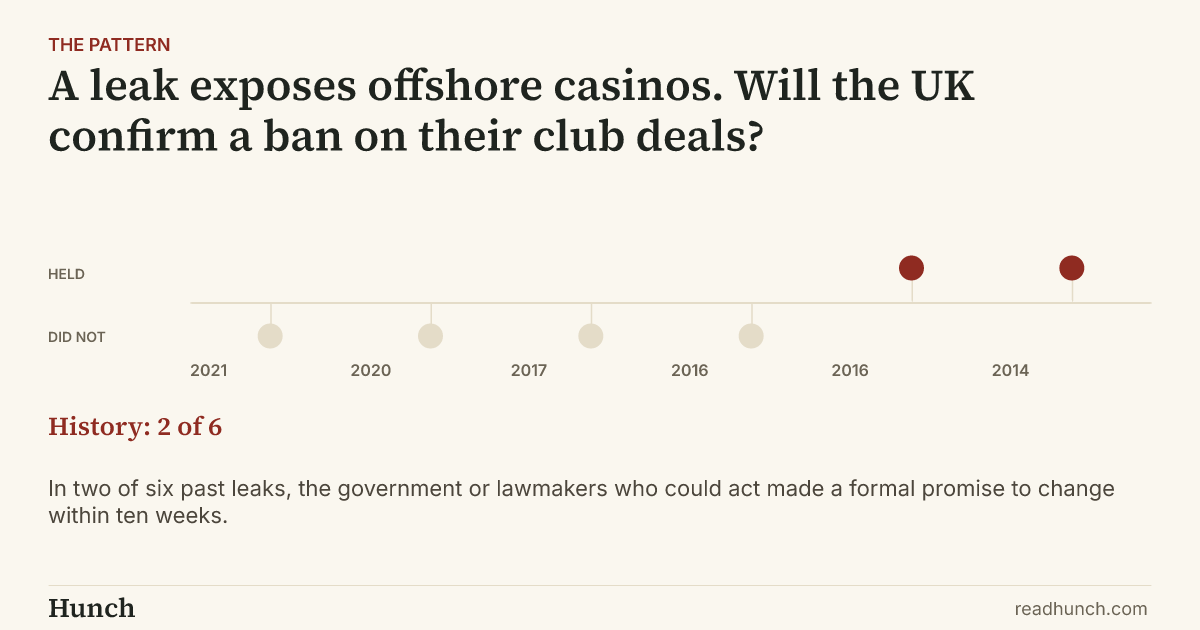
We looked for cases where a leak or a press investigation showed something the responsible regulator could not stop on its own, while a government or lawmakers had the power to act. We found six cases since 2014, from LuxLeaks to the Pandora Papers. None is about gambling; all are about hidden money, where the same gap between regulator and lawmaker applies. In five, a law or agreement followed.
Show the other 4 cases
The Read
History says a quick promise is the exception. Only twice in six cases did the government or leaders make a new formal promise within 10 weeks, and both times nothing was planned before the leak. Here the plan came first: the government asked for views on a ban in July, as it had set out its plan for the companies register just before the FinCEN Files. In those cases the leak did not speed things up. What may move this one is the government’s own clock. Its guidance puts the response at , and a ban from needs rules well before then.
The pattern is weak in two ways. None of the six cases is about gambling, and four were decided by the same UK government and Parliament. The laws took 5 to 37 months, and where another place had to make the change, as with the overseas territories and the Isle of Man, the full change did not come. Curaçao, where these casinos are licensed, is in that position now. A response that keeps existing club deals running, as the Premier League wants, would still count as a promise.
Disclaimer
Hunch works only from sources that are publicly available, and publishes on the basis of analysis of that material. We do not form an editorial opinion or take sides, we give a simpler and wider view of news that already exists. If information in a source we used was inaccurate, distorted, or later disputed but had already entered our analysis, Hunch accepts no liability for that. Predictions are not advice. Phase 1 markets use Hunch Points, not money.
Published by Hunch under the Editorial Code. Complaints and corrections: /contact/.