Anthropic's Claude Science hunts for drugs. Will one reach a trial by 31 August?
Anthropic launched Claude Science on 30 June. The product writes and runs research code and searches for possible new drugs.
What happened
Anthropic launched Claude Science, a product that autonomously runs computational-biology and drug-discovery work for paid subscribers.
Anthropic launched Claude Science on . It showed the product at an event for drug company bosses, biotech founders and researchers, as a partner to Claude Code built for lab work. Claude Science writes and runs code on large groups of computers, connects to scientific software and databases, and is built so that results can be repeated and traced back to how they were made.
Eric Kauderer-Abrams, Anthropic’s head of life sciences, linked the launch to the company’s mission. He argued that the biggest chance to improve human wellbeing lies in the life sciences.
The launch came with a notable hire. John Jumper, the DeepMind researcher who shared a Nobel Prize for AlphaFold, has moved to Anthropic, a sign of how top AI science talent is moving between companies. The product is open to all paid Claude subscribers, so it is a bid to reach many users as much as a research tool.
The Pattern
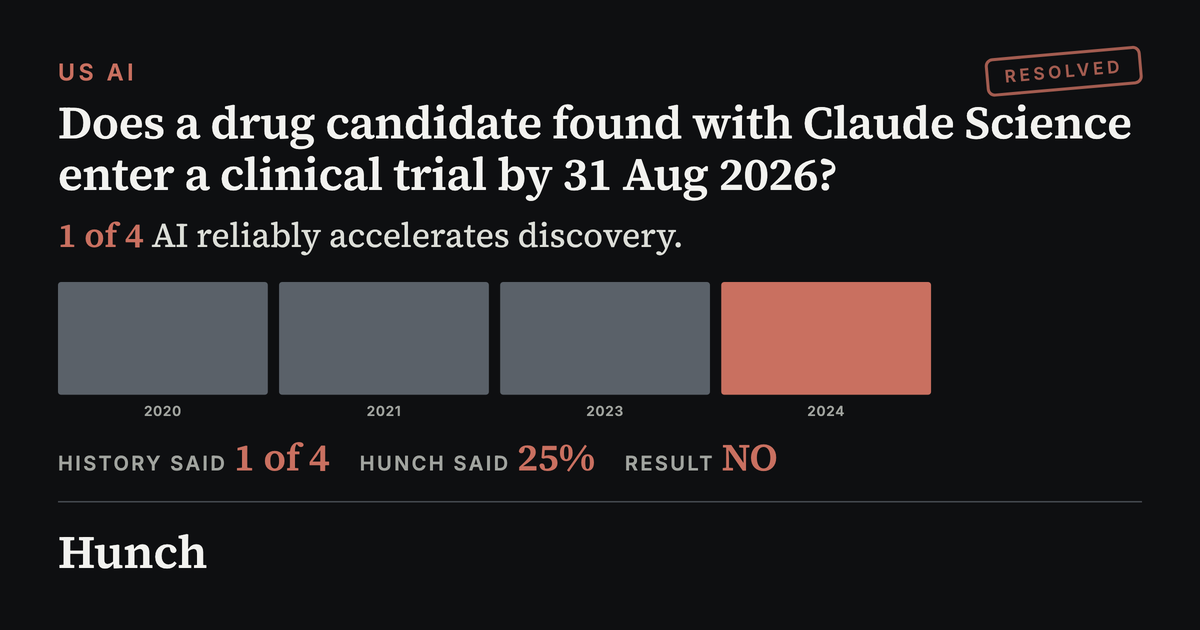
AI has often sped up the early stages of drug discovery. It has not yet changed the fact that roughly nine in ten drugs fail in clinical trials. We looked at four big AI science efforts. The record of AI-made drugs is split: real scientific progress, and trials that stalled all the same.
Show the other 2 cases
The Read
The case for taking this seriously rests on reach and talent. Claude Science goes to every paid subscriber, not only to a small group of business customers in a closed trial, and the Jumper hire shows Anthropic can attract the best in the field. If one credible partnership or a result others can repeat comes within the next month, the partnership market is the one that matters. The short-term signs point to at least one business customer being named quickly.
The case against is history. The earlier big AI science efforts had impressive early wins, and most then hit the same wall: drugs failing in clinical trials. A Harvard physicist quoted at the launch put the underlying model at about the level of a second-year graduate student: useful, not transformative. The likeliest short-term result is wide use of the tool with no named drug partner before August. That is why that market sits below half despite the attention.
Disclaimer
Hunch works only from sources that are publicly available, and publishes on the basis of analysis of that material. We do not form an editorial opinion or take sides, we give a simpler and wider view of news that already exists. If information in a source we used was inaccurate, distorted, or later disputed but had already entered our analysis, Hunch accepts no liability for that. Predictions are not advice. Phase 1 markets use Hunch Points, not money.
Published by Hunch under the Editorial Code. Complaints and corrections: /contact/.