UK may make Apple allow cheaper app deals. Most rules it planned before went ahead.
The UK competition regulator has published replies to its plan to make Apple let app makers send customers to payment outside the App Store.
What happened
The CMA publishes the responses to its consultation on a proposed steering conduct requirement for Apple’s mobile platform; the consultation closed on .
On the UK competition regulator proposed a rule for Apple. The Competition and Markets Authority (CMA) asked for views on a ‘steering’ rule for Apple’s mobile platform, drafted under the Digital Markets, Competition and Consumers Act 2024. Steering means app makers pointing users to other places to pay.
The rule would make Apple let developers tell UK users about cheaper terms elsewhere, and show links or buttons that send them to an outside website to pay. It would also stop Apple from punishing developers through app review, search ranking or access to features that let other products work with Apple’s. A parallel consultation covers Google’s mobile platform.
The consultation closed on , and the replies, without their confidential parts, were published on . That is the last step recorded on the case file. The CMA said on that it would decide later this year whether to impose any new rule.
Apple has been under this system since , when the CMA confirmed it has strategic market status, the legal label for firms with lasting power in a market. On the regulator published final promises from Apple on app review, ranking, use of data and access for other products.
The decision is unusually simple. No minister signs it, no committee votes on it, and nothing happens by default if the CMA does nothing. The regulator issues a notice, accepts promises from Apple instead, or does not go ahead.
Apple can only appeal to the Competition Appeal Tribunal on judicial review grounds, a narrow challenge to how the decision was made. So the question is how this regulator has behaved after closing a consultation of exactly this kind.
The Pattern
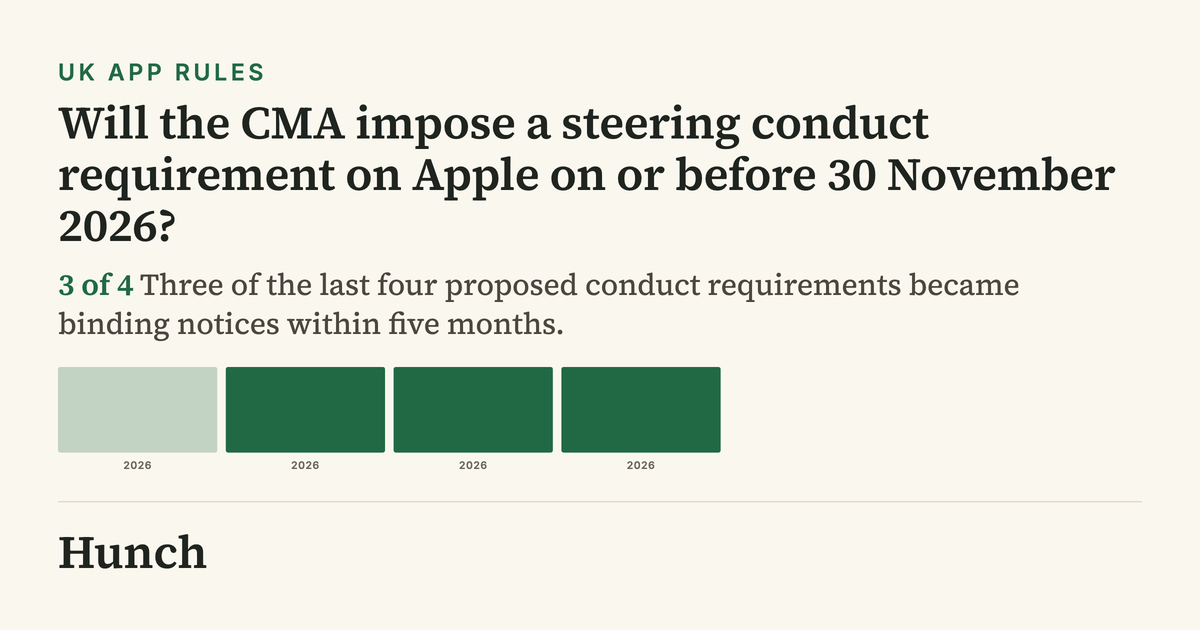
Before this, the CMA had proposed four rules, all for Google search. We looked at every rule the CMA has formally asked for views on under the 2024 Act, from the start of the system in to , and counted each proposed rule once. The question for each: was the rule imposed within five months of the consultation opening? Status decisions, voluntary promises and decisions by other bodies are left out.
Show the other 2 cases
The Read
History points to the CMA imposing the rule this autumn. The process is the one that produced the Google search rules: one decision-maker, no one who can block it, a consultation that has already closed, and a regulator working to a published plan. Three of the four rules it proposed became binding within four to five months of the consultation opening. The steering consultation opened on , so on that timing the decision would fall between early and mid-November. Apple’s April promises cut the other way only in part: they covered review, ranking and access for other products, and left payments alone.
The doubt is the user choice rule. The CMA proposed four rules in January and imposed three, without publishing a decision that explains the fourth. Steering is the most disputed of the phone proposals, because it goes straight at the commission Apple earns on App Store sales, and the replies published on include detailed objections. A regulator that has already dropped one proposed rule can drop this one, split it, or hold it while it works through its separate call for evidence on NFC access, the chip used for contactless payments.
Disclaimer
Hunch works only from sources that are publicly available, and publishes on the basis of analysis of that material. We do not form an editorial opinion or take sides, we give a simpler and wider view of news that already exists. If information in a source we used was inaccurate, distorted, or later disputed but had already entered our analysis, Hunch accepts no liability for that. Predictions are not advice. Phase 1 markets use Hunch Points, not money.
Published by Hunch under the Editorial Code. Complaints and corrections: /contact/.