Apple and Google face a UK ruling on app payments. Will it come by 31 October?
The CMA, the UK competition regulator, published the replies on 14 August to its plan for a new app store rule for Apple and Google. No decision yet.
What happened
The CMA publishes the responses to its consultation on a proposed steering conduct requirement for Apple’s and Google’s mobile platforms, with no decision yet issued.
On the UK competition regulator published the replies. The Competition and Markets Authority (CMA) had asked on for views on a proposed ‘steering’ rule for Apple’s mobile platform, and the same day for Google’s. The replies for both came out on the same day too.
Steering would let app makers point users to ways to pay and buy outside the app store. It would be the first rule of this kind imposed on either phone platform under the Digital Markets, Competition and Consumers Act 2024.
The Apple and Google files have moved on the same day at every step. Both investigations opened on . Both proposed designations and plans came on , with views due by . Both sets of replies were published on , and on both firms were named as having strategic market status, the legal label for firms with lasting power in a market.
On the CMA asked for views on promises from each firm on app review, ranking and data use, and on it published final promises from both. The steering rule has followed the same pairing.
The only rules the regime has finished sit in a third file, on Google search. There the CMA asked for views on , published the replies on , imposed the publisher rule on , and the fair ranking and data portability rules on . That is the closest example of what the phone files now face: a rule the firm opposes, decided after the replies are in.
The Pattern
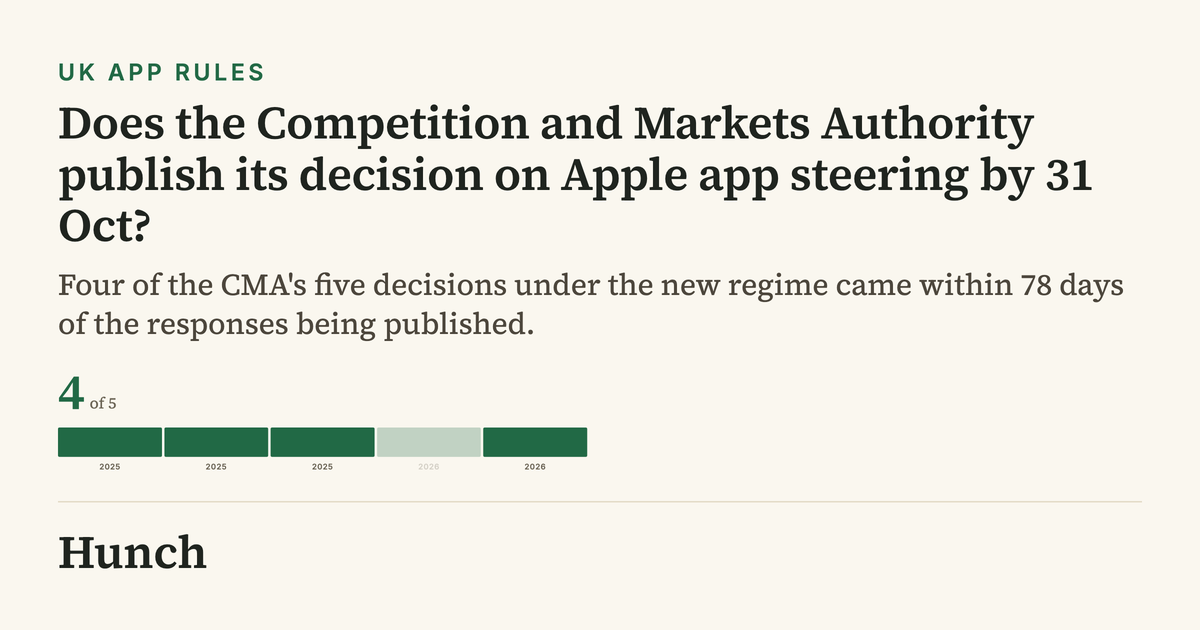
Five decisions qualify, one short of the six we need to show History. We looked at every finished step in the CMA’s three big tech cases, Apple’s phones, Google’s phones and Google search. For each we counted the days from the CMA publishing the replies to a consultation to publishing its decision, as recorded on the three case pages on . Where one consultation led to decisions on two dates, each counts. The test is the one the first market asks: did the decision come within 78 days? The step from opening an investigation to proposing a designation is left out, because the law gives it nine months.
Show the other 3 cases
The Read
The two date markets follow the short record directly. Forty-one to fifty days from falls between and , which is why the September market sits low and the October one above half. What pulls the October price below four in five is the kind of decision in the record. The fast ones were designations the firms had largely accepted. The only two imposed rules, in the search file, took 77 and 91 days. Steering is an imposed rule that both firms have argued against, and 91 days would put it at .
The same-day market tells us the most. In nineteen months the Apple and Google phone files have not split by a single date, which means the CMA is running one phone policy with two addressees. If the steering decisions come on different days, something in one file has become disputed in a way the other has not, and this timing record stops describing it.
What would break the pattern altogether is a further consultation or call for evidence in place of a decision. The search file did not need one, but here it would restart the clock.
Disclaimer
Hunch works only from sources that are publicly available, and publishes on the basis of analysis of that material. We do not form an editorial opinion or take sides, we give a simpler and wider view of news that already exists. If information in a source we used was inaccurate, distorted, or later disputed but had already entered our analysis, Hunch accepts no liability for that. Predictions are not advice. Phase 1 markets use Hunch Points, not money.
Published by Hunch under the Editorial Code. Complaints and corrections: /contact/.