Nine countries pause EU fingerprint checks at borders. Will the EU set a new date?
France, Germany, Italy and six other countries told Brussels they will not run the EU's new fingerprint and photo checks until the systems work.
What happened
Nine countries, among them France, Germany, Greece, Italy and Portugal, have told the European Commission they need more time before enforcing the Entry/Exit System’s fingerprint and facial checks, which were due in full on , and Brussels sources say the states now technically in breach will not be prosecuted.
The Entry/Exit System is the EU’s new rule that every non-EU visitor, Britons included, gives fingerprints and a photo at the border. Belgium, the Netherlands, Malta and Switzerland are also among the nine. They told the European Commission they will not run the checks until the technology and systems work. Spain is enforcing in full.
The summer grace period ended on . For 150 days it let states drop the checks, so the nine are now technically breaking the EU rules. Brussels has allowed this informally and said the states will not be prosecuted. It declined to comment.
For British travellers the change is at the Channel. French police check passports on UK soil at Dover, Folkestone and St Pancras. They have not started taking fingerprints from car passengers at Dover. The kiosks bought by Eurotunnel, the Port of Dover and Eurostar are not yet in use, and Eurostar border officers still register travellers by hand.
The UK government has put £10.5 million into those three ports and a further £20 million into passport and vehicle capacity at Dover. On flights, big airports such as Frankfurt and Schiphol are taking fingerprints and photos, and some smaller holiday airports are not. Greek border staff had already stopped checking British passengers over the summer.
Airlines now want the delay in writing. On Ryanair asked for the derogation, a formal exception to the rules, to run to at least . IATA, the airlines’ global body, and Abta, the UK travel trade body, want a written right to suspend checks beyond September.
The Commission says a few crossing points need more time to adjust, that it will support the states concerned, and that it aims to fix the remaining problems by the end of the year. The question is whether that becomes a written decision with a date within 30 days.
Sources: Guardian (2), Independent, Times, GOV.UK
The Pattern
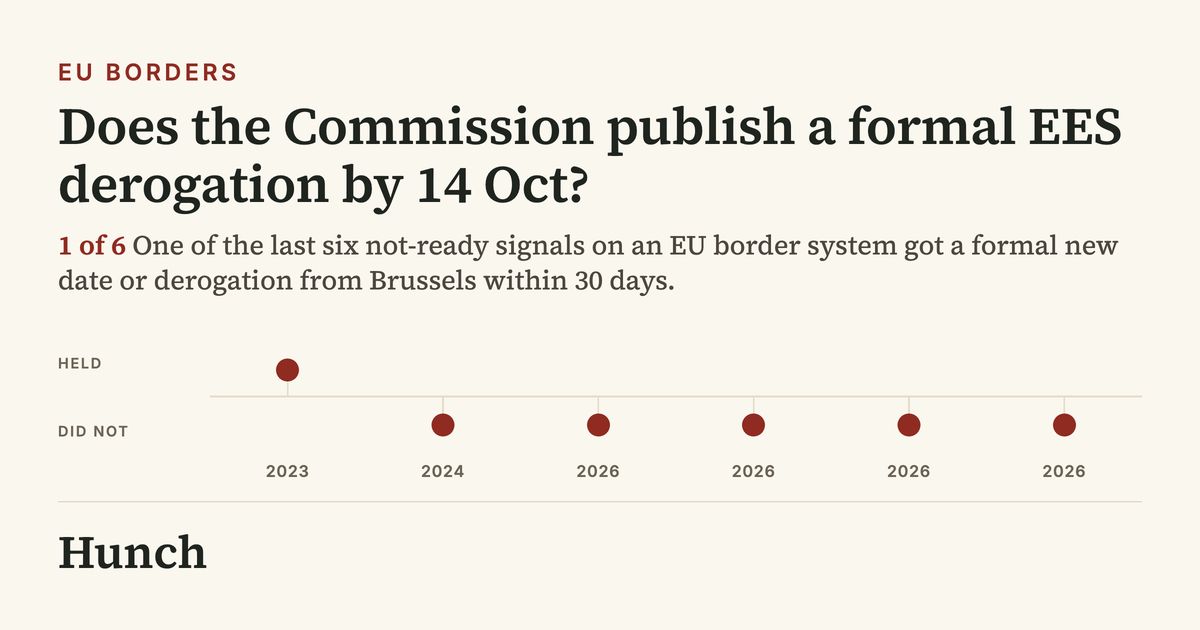
Only one of six recent warnings got a new date in writing. We looked at every public warning since 2023 that an EU border system would miss its start date. The warnings came from member states, from eu-LISA, the EU agency that runs the systems, and from airlines and airports. We checked whether the Commission or eu-LISA put a new start date, an extension or an exception in writing within 30 days. The newest cases come first.
Show the other 4 cases
The Read
History points against a formal new date. Since every warning got silence, a refusal, or a pointer to rules already in place. This month the Commission spoke only of an unnamed period of adjustment, with the problems fixed by the end of the year. We still start the first market at 22 per cent, above that record, because nine states are now openly breaking the rules and Ryanair has asked for a date the Commission could simply adopt.
The nine governments want queues to move this autumn, after a summer of waits of up to five hours. Stopping the checks costs them nothing and leaves Brussels to object. The Commission wants to avoid admitting in writing that its main border system has missed its date twice in a year. That is why it accepts the breach and says nothing. In the next 30 days the moves belong to the Commission, eu-LISA’s board on the ETIAS timetable, the airlines and travel bodies with their named dates, and the French interior ministry on the Dover kiosks.
The case against is that a formal text may now be the easier way out. In July the Commission said a mix of borders that check and borders that do not leaves travellers stuck when they enter at one and leave at another, and the nine states have now created that mix. The prediction fails if the Commission answers the breach with a dated decision, or if eu-LISA’s autumn board puts a joint EES and ETIAS timetable in writing. The Dover market fails the other way if France switches the kiosks on before the October half-term.
Disclaimer
Hunch works only from sources that are publicly available, and publishes on the basis of analysis of that material. We do not form an editorial opinion or take sides, we give a simpler and wider view of news that already exists. If information in a source we used was inaccurate, distorted, or later disputed but had already entered our analysis, Hunch accepts no liability for that. Predictions are not advice. Phase 1 markets use Hunch Points, not money.
Published by Hunch under the Editorial Code. Complaints and corrections: /contact/.