The EU delays its strictest AI rules. Will the 2 August date for AI labels hold?
The EU pushed its toughest AI Act rules back by up to two years. One date did not move. Rules on telling users they talk to AI start on 2 August.
What happened
The Council of the EU gave its final green light to the AI Act simplification package, following the European Parliament’s endorsement on ; publication in the Official Journal is expected shortly.
The Council of the EU, where member governments sit, gave final approval on to the Digital Omnibus on AI. It is the first change to the AI Act since the law was adopted in 2024. The European Parliament approved it on , and the Council, Parliament and Commission had agreed the deal on .
The strictest rules now start in and . Rules for high-risk AI systems that stand alone, listed in Annex III of the law, move from to , a delay of 16 months. Rules for AI built into regulated products, listed in Annex I, move a full year to .
The package also adds new banned uses of AI from . One of them is using AI to make intimate images of people without their consent.
One date did not move. From , Article 50 of the law says users must be told when they are dealing with an AI system, and content made by AI must be labelled. Whatever the delay on high-risk systems, this date arrives in five weeks.
Sources: Council of the EU (2), European Parliament
The Pattern
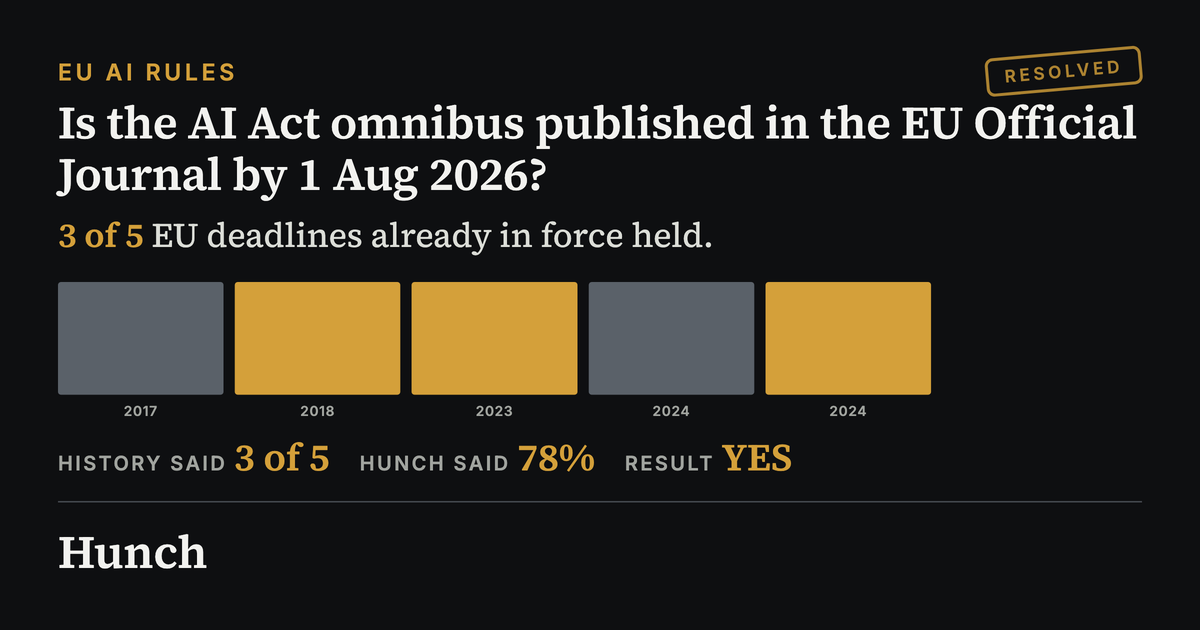
The EU’s record on its own digital deadlines is split. We looked at five big EU digital laws and checked whether their deadlines came on the date the law set. The main laws took effect on the day promised. The more ambitious laws that followed slipped or died. The AI Act is now doing both at once.
Show the other 3 cases
The Read
History points to both remaining dates holding. The Council and the Parliament have both given final approval, so publishing the law in the Official Journal, the EU’s official record, is a routine step, and five weeks is usually plenty. On Article 50, lawmakers have just chosen what to delay, and they chose to keep the transparency rules. Reversing that within weeks would need a new law, and nobody has proposed one. That is why we put the date at 88 per cent.
The risks are timing and lobbying. Publication has slipped before when the legal and translation checks ran long, and publication in late July would leave no spare time. The delay also showed that AI Act dates can move under pressure. The same industry groups that won a 16-month delay on high-risk systems have every reason to argue that the labelling standards for AI-made content are not ready either. A deadline the EU has moved once is easier to move again.
Publication in the Official Journal by , with no new proposal to move Article 50, would settle both questions.
Disclaimer
Hunch works only from sources that are publicly available, and publishes on the basis of analysis of that material. We do not form an editorial opinion or take sides, we give a simpler and wider view of news that already exists. If information in a source we used was inaccurate, distorted, or later disputed but had already entered our analysis, Hunch accepts no liability for that. Predictions are not advice. Phase 1 markets use Hunch Points, not money.
Published by Hunch under the Editorial Code. Complaints and corrections: /contact/.