EU top court keeps Google's €4.1bn Android fine. Will rivals now sue for damages?
Europe's top court rejected Google's last appeal against the €4.1bn Android fine on 2 July. The fight lasted 8 years. Rivals can now claim damages.
What happened
The European Court of Justice dismissed Google’s appeal against the €4.1bn ($4.7bn) Android fine, leaving the record penalty permanently in place.
Google cannot appeal again. On the European Court of Justice, the EU’s top court, dismissed Google’s appeal against the European Commission’s Android penalty. The €4.1bn fine stands in full, and the decision is legally binding.
The case goes back to 2018. The Commission found then that Google had misused its power over Android. Phone makers who wanted the Play Store had to pre-install Google Search and Chrome on every device.
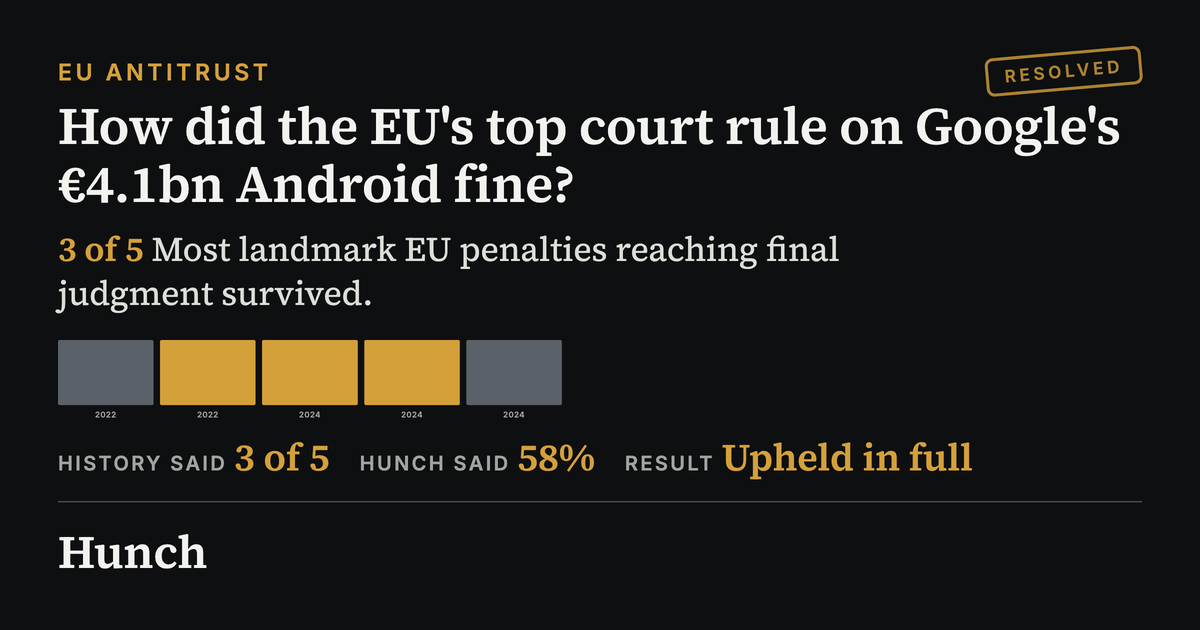
The ruling ends the largest competition fine the EU has ever imposed, and the last of Google’s three big Brussels cases still in the courts. In 2022 the General Court, the lower EU court, cut the fine from €4.34bn to €4.125bn but kept the Commission’s main findings. The top court has now confirmed that result.
The final ruling matters beyond the fine. Rivals and consumers can now claim damages in national courts on the strongest legal ground there is. After Google’s Shopping ruling became final in 2024, firms that pay for such lawsuits moved quickly.
A separate fight is still open. In the Commission fined Google €2.95bn over its online advertising business and demanded changes to end its conflicts of interest. That review was still unresolved when the Android ruling came.
Sources: Court of Justice of the EU, Bloomberg
The Pattern
Big EU competition fines usually survive the courts, but not always. We looked at the landmark EU fines that reached a final ruling since 2022. The record favours the European Commission, and the exceptions were not small ones.
Show the other 3 cases
The Read
History points to a damages claim soon. Claims tend to follow final rulings quickly. Sweden’s PriceRunner sought €2.1bn from Google while the Shopping case was still on appeal, and a final ruling removes the biggest legal risk for claimants and the firms that fund them. With the Android ruling now beyond challenge, a filing within five weeks is more likely than not. Firms bringing claims have had four years since the General Court ruling to prepare.
The weak point is timing. Lawyers choose when to announce damages claims, and July and August are the main court holidays across the EU. A claim being prepared is not yet a claim filed. Five weeks is short, and funders may prefer to launch in September, when more people are paying attention.
A claim filed in an EU or UK court that cites the Android ruling, before , would settle the question.
Disclaimer
Hunch works only from sources that are publicly available, and publishes on the basis of analysis of that material. We do not form an editorial opinion or take sides, we give a simpler and wider view of news that already exists. If information in a source we used was inaccurate, distorted, or later disputed but had already entered our analysis, Hunch accepts no liability for that. Predictions are not advice. Phase 1 markets use Hunch Points, not money.
Published by Hunch under the Editorial Code. Complaints and corrections: /contact/.