OpenAI limits GPT-5.6 to 20 partners. Recent AI previews took months to go public.
OpenAI showed GPT-5.6 Sol on 26 June to about 20 government-approved organisations, after the White House asked it to hold back a wide release.
What happened
OpenAI rolls out GPT-5.6 Sol, Terra and Luna to a limited pool of users vetted by the US government, with wide release promised “in the coming weeks”.
The request came from two White House offices, the Office of the National Cyber Director and the Office of Science and Technology Policy. They asked OpenAI to release GPT-5.6 only to a small number of partners approved by the government, while the administration builds a system for testing and checking advanced AI models.
The reason given was the model’s power. Officials said it was close to the “Mythos-like” level that led Washington to step in against Anthropic earlier in June.
OpenAI agreed, and presented this as its own choice. The preview of the GPT-5.6 series opened on to about 20 trusted partners approved by the government. Sol is the top model, Terra is for everyday work and Luna is the low-cost option.
OpenAI also pushed back in public. It said this kind of government access process should not become the long-term default, because it keeps the best tools from people who need them, from users and developers to businesses, cyber defenders and global partners.
OpenAI says the wider release will come in weeks. No US law forces the hold. The deal is voluntary, and either side can end it. That makes the timetable a test of how much power the White House really has over a leading AI company that has said in public that it wants the limits lifted.
Sources: OpenAI, The Guardian
The Pattern
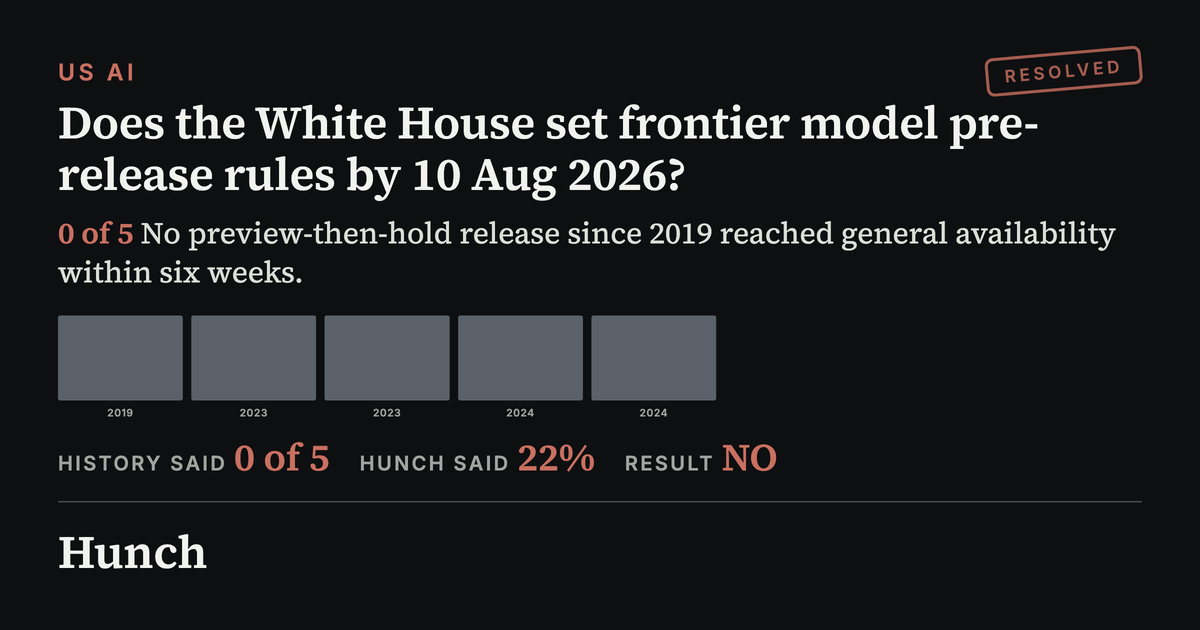
None of five big AI previews since 2019 went public within six weeks. Leading AI companies have shown major models early and kept back the full release before, usually by their own choice. In none of the cases we found did a government ask for the hold. The gap between the preview and the full public release is what matters here, and in these cases it was never short.
Show the other 3 cases
The Read
History points against a full release within six weeks. None of the five earlier cases got there, and in each one the company kept back its own product and controlled the timetable. Here the timetable is shared with an administration that has stepped in twice in a month, first against Anthropic and now OpenAI. It has every reason to keep its power of approval while its rules are still unwritten. A promise of “coming weeks” means less from a company that cannot deliver it alone.
The case against is that this hold differs from the earlier ones in a way that could speed things up. OpenAI’s public statement was barely polite, and the company wants this over. The administration itself favours moving fast on AI, and it lifted its order against Anthropic in nineteen days. If the White House treats the GPT-5.6 deal as a trial run and not a permanent gate, a fast release would show that cooperation works.
Sol opening to paid ChatGPT users by would answer the question. The Anthropic order, lifted in nineteen days, is the example for a fast release. The earlier previews, with a typical gap of about four months, point to a slow one.
Disclaimer
Hunch works only from sources that are publicly available, and publishes on the basis of analysis of that material. We do not form an editorial opinion or take sides, we give a simpler and wider view of news that already exists. If information in a source we used was inaccurate, distorted, or later disputed but had already entered our analysis, Hunch accepts no liability for that. Predictions are not advice. Phase 1 markets use Hunch Points, not money.
Published by Hunch under the Editorial Code. Complaints and corrections: /contact/.