Meta takes Ofcom to court on fees and fines. Recent tech challenges mostly failed.
Meta has taken Ofcom, the UK's media regulator, to the High Court over how it sets Online Safety Act fees and fines. A hearing is set for October.
What happened
Meta is fighting Ofcom in the High Court over how many billions count as billions, seeking judicial review of the Online Safety Act fees and fines regime.
Meta has three complaints about Ofcom, the UK media regulator, the High Court was told in early May. First, fees should reflect UK revenue from the services Ofcom regulates, not worldwide income. Second, putting several services under one parent company wrongly makes the whole group jointly liable. Third, Ofcom adds up revenue across services instead of looking at each service on its own.
Ofcom can fine a firm up to 10 per cent of its worldwide revenue, or £18 million if that is higher. This limit is set by the law itself, and the revenue counted is called qualifying worldwide revenue. Ofcom also pays for its online safety work with fees from the largest platforms, worked out on the same worldwide basis.
The full hearing is set for 13 and . Ofcom’s lawyer told the court the first fee bills should go out in the third quarter, most likely September. Epic Games and the CCIA, a US trade body, are expected to join the case as third parties, outside groups with an interest in the result.
Sources: BBC
The Pattern
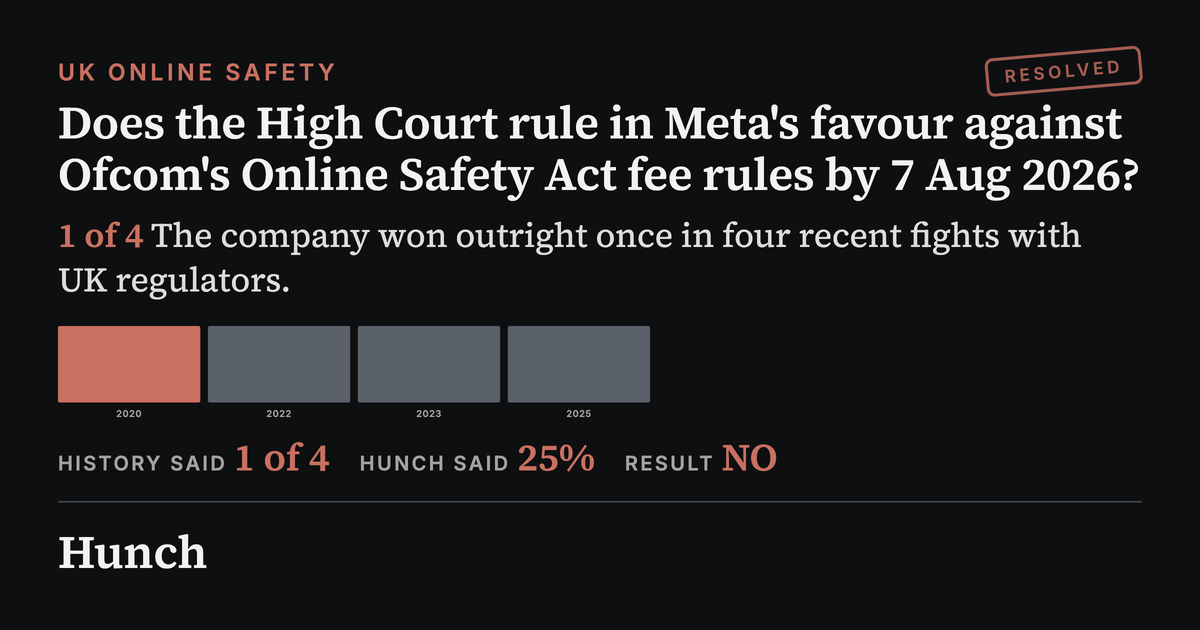
In four big fights since 2020, the company won outright once. A judicial review is narrow: judges check whether a regulator acted lawfully and followed a fair process, not whether its policy is wise. We looked at recent legal challenges by tech companies against UK regulators to see how often the company won.
Show the other 2 cases
The Read
History favours Ofcom. In the four big fights since 2020, the regulator’s position survived three times. The one company win, Uber in 2020, was about a licence, not about a regulator’s main finding. Ofcom is also busy. It issued 16 fines in its first year of enforcement and has said it will step up action on age checks and illegal content, so another large fine within five weeks is more likely than not.
The record is small, four cases, and the court case itself may slow Ofcom down. The judges hearing Meta’s claim in October will read every decision Ofcom makes before then, which argues for caution in exactly these weeks: fewer tough fines, more process. Meta is also attacking the one part of the rules where the Act’s wording is truly open to argument, how revenue is counted. It does not need to win outright to push Ofcom towards a narrower basis for fees.
The October hearing and the judgment after it will decide the main fight. Before then, a new fine above £500,000 would show whether the court case has made Ofcom more careful.
Disclaimer
Hunch works only from sources that are publicly available, and publishes on the basis of analysis of that material. We do not form an editorial opinion or take sides, we give a simpler and wider view of news that already exists. If information in a source we used was inaccurate, distorted, or later disputed but had already entered our analysis, Hunch accepts no liability for that. Predictions are not advice. Phase 1 markets use Hunch Points, not money.
Published by Hunch under the Editorial Code. Complaints and corrections: /contact/.