The UK regulator sees one fix for a broadband deal: a ban. No such deal went ahead.
The Competition and Markets Authority is due to rule on nexfibre buying Netomnia's owner by 15 December. The only fix it has named is a ban.
What happened
The CMA publishes replies to its interim report and to its consultation on fixes in the review of nexfibre buying Substantial, the owner of Netomnia, including CityFibre’s request for a ban.
The UK regulator has named one fix for a £2bn deal: a ban. In February nexfibre agreed to buy Substantial, owner of the Netomnia and Brsk fibre networks. nexfibre belongs to Liberty Global, Telefónica and the investor InfraVia. The first two also own Virgin Media O2, nexfibre’s only customer.
On the regulator said the deal could cut competition. Without the deal, the Competition and Markets Authority (CMA) expects CityFibre to buy Substantial, and three networks would then sell to broadband brands in about 32% of the Virgin Media O2 and nexfibre area. With the deal, that falls to about 18%.
On the CMA named a ban as the one fix it had found. The buyers offered no fix of their own, and the CMA found no separate business that could be sold instead. nexfibre’s owners called the report “fundamentally flawed”.
CityFibre, which lost Substantial to nexfibre in 2025, wants a ban. Its reply, published on , says a ban “is the only effective and proportionate remedy”. nexfibre’s owners say a ban would suggest Britain is “closing the door on international investment”.
The legal deadline for the final decision is . Because the firms asked for this fast route, the CMA can add up to 11 weeks for special reasons, to . It can go further if the firms agree, or if someone fails to give it information.
We have identified prohibition of the Transaction (Prohibition Remedy) as a possible remedy option. The Transaction currently remains anticipated.
CMA, invitation to comment on remedies, paragraph 11. The CMA uses prohibition to mean a ban on the deal
Sources: CMA, The Independent, CMA (2, 3, 4, 5), nexfibre shareholders, legislation.gov.uk
The Pattern
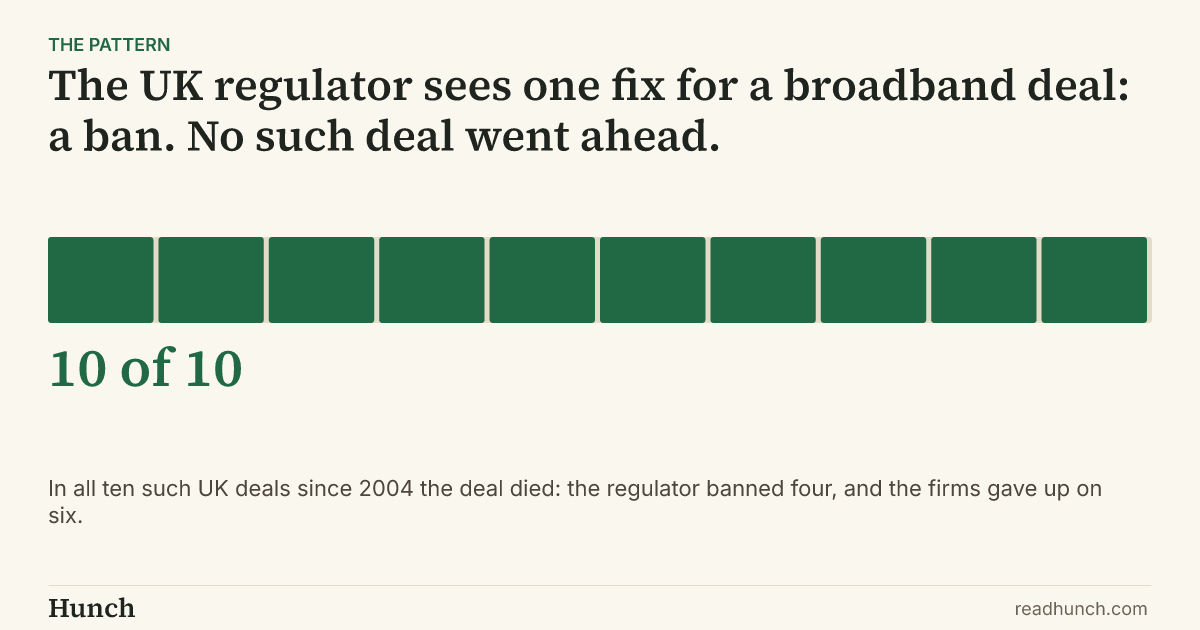
We looked for cases where the UK competition regulator, in a full review of a merger not yet completed, found harm to competition, rejected the firms’ claimed benefits and named only a ban as a working fix. We found ten such deals from 2004 to 2021. Until 2014 the regulator was the Competition Commission, after that the CMA. (CMA; CMA; GOV.UK)
Show the other 8 cases
The Read
In five of the ten past deals the firms offered a fix after the regulator’s notice, and none of those deals went ahead: four were banned and one was dropped. The four quick walk-aways all came within 25 days. This deal is alive on day 38 and the firms are still fighting, so it is on the later path. Of the six past deals still alive at this point, four were banned and two were dropped, both after the regulator gave itself more time. The bans came 3 to 20 days before the deadline in force, and the CMA timetable puts this final report in early December.
There are reasons for doubt. Each time it was the same body deciding, the UK competition regulator, and all ten deals came before . That month the government asked the CMA to give weight to investment in the UK, after the CMA began a review of its approach to fixes in March. Since then the CMA has closed six full merger reviews and banned none. In the ten past deals one firm led its market or the two were the largest, while here both are smaller rivals of Openreach, the BT network. The CMA’s view also rests on CityFibre buying Substantial instead, and CityFibre is in talks with its lenders about its debt. On Virgin Media O2 said it will stop upgrading its own network to full fibre, which the CMA had expected it to keep doing.
Sources: nexfibre shareholders, CMA (2), CMA (2, 3, 4, 5), The Guardian, Virgin Media O2
Disclaimer
Hunch works only from sources that are publicly available, and publishes on the basis of analysis of that material. We do not form an editorial opinion or take sides, we give a simpler and wider view of news that already exists. If information in a source we used was inaccurate, distorted, or later disputed but had already entered our analysis, Hunch accepts no liability for that. Predictions are not advice. Phase 1 markets use Hunch Points, not money.
Published by Hunch under the Editorial Code. Complaints and corrections: /contact/.