nexfibre is buying Netomnia's owner. Will the UK regulator see harm to competition?
The competition regulator published the firms' reply on 14 August in its review of nexfibre buying Netomnia. An interim report is due in October.
What happened
The CMA publishes the merging parties’ joint response to its areas of focus document, the latest filing in the Phase 2 inquiry into nexfibre’s acquisition of Substantial.
nexfibre, owned jointly by Liberty Global, Telefónica and InfraVia, is buying Substantial, the company that owns the Netomnia, brsk and YouFibre broadband networks. The Competition and Markets Authority (CMA), the UK competition regulator, opened its review on . On , at the firms’ own request, it sent the deal straight to a full, in-depth review, called Phase 2, under its fast-track route.
A panel of four chaired by Cyrus Mehta runs the review. On the CMA accepted temporary promises from Substantial, known as interim undertakings, and published them on .
Rivals have had their say. The CMA set out the issues it would look at on , with replies due by . BT Group, Grain Connect and Hyperoptic sent views on , Sky on and CityFibre on . The CMA published the two firms’ joint reply on .
The business question is whether joining two of the bigger challengers to Openreach removes competition in the places where both networks are built.
An interim report is due in early October. The CMA’s timetable of has the panel gathering evidence until then. If needed, it consults on fixes from mid to late October, holds hearings with the firms in late October and early November, and publishes a final report in early December. The legal deadline is .
The panel decides alone under the Enterprise Act 2002. Ministers cannot step in on competition grounds.
Sources: CMA, CMA administrative timetable
The Pattern
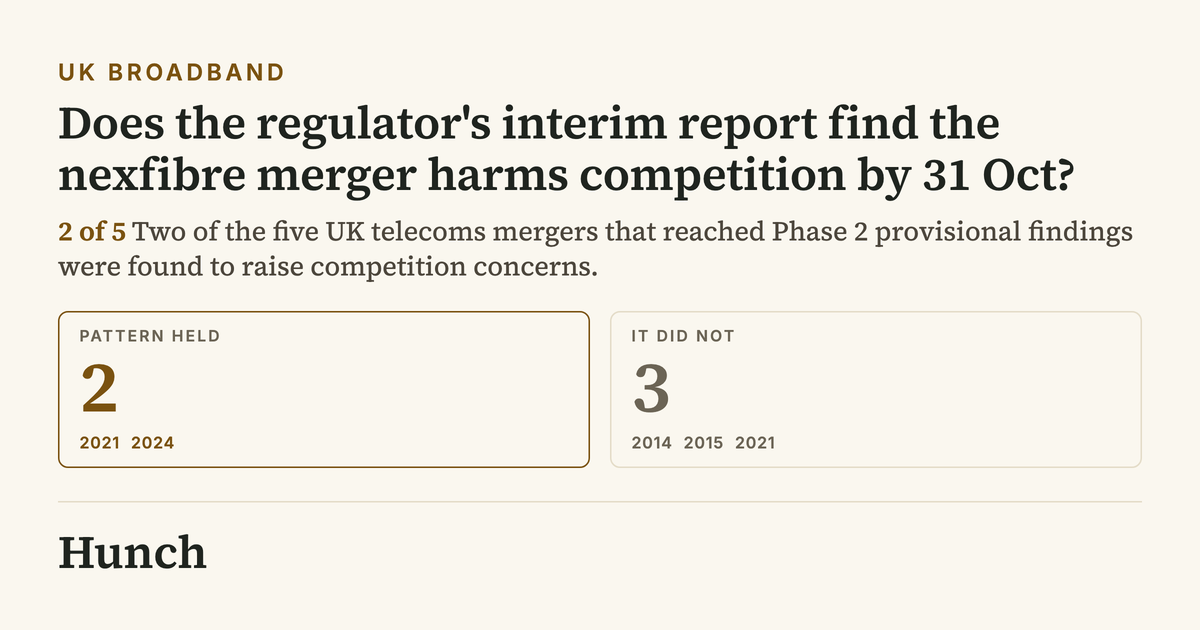
Five telecoms mergers reached this stage with findings on record. We set the rule before counting: every telecoms merger the CMA sent to a Phase 2 review whose first findings, now called an interim report, are published on its case page. We asked one thing: did those findings say the deal would substantially reduce competition? Three older cases have only final results on record, so they are left out.
Show the other 3 cases
The Read
History leans slightly towards clearance. Three of the five earlier telecoms reviews found no problem at the interim stage, and the two that did ended with fixes, not a ban. Both of those involved mobile networks or phone masts across the whole country. A fibre case like this one turns on local overlap. If the panel finds enough competition from Openreach and CityFibre where the two networks meet, the interim report clears the deal. The record is also small, five cases.
This deal has signs that point the other way. The firms asked to skip the first stage of review, which buyers tend to do when they expect to agree fixes rather than argue for a clean result. The temporary promises keep the businesses separable, which a later sale of part of them would need. The rivals objecting are BT, Sky, CityFibre and Hyperoptic, all big players. And both firms build fixed networks in the same areas, where harm to competition is easiest to explain, unlike the two deals joining fixed and mobile networks that the CMA cleared in 2016 and 2021.
The timing is a useful sign. If the panel publishes its interim report in early October, it has found the case simple, in either direction. A delay into late October would fit a panel drafting fixes.
Disclaimer
Hunch works only from sources that are publicly available, and publishes on the basis of analysis of that material. We do not form an editorial opinion or take sides, we give a simpler and wider view of news that already exists. If information in a source we used was inaccurate, distorted, or later disputed but had already entered our analysis, Hunch accepts no liability for that. Predictions are not advice. Phase 1 markets use Hunch Points, not money.
Published by Hunch under the Editorial Code. Complaints and corrections: /contact/.