The NHS plans home tests ordered by app. Will a tender or pilot come by 10 August?
NHS England has opened talks with suppliers for HomeTest, a national service that would let patients order medical tests at home through the NHS App.
What happened
NHS England is exploring at-home health tests ordered through the NHS App, opening a market engagement exercise for suppliers — the first step towards home testing at scale.
NHS England opened early talks with suppliers on for HomeTest, a planned national service. Patients would order medical tests in the NHS App, do them at home and get the results in the app. Suppliers had until to respond.
The first plan covers seven areas: sexual health, gut problems (gastroenterology), urology, gynaecology, bones and joints (orthopaedics), rheumatology, and GP tests such as cholesterol.
The target is to run the service in 2027/28, if studies show it can work and ministers approve it. NHS England says people already look at their GP records in the app more than 30 million times a month, including 10 million views of test results. HomeTest would let the app order tests as well as show results.
The plan is part of the 10 Year Health Plan’s promise to make the NHS App a doctor in your pocket. GP leaders have set conditions. They want any expansion to be based on evidence and checked by doctors, and they worry that unclear results could make patients anxious and send more of them to GPs. No model for running it, national or local, has been chosen.
Sources: The Daily Telegraph
The Pattern
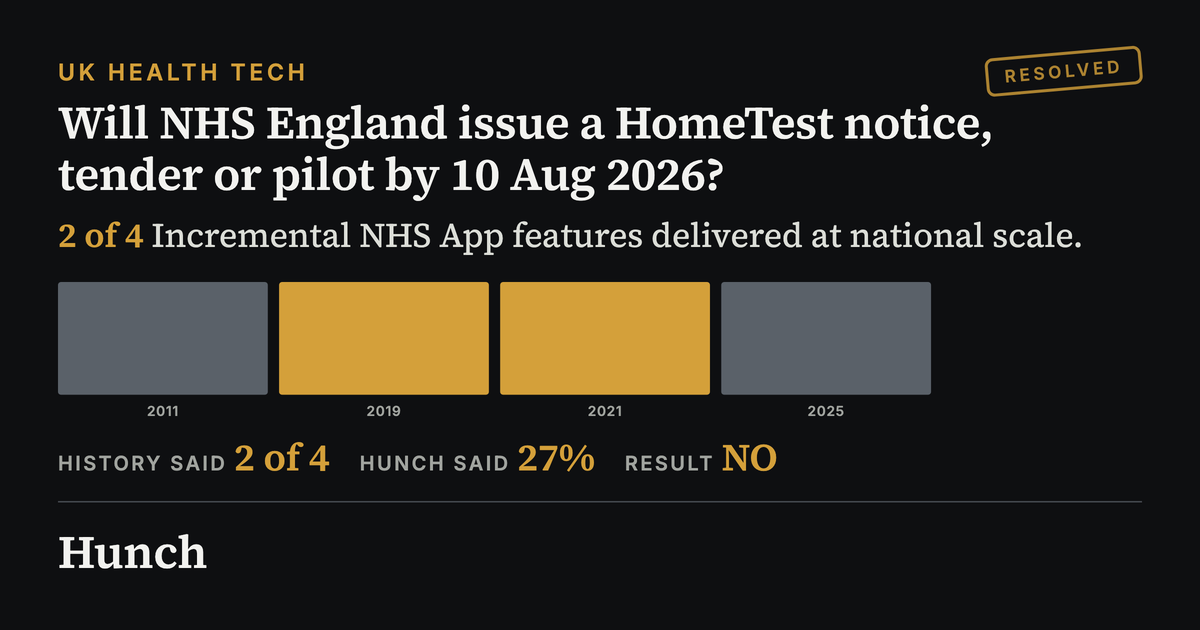
Features added to the NHS App tend to work. Large projects bought centrally for the whole NHS tend to struggle. We looked at the biggest NHS digital projects and found a split record. The same organisation ran the largest civilian IT failure in UK history and also built one of its fastest-adopted digital products.
Show the other 2 cases
The Read
History says be patient in the short term. Early talks with suppliers are the first step in public buying. The stated path is studies, then ministerial approval, then a launch in 2027/28, so a formal next step within weeks is unlikely. NHS England’s own words are careful, with no promise of a national service and no fixed conditions.
A government announcement about the app is a different matter. Governments rarely let the first birthday of a flagship plan pass quietly, and the app is the part of the plan that is easiest to show off. The Health Secretary has backed home testing as a way to faster diagnosis, and the 10 Year Plan needs visible progress before its anniversary. The Covid Pass went from idea to national service in months when ministers wanted it.
The record cuts both ways for HomeTest. It is built on the app, the part of NHS technology that has delivered, but it would be bought nationally, the way the failed projects were. A HomeTest pilot confirmed in a July anniversary package would answer both questions at once.
Disclaimer
Hunch works only from sources that are publicly available, and publishes on the basis of analysis of that material. We do not form an editorial opinion or take sides, we give a simpler and wider view of news that already exists. If information in a source we used was inaccurate, distorted, or later disputed but had already entered our analysis, Hunch accepts no liability for that. Predictions are not advice. Phase 1 markets use Hunch Points, not money.
Published by Hunch under the Editorial Code. Complaints and corrections: /contact/.