Lisa Nandy promises a phone law on nude images. Will a bill come by 8 December?
The culture secretary told MPs on 8 September a law will make devices and apps stop under-18s taking or sharing nude images. No bill and no date yet.
What happened
In an oral statement on the Secretary of State for Digital, Culture, Media and Sport, Lisa Nandy, committed the government to primary legislation requiring major technology platforms to build device-level protections so that it is impossible for anyone under 18 to take, view or send nude images, said it would be introduced to Parliament as soon as the government can, and added that if platforms in scope develop and implement technical solutions in the meantime the government will reassess whether legislation is necessary.
There is no bill yet, and no date. Lisa Nandy made the promise to MPs on without a bill to point to. No draft text was published and no session of Parliament was named.
Her department’s notice the next day added a second part: apps that children use must block nudity. It set out three principles for the law, including filters that detect nudity switched on by default, and age checks before any adult can see such content.
The government had given Apple and Google three months. At London Tech Week on , the Home Office told them to switch on blocking technology and said it would bring in a law to force them if they did not. Three months later the government answered with a further promise. The Commons breaks for the party conferences on and returns on .
The promise has a way out. Lisa Nandy told MPs that if the platforms covered develop and use technical fixes while the work goes on, the government will reconsider whether a law is needed at all. The department’s notice said the same.
The BBC reported both points: the government will legislate as soon as it can, and may think again if firms deliver first.
The Guardian reported that Lisa Nandy told MPs the two companies could still reach a deal, while calling a law almost certain, and that the government was only starting work on an act of parliament. A duty that can be dropped if industry moves is a different kind of promise from a duty in a bill.
Sources: GOV.UK (2, 3), UK Parliament, BBC, Guardian
The Pattern
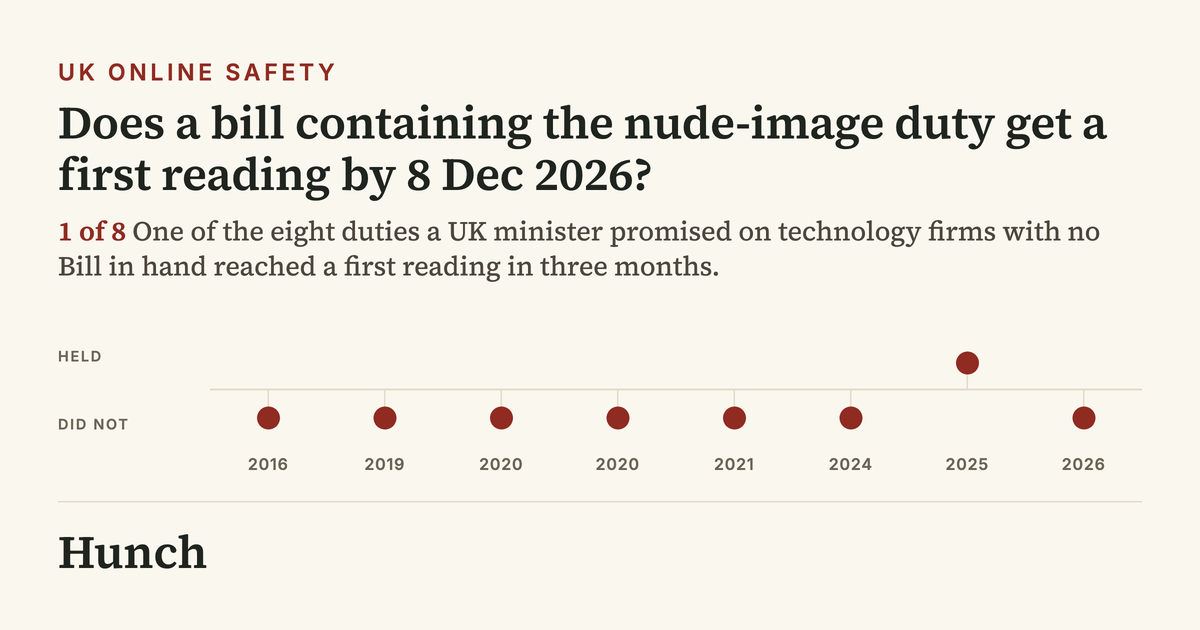
Of eight such promises since 2016, one got a bill within three months. We set the rule before counting. We looked at every time since 2016 that a UK minister publicly promised a law putting a new duty or offence on tech companies or online platforms, when no bill carrying it was before Parliament. Then we checked if a bill containing that duty had its first reading, its formal start in Parliament, within three calendar months. Changes to bills already in Parliament are left out.
Show the other 6 cases
The Read
History points to no bill by December. Of the eight promises, only one reached a first reading within three months, and in that case a bill to carry it was already planned. Here none is named. The government says it needs time to get the law right, and it has kept the right to drop it if Apple and Google act first. The Commons sits for four more days before the break, which leaves roughly forty sitting days until December to draft, agree and introduce a bill that must define age checks for every device and app a child uses.
The doubt is that this government has moved fast when a bill was at hand. The deepfake offences went from announcement to first reading in 49 days. Ministers have often added online offences to the Crime and Policing Bill and the bills that followed it, instead of waiting for a new bill of their own.
A named bill would decide it. If a criminal justice or online safety bill is already being prepared for this session, the duty can be added to it and the answer is yes quickly. If Apple and Google offer enough that the government uses its way out and drops the law, the answer is no, and the question about Apple and Google moves at the same time.
Disclaimer
Hunch works only from sources that are publicly available, and publishes on the basis of analysis of that material. We do not form an editorial opinion or take sides, we give a simpler and wider view of news that already exists. If information in a source we used was inaccurate, distorted, or later disputed but had already entered our analysis, Hunch accepts no liability for that. Predictions are not advice. Phase 1 markets use Hunch Points, not money.
Published by Hunch under the Editorial Code. Complaints and corrections: /contact/.