US cleared Nvidia's H200 for China. Earlier China chips lasted a year or less.
The US cleared ten Chinese firms to buy Nvidia's H200 chip in May. Seven weeks on, not one chip has shipped, and the block now comes from China.
What happened
Seven weeks after Washington cleared H200 sales to ten Chinese firms, deliveries remain stuck at zero — and Nvidia’s China problem has become the test case for the whole export regime.
The US cleared about ten Chinese firms to buy Nvidia’s H200 on . The US Commerce Department’s list includes Alibaba, Tencent, ByteDance and JD.com. It is the first approved way back into China since 2023 for an American AI chip close to the most advanced. Each approved buyer can take up to 75,000 chips, a limit Washington had been weighing since the spring.
No chips have been delivered. Chinese buyers pulled back after guidance from Beijing, which wants its big tech companies to build on Huawei’s Ascend chips instead.
Nvidia’s chief Jensen Huang has said the company received orders and restarted H200 production for China. But the US Commerce Secretary has confirmed that no H200s have been sold into China, and blames the Chinese government for blocking imports.
The Pattern
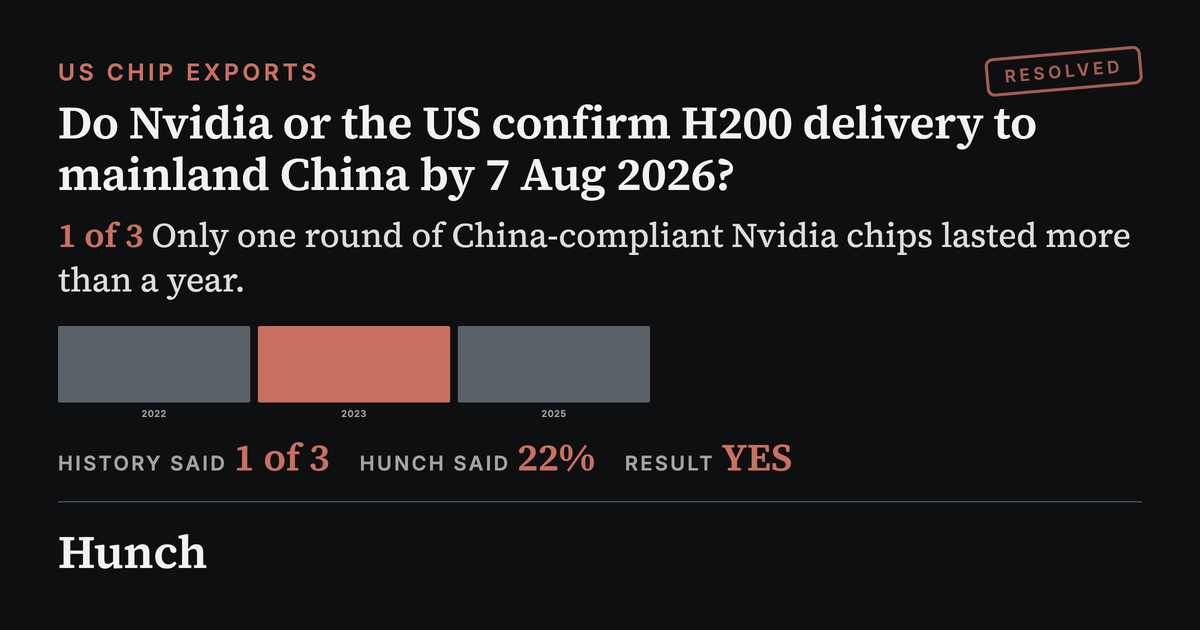
We looked at each round of US limits on Nvidia’s chip sales to China since 2019. The same cycle kept coming back. Washington set limits, Nvidia made a chip that fit them or won a licence, and then one of the two governments shut the door. Of the three China versions since 2022, only one sold for about a year. What has changed is which government shuts the door.
Show the other 2 cases
The Read
History leans towards no chips shipping by early August. Beijing’s block looks like long-term industrial policy more than a pause for talks. Every quarter that Chinese firms spend on Huawei’s Ascend chips instead of the H200 builds up China’s own chip industry, and that is the aim. Beijing’s order to stop buying the H20 was never reversed. The H200 approval changes US policy and leaves Chinese policy as it was. In the past, the door for these China chips closed every time. This one may have been closed from the start.
There are reasons for doubt. The H200 is a much bigger prize than the H20, and Chinese labs racing to build top AI models know Ascend chips cannot yet match it in supply or software. Orders exist, and Huang says production has restarted. If even one approved buyer takes delivery with Beijing’s quiet approval, the picture changes fast. A US and China trade deal over the summer could also turn chips into a bargaining tool. That is why the market put delivery at 22%, low but well above zero.
A delivery confirmed by Nvidia or by US officials would answer the question. So would Chinese firms saying in public that they have placed orders.
Disclaimer
Hunch works only from sources that are publicly available, and publishes on the basis of analysis of that material. We do not form an editorial opinion or take sides, we give a simpler and wider view of news that already exists. If information in a source we used was inaccurate, distorted, or later disputed but had already entered our analysis, Hunch accepts no liability for that. Predictions are not advice. Phase 1 markets use Hunch Points, not money.
Published by Hunch under the Editorial Code. Complaints and corrections: /contact/.