Openreach ends copper sales in 238 more areas. Lists have come steadily since 2021.
Openreach put 1.69 million more homes and firms on its list to leave copper. Where full fibre is available, new copper broadband and phone orders end.
What happened
Openreach publishes Tranche 24 of its FTTP stop-sell programme: 238 exchanges and 1.69 million premises where new copper orders will cease.
In a year, new copper orders stop in 238 more exchange areas. Openreach published this list, called Tranche 24, on . It covers 1.69 million homes and businesses served by 238 telephone exchanges. Twelve months after a list comes out, new copper broadband and old-style phone orders stop in those areas. Full fibre becomes the only option for new connections.
An exchange joins the list once more than 75% of the homes and businesses it serves can order full fibre (FTTP).
The new list takes the programme to 1,432 exchanges and 14.2 million premises. That is roughly 61% of the places Openreach’s full fibre reaches, which is now more than 21 million premises. James Lilley, Openreach’s managed customer migrations director, called the programme a vital step in speeding up the UK’s move to a modern full fibre future.
Running copper and fibre side by side is expensive, and copper is less and less able to support modern services. Stopping copper sales area by area is the slow, step-by-step half of the change. The other half, the national switch-off of the old analogue phone network, has already been delayed once.
Sources: Openreach
The Pattern
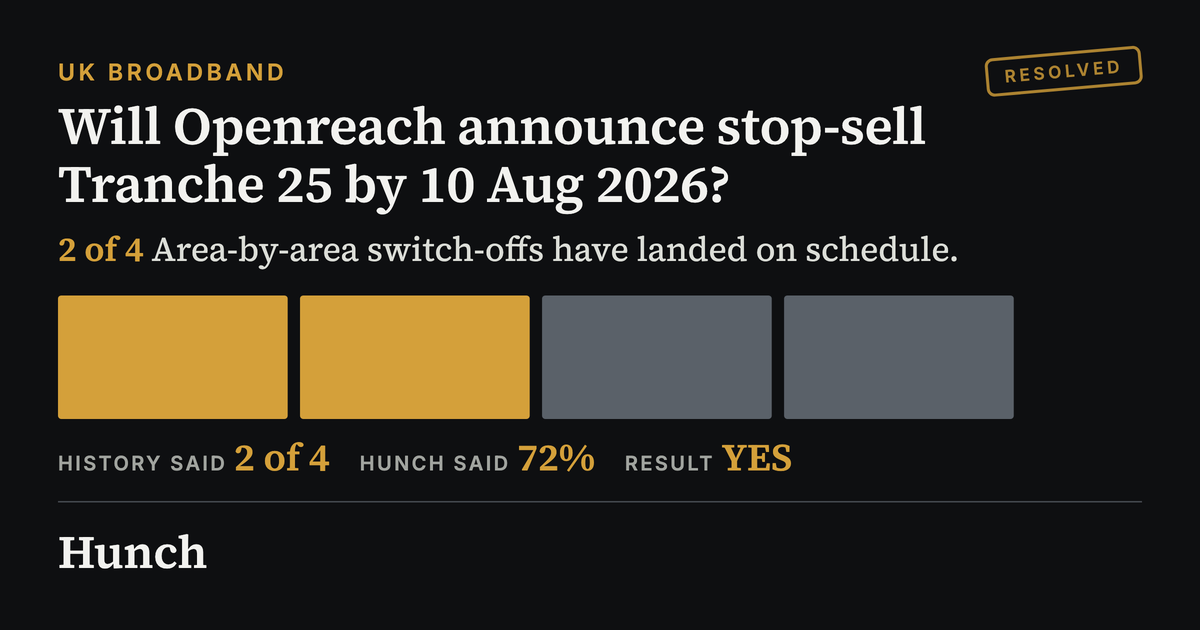
We looked at four big national technology switch-offs in Britain: the old phone network, 3G mobile, the copper stop and digital TV. Half of them ran to their first schedule. The ones done area by area mostly kept to time. The one with a single national date, the old phone network, moved by 13 months.
Show the other 3 cases
The Read
History leans towards more lists on time. Stopping copper sales is the most predictable process in UK telecoms. New lists have come out roughly every month through 2026, and each follows the same rule: 75% full fibre coverage and 12 months’ notice. Openreach builds full fibre to roughly a million premises a quarter, so both questions lean towards yes. Every quarter of running copper and fibre side by side costs BT money, so the reason to keep publishing lists does not go away.
There are weak spots. The 22 million mark in the second question is tighter than it looks. Public figures put full fibre at just over 21 million, and quarterly reports can run weeks behind the real build. A figure of 21.8m at the cut-off would mean no, even with the build on track. The delay to the old phone network is also a warning. Failures for vulnerable users on telecare lines (alarms that let people call for help) can create political pressure that pauses even a well-run programme.
A Tranche 25 list by would answer the first question. BT’s next quarterly results will answer the second.
Disclaimer
Hunch works only from sources that are publicly available, and publishes on the basis of analysis of that material. We do not form an editorial opinion or take sides, we give a simpler and wider view of news that already exists. If information in a source we used was inaccurate, distorted, or later disputed but had already entered our analysis, Hunch accepts no liability for that. Predictions are not advice. Phase 1 markets use Hunch Points, not money.
Published by Hunch under the Editorial Code. Complaints and corrections: /contact/.