Sky wants ITV's TV arm. About half of recent merger reviews began in eight weeks.
The CMA, the competition watchdog, opened a file on Sky buying ITV's media and entertainment arm on 23 July. It has not yet begun its formal review.
What happened
The CMA case page for Sky’s anticipated acquisition of ITV M&E Holdings Limited records only the invitation to comment of to and states that Phase 1 has not been formally launched; on the CMA launched Phase 1 in E.ON’s acquisition of OVO, 56 days after opening that file.
No legal deadline applies to the deal until the formal review starts. The CMA, the UK competition watchdog, opened its file on Sky UK Limited buying ITV M&E Holdings Limited, ITV’s media and entertainment arm, on . It asked for public comments until .
The CMA’s case page says the formal investigation has not started yet. It says the CMA has the information it needs to begin early talks with the companies before they file, and that the page will be updated when the first stage, called Phase 1, formally begins.
The timing depends on that step. Phase 1 lasts 40 working days, but the clock starts only when the CMA formally opens it by notice to the companies, after the early talks are done. So a merger can sit in public view for months with no clock running.
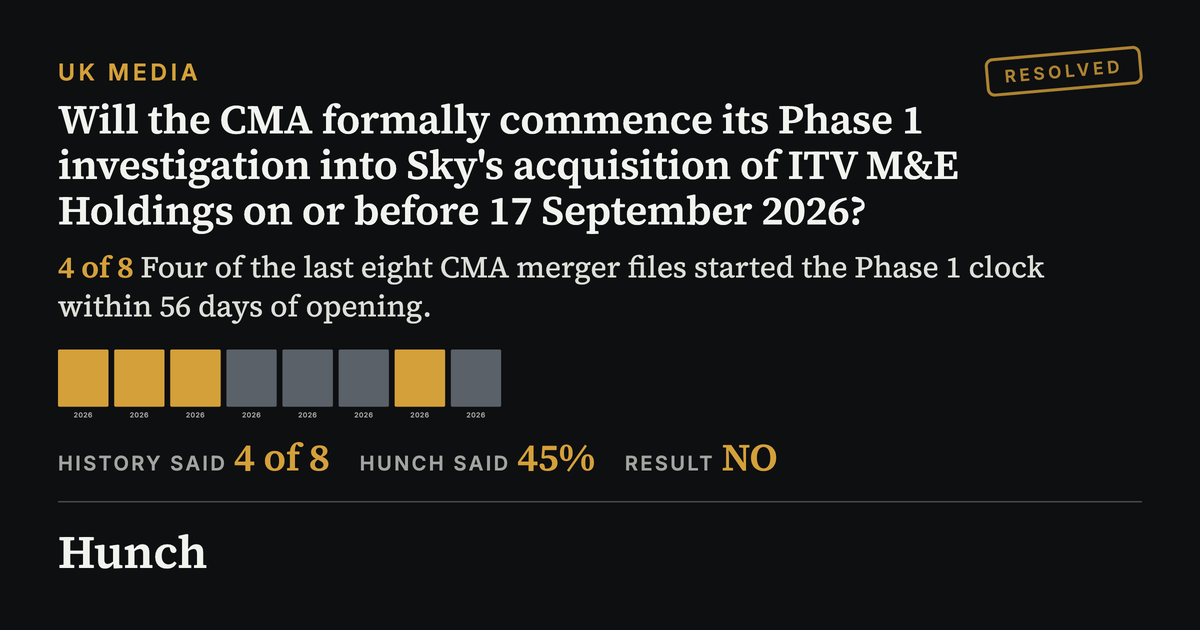
The day before this Echo, the CMA started Phase 1 in E.ON’s purchase of OVO, a file opened on . That was 56 days after opening, with a decision due by . The Co-operative Group’s purchase of Southern Co-operative, opened on , started on , also after 56 days.
The CMA is handling a second big media case at the same time, under a different process. The Secretary of State said on that she was inclined to step in on Daily Mail and General Trust buying Telegraph Media Group. She issued a public interest intervention notice on . The CMA sent its report on , ahead of a deadline shared with Ofcom, and the case is still open.
A notice like that on Sky and ITV would bring the minister and Ofcom into the timetable alongside the CMA.
The Pattern
We found 29 merger cases like this one since . The CMA opened each with a call for public comments before it started the formal review. For each we asked the question the first market asks: did Phase 1 begin within 56 days of the case opening? Cases that started on the day they opened, or were less than 56 days old on , are left out because they cannot answer it. The last eight are shown below.
Show the other 6 cases
The Read
The first question is whether Sky and ITV move like a typical case or like the big ones. Half of the last eight started the formal review by day 56, two of them on day 56 itself, so history puts this close to even. Size pulls the other way. The two largest deals, Paramount with Warner Bros. Discovery at 57 days and Getty with Shutterstock at 60, both just missed. The one case with no start after 140 days, AkzoNobel and Axalta, is a cross-border industrial merger also under review in other countries. The early talks depend on the companies as much as on the CMA.
The two questions about a government step could change the shape of the case. A deal between the largest commercial broadcaster and the largest pay TV company raises questions about media plurality, meaning how many different voices own the media, and competition law alone does not answer them. This year the government stepped in on a newspaper deal, first saying it was inclined to act and then issuing a notice 23 days later. If a notice comes, Ofcom joins the timetable and the Secretary of State makes the decision. The Telegraph case, opened in February and still open in September, shows how long that can take.
The CMA case page will show whether Phase 1 has begun by . The timing pattern would stop applying if the start comes with a notice attached, because all 29 earlier cases were decided by the CMA alone.
Disclaimer
Hunch works only from sources that are publicly available, and publishes on the basis of analysis of that material. We do not form an editorial opinion or take sides, we give a simpler and wider view of news that already exists. If information in a source we used was inaccurate, distorted, or later disputed but had already entered our analysis, Hunch accepts no liability for that. Predictions are not advice. Phase 1 markets use Hunch Points, not money.
Published by Hunch under the Editorial Code. Complaints and corrections: /contact/.