SpaceX went public at $135. Most giant listings before it were up a month later.
SpaceX went public on 12 June and raised $75 billion, the largest listing ever. Its first big test comes within weeks, when the Starship rocket flies.
What happened
Two weeks after the record Nasdaq debut, short sellers are raising bets against SpaceX as the shares sell off from their first-day close.
SpaceX raised $75 billion on , the most ever in a listing. It began trading on the Nasdaq that day, selling 555.6 million Class A shares at $135 each. That valued the company at $1.77 trillion. SpaceX marked the day by launching the Starlink 10-54 mission from Cape Canaveral that morning, the 650th flight of a Falcon 9 rocket.
The listing comes in the middle of the Starship rocket programme. Flight 12 in May was the first flight of the Version 3 rocket. Flight 13, with the new Booster 20 and Ship 40, is planned from Starbase in late July, once final engine test firings are done and the FAA, the US aviation regulator, signs off.
Public investors have never owned a company like this. Its main project explodes or succeeds on live video every few weeks. Every Starship step forward, and every failure, now changes the value of a company worth more than a trillion dollars in real time.
Before the listing, Elon Musk posted about UK politics far more than about the company he was taking public. Within two weeks of the first day of trading, he was no longer worth more than a trillion dollars, as the shares fell back.
Sources: Reuters, BBC, The Guardian (2)
The Pattern
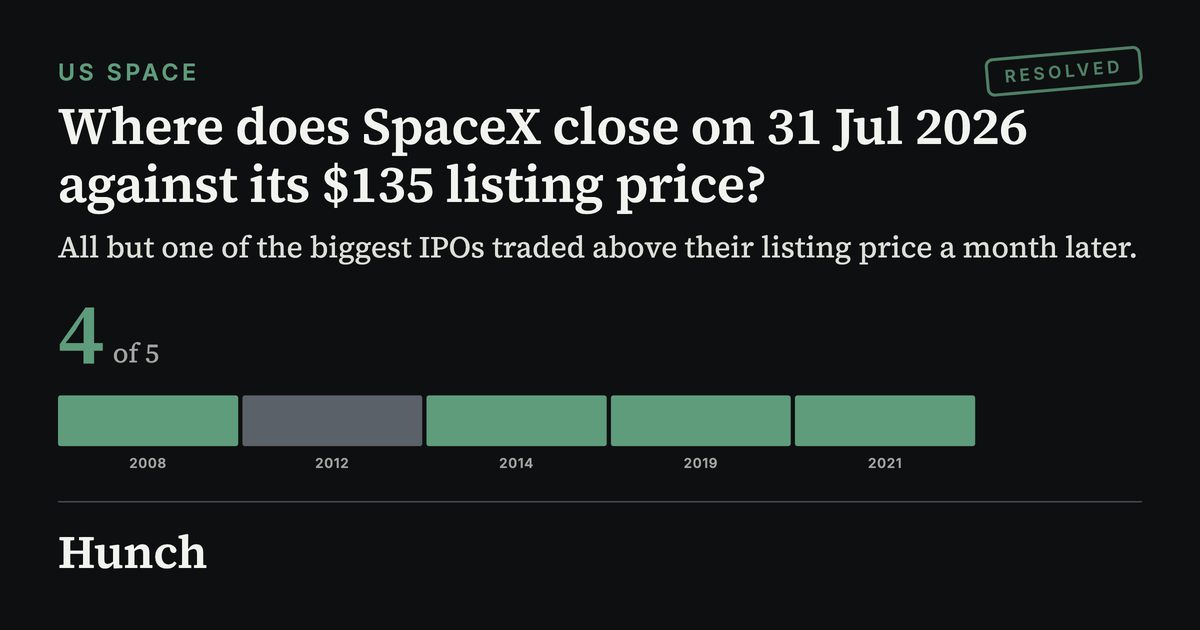
We looked at the five largest listings before SpaceX and asked where each stock stood a month after its first day of trading. Most were above their listing price. Facebook, in 2012, was the famous exception.
Show the other 3 cases
The Read
History leans towards a launch in the July window and a firm share price. Ship 40’s engine tests are under way, Starbase has flown from Pad 2 before, and pressure to launch often now comes from shareholders too. On price, four of the five biggest listings before it were above their price a month later. The number of shares sold is small next to the demand behind $75 billion of orders, and buying by index funds is still to come. The 68% chance given to Flight 13 flying by roughly matches the recent gap between engine tests and launch.
There are reasons for doubt. Starship has never kept to a schedule, and the Version 3 rocket is very new. A problem on the pad or a hold from the FAA could push Flight 13 past without anything being badly wrong. The Facebook case matters here. Its shares fell when a core doubt about the business showed up at once, and SpaceX’s main doubt can show up on camera. A Flight 13 failure in the first month would test whether public markets reward fast trial and error the way Elon Musk’s private investors did.
The closing price on will answer the first question. Flight 13 lifting off by will answer the second.
Disclaimer
Hunch works only from sources that are publicly available, and publishes on the basis of analysis of that material. We do not form an editorial opinion or take sides, we give a simpler and wider view of news that already exists. If information in a source we used was inaccurate, distorted, or later disputed but had already entered our analysis, Hunch accepts no liability for that. Predictions are not advice. Phase 1 markets use Hunch Points, not money.
Published by Hunch under the Editorial Code. Complaints and corrections: /contact/.