Will Starship fly again by 31 December? Never so soon after losing a booster.
The US firm SpaceX caught the upper part of its Starship rocket for the first time on 14 November. The booster exploded. The next flight has no date.
What happened
Pieces of the SpaceX Starship booster that exploded on are arriving on Bagdad beach in Mexico, and Mexico’s environment agency has sent inspectors.
SpaceX launched its Starship rocket for the 15th time on . It left the US company’s site in Texas at 16:47 local time. Starship has two parts: the booster lifts the rocket off the ground, and the ship flies on into space.
The booster was lost on its way back. A burn of its engines ended early because it was low on fuel, and SpaceX says the root cause is under investigation. The booster steered itself to a spare point over the Gulf of Mexico. After its engines shut down, the system that ends a flight was set off, and the booster exploded over the water. Pieces reached Bagdad beach in Mexico, where the environment agency PROFEPA collected about 2kg on .
The ship was caught for the first time on . It had flown 14 times around the Earth in 22 and a half hours before the mechanical arms of the launch tower caught it.
Some mishap investigations might conclude in a matter of weeks. Other more complex investigations might take several months.
FAA, Compliance, Enforcement and Mishap
The US regulator has not ordered an investigation. The Federal Aviation Administration (FAA) allows rocket launches in the US. After an accident, which it names a mishap, a rocket flies again when the FAA accepts the final investigation report or allows a flight earlier at the company’s request. On the FAA’s statements page had nothing on flight 15.
SpaceX has not named a date for flight 16. Elon Musk of SpaceX told investors that the company plans to bring Starship test flights to one a week. NASA, the US space agency, plans to land people on the Moon in 2028 in a SpaceX vehicle.
Sources: The Independent (2), BBC, SpaceX, PROFEPA, FAA (2), The Guardian
The Pattern
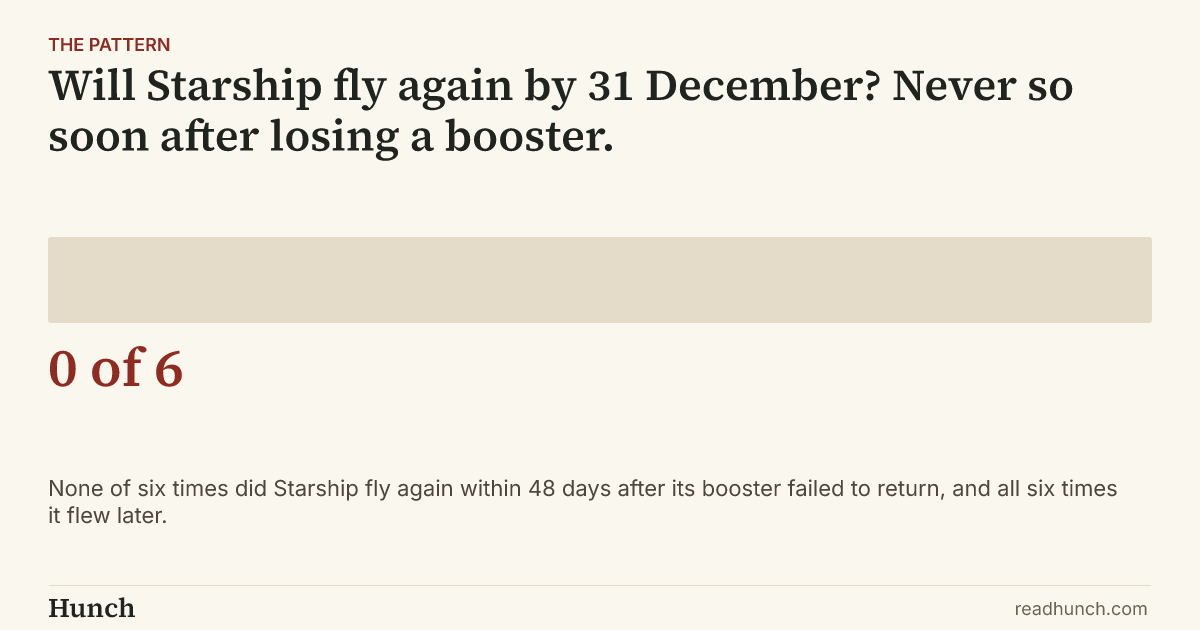
We looked for cases where the Starship booster did not come back from a test flight as planned. This happened six times between and . Each time SpaceX launched Starship again, after 58 to 117 days. None of the six launches came within 48 days, which is the time from the flight to .
Show the other 4 cases
The Read
Six times the Starship booster failed to come back as planned, and six times the rocket flew again. The shortest wait was 58 days, after flight 6 in . The others were 63, 66, 84, 91 and 117 days. Counted from , 58 days ends on . The date in the first question, , comes after 48 days. The date in the second question, , comes after 62 days, and one of the six launches came that fast.
Nine days after flight 15, the FAA’s statements page shows no investigation order. The FAA ordered an investigation after four of the six earlier flights, and after flights 9 and 12 the order came within three and five days. After flights 6 and 13 the page shows no order, and Starship flew again after 58 and 66 days. The ship came back whole to the launch tower on , which had not happened after any of the six flights. The wait before flight 15 was 46 days, and it followed a flight on which both parts came down as planned. SpaceX is still looking for the root cause of the fuel problem, and the BBC reported that work on the rocket has gone much slower than the company wanted.
Disclaimer
Hunch works only from sources that are publicly available, and publishes on the basis of analysis of that material. We do not form an editorial opinion or take sides, we give a simpler and wider view of news that already exists. If information in a source we used was inaccurate, distorted, or later disputed but had already entered our analysis, Hunch accepts no liability for that. Predictions are not advice. Phase 1 markets use Hunch Points, not money.
Published by Hunch under the Editorial Code. Complaints and corrections: /contact/.